Germany’s $55 Billion Military Buildup, Europe Buys ‘Guns’ on Debt While Cutting ‘Butter’

Oliver Griffin is a policy and tech reporter at The Economy, focusing on the intersection of artificial intelligence, government regulation, and macroeconomic strategy. Based in Dublin, Oliver has reported extensively on European Union policy shifts and their ripple effects across global markets. Prior to joining The Economy, he covered technology policy for an international think tank, producing research cited by major institutions, including the OECD and IMF. Oliver studied political economy at Trinity College Dublin and later completed a master’s in data journalism at Columbia University. His reporting blends field interviews with rigorous statistical analysis, offering readers a nuanced understanding of how policy decisions shape industries and everyday lives. Beyond his newsroom work, Oliver contributes op-eds on ethics in AI and has been a guest commentator on BBC World and CNBC Europe.
Authored On
Modified
Germany’s Bundestag approves a $55 billion military procurement package and accelerates rearmament by loosening constitutional debt limits
Under NATO’s unprecedented “5% of GDP” agreement, the EU injects funding through joint borrowing such as 45-year SAFE loans
Debt-laden Europe faces a “guns-and-butter” dilemma, cutting welfare budgets to finance security
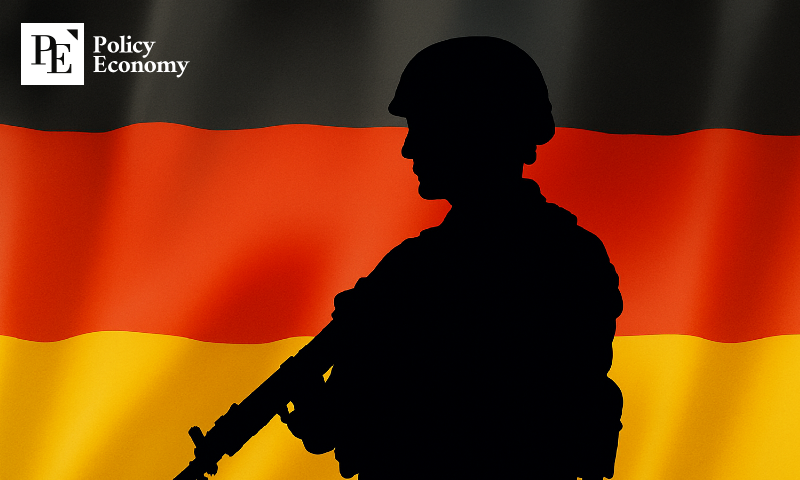
Germany’s Bundestag has approved a massive $55 billion military procurement package, accelerating rearmament efforts. To meet the North Atlantic Treaty Organization’s (NATO) target of investing 5% of gross domestic product (GDP) in defense, Europe has entered a phase in which security costs are becoming a permanent fiscal constant, mobilizing long-term financing tools such as joint borrowing under the SAFE framework. As defense budgets swell, however, conflicts over budget allocation are becoming unavoidable, with welfare and climate spending increasingly crowded out. For highly indebted countries, mounting political backlash and the erosion of fiscal rules are emerging as powerful headwinds.
Germany Commits $55 Billion to Military Reinforcement, Full-Scale Rearmament Underway
On the 17th, the Financial Times reported that Germany’s Bundestag approved a $55 billion military equipment procurement package, marking the full launch of Germany’s rearmament drive. The package emphasizes the simultaneous reinforcement of “basic supplies” and “advanced capabilities.” About 40% of the total budget—roughly $23 billion—is allocated to replacing uniforms and personal equipment such as combat gear, underscoring the depth of Germany’s long-standing security gaps despite its status as an economic powerhouse.
Germany also confirmed the acquisition of advanced systems, including Puma armored vehicles ($4.6 billion), the “Spook” satellite system ($1.9 billion), Patriot missile systems ($1.7 billion), and SeaGuardian unmanned aerial vehicles. Looking ahead, the German government plans to spend approximately $710 billion over the next five years to comprehensively overhaul its military hardware by 2030—double the amount spent over the previous five-year period.
To secure the necessary funding, Germany has effectively unlocked the constraints of national finance. In March, constitutional amendments relaxed limits on new borrowing, effectively allowing unrestricted spending on defense and infrastructure funds. As a result, a $545 billion infrastructure investment fund spanning 12 years has also been exempted from debt-limit restrictions. This move is widely interpreted as a decisive break from the “peace dividend” era that followed the Cold War—when defense spending was capped around 1% of GDP and Germany relied heavily on the U.S. security umbrella—and a declaration of strategic self-reliance in the post-Ukraine war environment.
Political consensus has largely transcended party lines. Following former Chancellor Olaf Scholz’s declaration of a “Zeitenwende,” current Chancellor Friedrich Merz has likewise elevated the construction of “Europe’s strongest armed forces” and “security independence from the United States” to top national priorities. In parallel, force-structure reforms are accelerating. Beginning next year, mandatory military aptitude testing for 18-year-old men will be introduced, with plans to expand active-duty personnel from roughly 180,000 to 260,000 by 2035, and to increase reserve forces to 200,000, preparing for potential reductions in U.S. troop deployments.
NATO’s 5% of GDP Defense Pact, EU Buys Time with 45-Year Loans
Germany’s unprecedented rearmament push is merely the opening chapter of a fundamental shift in Europe’s security landscape. The cost of security is no longer an informal pressure but has hardened into a formal alliance commitment. At the 2025 Hague Summit, NATO agreed to a target of allocating 5% of GDP to defense by 2035, subdivided into 3.5% for core military spending and 1.5% for defense industrial bases, infrastructure, and resilience. Member states will submit annual implementation plans, with a mid-term review scheduled for 2029.
This benchmark exceeds even the defense spending of armistice-state South Korea. South Korea’s defense budget this year stands at about $46 billion, equivalent to 2.32% of GDP. Applying NATO’s 5% target to the Korean economy would imply an immediate increase to more than $100 billion—more than double current levels. Analysts argue that Europe has effectively declared a transition from a peacetime economy to a “war economy.”
Major European powers are moving swiftly. Germany plans to raise defense spending from 2.4% of GDP this year to 3.5% by 2029, likely achieving NATO’s target ahead of traditional military powers such as the United Kingdom and France. France aims to lift defense spending from around 2% to 3–3.5% by 2030, while the UK plans to increase from 2.3% to 3.5% by 2035.
The cost is staggering. According to analysis by a European Parliament think tank, merely raising defense spending from 2% to 3.5% of GDP across the EU-NATO’s 23 overlapping members would require an additional $277 billion annually. Confronted with this burden, the EU has opted for a workaround: joint borrowing backed by collective credit rather than individual national balance sheets. The SAFE (Security Action for Europe) mechanism allows the EU to leverage its AAA credit rating to raise funds in the market and provide long-term loans to member states at near-cost rates for defense projects. Demand for the initial $164 billion SAFE tranche exceeded $207 billion, and the loans carry extraordinary terms—maturities of up to 45 years with a 10-year grace period on principal repayment. The European Commission’s consideration of a second SAFE tranche underscores a strategy of pushing repayment as far into the future as possible to “buy time.”
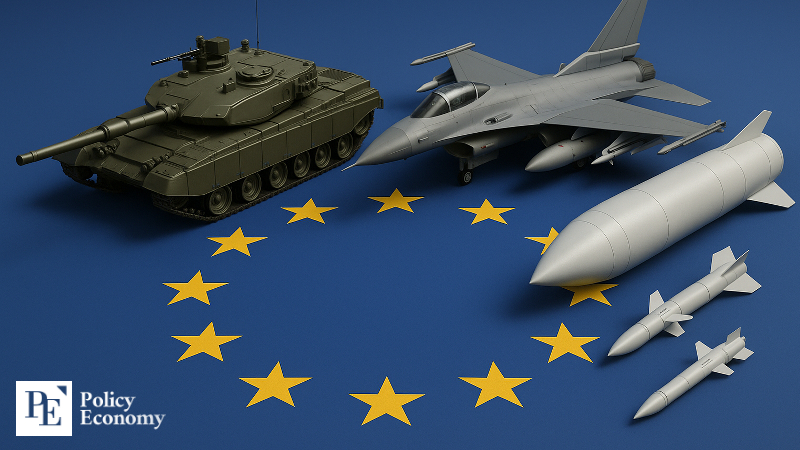
The Welfare State Era Ends, Europe Cuts ‘Butter’ to Buy ‘Guns’ on a Mountain of Debt
The EU’s reliance on de facto repayment deferrals reflects the exhaustion of national fiscal capacity. According to Eurostat, the eurozone’s government debt ratio reached 87.4% of GDP as of the fourth quarter of 2024. Alfred Kammer, Director of the IMF’s European Department, warns that if current policies persist, Europe’s average debt could climb to 130% of GDP within 15 years. Germany itself—once a paragon of fiscal discipline—posted a general government deficit of $130 billion in 2024, equivalent to 2.8% of GDP, with expanded defense and infrastructure spending expected to exert further pressure on fiscal metrics.
Across Europe, governments are now dismantling welfare reserves to fund security. The stark reality of cutting “butter” to buy “guns” is being codified into policy. France is the most acute case. IMF data show France’s debt-to-GDP ratio rising from 95.4% in 2014 to 113.1% recently. With economic growth projected at just 0.6% this year, the French government has turned to budget freezes. Prime Minister François Bayrou declared that $48 billion in savings would be required to strengthen defense, stating that “excluding defense, not a single additional dollar will be spent next year.”
Other countries face similar trade-offs. The UK, where debt has surpassed 100% of GDP since the pandemic, plans to raise defense spending to $79 billion next year while cutting official development assistance to 0.3% of gross national income and reducing welfare benefits, including disability payments, by $6 billion. The Netherlands announced austerity measures that raise defense spending to $26 billion while cutting higher-education and scholarship budgets. Finland’s center-right coalition increased defense spending to $7.3 billion by slashing housing, unemployment, and healthcare support, as well as $1.3 billion from vocational education.
Despite these efforts, fiscal sustainability continues to deteriorate. The European Commission is moving to initiate an Excessive Deficit Procedure against Finland, whose deficit reached 4.4% of GDP in 2024, well above the 3% ceiling. The EU has introduced limited flexibility, activating a National Escape Clause in July that allows defense-spending increases of up to 1.5 percentage points of GDP per year to be excluded from fiscal assessments for four years starting in 2025. Yet for countries with weak underlying fiscal positions, even these exemptions may not avert sanctions.
Public fatigue is also mounting. Recent European surveys show support for higher defense spending has fallen to 67%, down 7 percentage points from the previous year. While approval remains above 80% in Nordic countries bordering Russia, it has dropped to around 50% in heavily indebted southern European states such as Italy and Spain, where economic anxieties outweigh security concerns. The Financial Times notes that Europe’s model of funding defense through debt without cutting welfare has reached its limits, warning that Europeans are unlikely to enjoy the generous social benefits of the past. With fiscal rules effectively neutralized, Europe’s vast rearmament experiment now stands as a critical test—one that may determine whether the continent’s welfare-state model can survive the age of permanent security spending.
Oliver Griffin is a policy and tech reporter at The Economy, focusing on the intersection of artificial intelligence, government regulation, and macroeconomic strategy. Based in Dublin, Oliver has reported extensively on European Union policy shifts and their ripple effects across global markets. Prior to joining The Economy, he covered technology policy for an international think tank, producing research cited by major institutions, including the OECD and IMF. Oliver studied political economy at Trinity College Dublin and later completed a master’s in data journalism at Columbia University. His reporting blends field interviews with rigorous statistical analysis, offering readers a nuanced understanding of how policy decisions shape industries and everyday lives. Beyond his newsroom work, Oliver contributes op-eds on ethics in AI and has been a guest commentator on BBC World and CNBC Europe.
Similar Post