Big Tech Bets on Fusion Energy, Trump Media Enters Market Through TAE Merger

Authored On
Modified
Google, Microsoft, and other Big Tech firms make large-scale investments in fusion companies
Rising as a long-term energy source amid data center expansion
Technological maturity and economic viability remain constraints, commercialization expected to take time
Trump Media & Technology Group (TMTG, hereafter Trump Media), the parent company of the social media platform Truth Social founded by U.S. President Donald Trump, is pursuing a merger with private fusion technology company TAE Technologies. As artificial intelligence (AI) and data center expansion drive a sharp surge in power demand, the move is widely interpreted as a preemptive strategy to invest in nuclear fusion as a next-generation energy source and a long-term solution to electricity supply. However, despite its technological potential, commercial fusion power generation is not expected until after the 2030s, prompting analysts to caution that the sector should be approached from a medium- to long-term perspective rather than with expectations of near-term returns.
Trump Media: “TAE Merger to Supply Power for AI”
According to local media reports including The Wall Street Journal (WSJ) and the Financial Times (FT) on the 18th (local time), Trump Media and TAE have agreed to an all-stock merger. Founded in 1998, TAE is recognized as a global leader in fusion technology and has raised more than $1.3 billion in funding from investors including Alphabet, Chevron, and Goldman Sachs. In the transaction, TAE is valued at $53.89 per share, and under the merger terms, shareholders of Trump Media and TAE will each hold 50% of the combined entity. The deal is expected to close in mid-2026. Upon completion, Trump Media will transition into a holding company with Truth Social, TAE Power Solutions, and TAE Life Sciences as subsidiaries.
For TAE, which has long struggled with funding constraints, the merger is expected to provide a more stable capital base. As of the end of September, Trump Media held $716 million in cash, cash equivalents, and short-term investments. Under the agreement, Trump Media will provide up to $200 million in cash to TAE at signing, with an additional $100 million to be injected upon the initial filing of registration documents. The combined company’s enterprise value is estimated at approximately $6 billion, with Trump Media CEO Devin Nunes and TAE CEO Michl Binderbauer serving as co-CEOs. The board will consist of nine members, including Donald Trump Jr., the U.S. president’s eldest son.
The merger is being interpreted as a strategic move to position fusion energy as a long-term solution amid surging data center power consumption. Earlier, the Trump administration released a roadmap for fusion commercialization in October and established a dedicated fusion office within the Department of Energy in November. In a joint statement, Trump Media and TAE said they aim to “combine Trump Media’s extensive access to capital with TAE’s leading fusion technology to deliver the power required for America to win the AI revolution.” Subject to regulatory approval, the companies plan to begin construction of a 50-megawatt (MW) fusion power plant next year, followed by a series of plants with capacities ranging from 350 MW to 500 MW.
Many Fusion Firms Pursuing Commercial Fusion Technology
The growing interest in fusion energy reflects mounting concerns over how to reliably supply massive amounts of electricity as high-performance computing infrastructure—anchored by large-scale data centers and supercomputers—rapidly expands. Unlike conventional nuclear power, which relies on fission, fusion generates energy by combining two or more light atomic nuclei, offering higher output and enhanced safety. It also produces minimal radioactive waste during operation, making it an attractive candidate as a next-generation energy source.
The investment landscape surrounding fusion is also evolving quickly. According to the Fusion Industry Association (FIA), the United States is the global hub for fusion startups, with 29 companies currently pursuing commercial fusion power through a range of technological approaches. As AI-driven electricity demand surges, Big Tech and global capital are increasingly viewing fusion less as a near-term profit engine and more as a strategic option for long-term energy security. Analysts note that investors are making early bets on the technology’s maturation potential, given its capacity to fundamentally reshape future power markets.
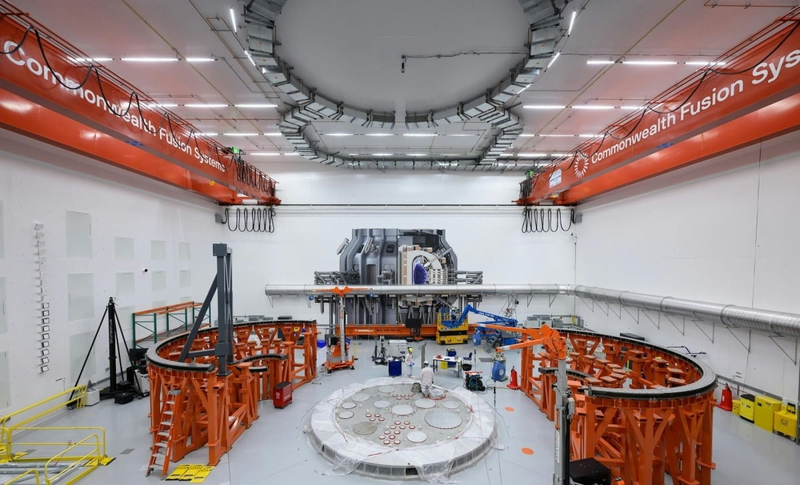
Major technology companies are already expanding collaboration with fusion firms through power purchase agreements (PPAs). Google has signed an agreement with Commonwealth Fusion Systems (CFS) for up to 200 MW of power, to be supplied by a fusion plant targeted for operation in the early 2030s. Microsoft has also partnered with Helion Energy, pursuing plans to source electricity from a power plant under construction in Washington state. Amazon, Chevron, Shell, Siemens, and Breakthrough Energy Ventures—founded by Bill Gates—are also reported to have invested in fusion startups.
Substantial Risks From Scale-Up and Process Complexity
Despite the momentum, significant time is still required before fusion energy can function as a commercially viable power source. While fusion experiments have recently achieved meaningful technical milestones, they have yet to demonstrate the ability to produce electricity continuously and economically over extended periods. Although a series of net-energy-gain experiments has spurred global investment and interest, commercial viability hinges on meeting three conditions simultaneously: output stability, repeatability, and efficiency.
The most formidable technical challenge lies in confining and controlling ultra-high-temperature plasma—reaching hundreds of millions of degrees—for sustained durations. Various approaches, including tokamak systems and laser-based inertial confinement, are under development, but plasma instability, magnetic field control errors, and structural damage caused by high-energy neutrons remain unresolved. In particular, the constant bombardment of reactor walls and structural components by high-energy neutrons accelerates material degradation and shortens operational lifespans, making the development of advanced, resilient materials a critical prerequisite.
Economic viability is another major hurdle. Transitioning from experimental reactors to commercial power plants requires generation costs to fall to levels competitive with existing energy sources. However, fusion power faces heavy cost burdens from key components such as superconducting magnets, laser systems, and cooling and shielding infrastructure, alongside significant risks tied to facility scale-up and process complexity. As a result, fusion timelines are increasingly framed in long-term terms. The European fusion research consortium EUROfusion has stated that “the true impact of fusion will begin to materialize after 2050,” emphasizing that fusion should be pursued as a medium- to long-term energy strategy grounded in international cooperation and technology sharing, rather than as an immediate alternative in power markets.
Similar Post