“Domestic Warning Signs Flash Amid Export Boom”: China Strains Under Property Slump and Limits of Its Export Model as Beijing Steps In

Authored On
Modified
China’s Export Growth Masks Weak Domestic Demand as Property Slump Drags on Consumption and Investment
Limits Emerge in China’s Subsidy-Driven Export Model, Growth Engine Wobbles Amid Trade Tensions
Chinese Party and Government Set Boosting Domestic Demand as Top Policy Priority for Next Year
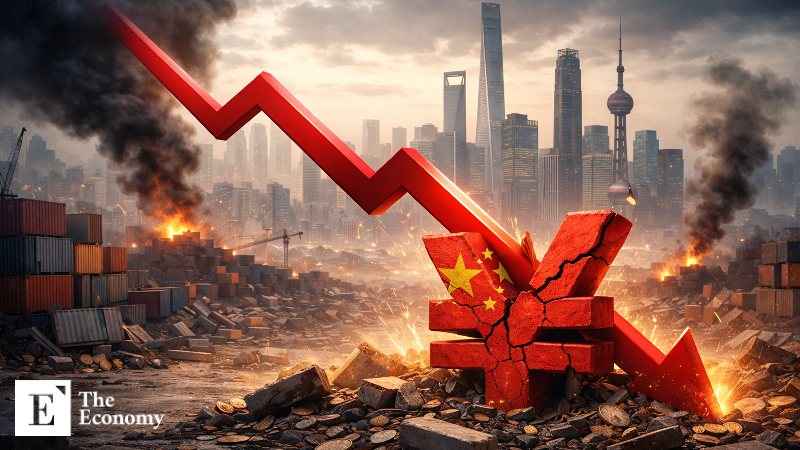
China’s economic growth is flashing warning signs. Despite a sustained increase in exports, domestic demand is freezing up across the board as the property market slump and the limits of China’s export model weigh on the economy, complicating the government’s plans to shift its growth strategy. In response, China’s party and government have named boosting domestic demand as their top policy priority for next year, signaling their intent to shore up the market.
China Struggles With an Export–Domestic Demand Imbalance
According to data released on the 22nd by China’s General Administration of Customs, the country’s trade surplus for January–November this year reached $1.076 trillion, already surpassing last year’s full-year surplus of $992.1 billion and setting a record no other country has achieved. Over the same period, exports rose 5.4% year on year while imports fell 0.6%, delivering a clear export performance despite heightened uncertainty driven by tariff disputes and other tensions.
The problem is that this export growth is not translating into stronger domestic demand. A series of warning signs has emerged across production, consumption, and investment. Data from China’s National Bureau of Statistics show industrial output in the most recent month rose 4.8% from a year earlier, marking the weakest growth rate since August last year. Retail sales increased just 1.3% over the same period, far below the forecast of 2.8%, and the lowest reading since December 2022, when COVID-19 lockdowns were in place. One of China’s biggest shopping events—Singles’ Day (Nov. 11)—also failed to provide much of a lift.
Weak investment is continuing as well. China’s fixed-asset investment for January–November fell 2.6% from a year earlier, a sharper decline than the market consensus (-2.3%) and worse than the average contraction posted in January–October (-1.7%). The drop in real-estate investment also widened to 15.9% over the same period, compared with 14.7% in January–October. The New York Times noted that China’s investment is expected to decline for the first time in more than three decades, arguing that the country—which has reshaped the global order through economic growth—is turning more conservative in areas such as investment.
This trend runs counter to Beijing’s stated goal of shifting its growth model. Since 2012, China has repeatedly declared an intention to pivot away from an export- and investment-led model toward one driven by domestic demand. Over the past decade, however, structural distortions—high savings and weak household consumption—have only deepened. International statistics show China’s savings rate sits at around 40% of GDP, nearly double the global average of roughly 24%. Meanwhile, private consumption remains in the 30–40% range as a share of GDP, well below the global average of around 60%, and about 20 percentage points lower than the average for countries with similar nominal GDP per capita.
Why the Domestic Market Crisis Has Intensified
A slumping property market is widely cited as the main driver of weak domestic demand. In China, a downturn triggered by defaults at major developers such as Evergrande and Country Garden has persisted for several years. Home prices continue to fall, and market demand has dropped sharply. According to NH Investment & Securities, China’s real-estate investment and housing transaction volumes in October fell 24.1% and 18.8% year on year, respectively. New housing starts, construction area under development, and completed floor space declined by 29.5%, 9.4%, and 28.2%.
The property slump feeds directly into weak domestic demand because a large share of household wealth in China is tied up in real estate. Joint research by Harvard professor Kenneth Rogoff and IMF economist Yang Yuanchen shows that real estate and its related supply chains account for roughly one-quarter to one-third of China’s GDP. When property falters, linked industries such as steel, cement, and home appliances suffer knock-on effects, while a “reverse wealth effect” suppresses household spending more broadly, dragging down domestic demand.
Structural limits in China’s export model are also amplifying market anxiety. China has expanded manufacturing exports by deploying massive financial resources, channeling subsidies into industries ranging from steel and shipbuilding to autos and chemicals to flood global markets with low-priced goods. While this approach helps ease global inflationary pressures, it also undermines the competitiveness of manufacturing bases in other major economies. Estimates from Goldman Sachs suggest that a 1 percentage point increase in China’s GDP leads to a 0.1–0.3 percentage point drop in GDP growth in major manufacturing countries such as Germany due to intensified export competition. China’s relatively lower inflation compared with its trading partners is also cited as a problem, as it effectively weakens the real effective exchange rate. A weaker yuan benefits exporters but creates unfavorable conditions for importers and domestic consumers.
The international community has repeatedly warned Beijing over these dynamics. The European Union and the United States, among others, are moving to erect tariff barriers to prevent Chinese products from distorting their domestic markets. Kristalina Georgieva, managing director of the IMF, said after recent annual consultations with China that the country’s economy is now too large to rely on exports alone for rapid growth, and that continued dependence on export-led expansion risks further escalating global trade tensions. She urged China to make a “bold choice” to prioritize domestic demand over exports.
“Building a Strong Domestic Market Is Essential”: Beijing Signals Resolve
As the need to shift toward a domestic-demand-driven economy grows, China’s party and government used the Central Economic Work Conference—held in Beijing on Dec. 10–11 with all top leaders, including President Xi Jinping, in attendance—to set “building a strong domestic market led by domestic demand” as the top policy priority for next year. This marked a sharper stance than at last year’s conference, when authorities took a more cautious tone, calling for actively promoting consumption and improving investment efficiency to expand domestic demand. This time, the leadership stressed the need to uphold the principle of prioritizing domestic demand and to build a powerful internal market.
According to state-run Xinhua News Agency, the government plans to focus on stabilizing the property market as a cornerstone of its push toward a domestic-demand-led economy. Measures to stimulate consumption, including subsidies, as well as plans to raise incomes for urban and rural residents, will be rolled out. Authorities also aim to revive subdued consumer sentiment by increasing investment within the central government budget and making greater use of policy-based finance. Bloomberg reported that Chinese policymakers are likely to tolerate a sizable fiscal deficit next year alongside interest-rate cuts, and will continue to pursue accommodative monetary and fiscal policies to support growth. In addition, the government plans to raise the minimum wage and corporate wages, and to strengthen social safety nets such as education and welfare. The strategy is to reduce households’ cost burdens through greater welfare spending, increase disposable income, and structurally expand domestic demand.
While these steps could provide near-term support for a recovery in domestic demand, skepticism remains widespread among global financial markets and analysts. Global investment banks including Nomura and Citi have broadly agreed that although policy support has been strengthened, measures capable of addressing China’s structural problems have yet to emerge. Critics argue that concerns over the debt burden have constrained Beijing from pursuing aggressive rate cuts or a large-scale fiscal expansion. China’s loan prime rate (LPR), often described as the country’s de facto benchmark interest rate, has in fact remained unchanged for seven consecutive months.
Similar Post