[China Semiconductors] U.S. Launches Full Probe Into Illegal Nvidia Chip Flows to China, Even as Washington Loosens Its Semiconductor Curbs

Authored On
Modified
U.S. Government Launches Probe Into Possible Circumvention of China Export Controls on Advanced Nvidia Chips
Routes Range From Sanctions Evasion via “Neoclouds” to Direct Smuggling Into China
Export Curbs and Tariff Barriers Ease Instead, Exposing Confusion in U.S. China Strategy
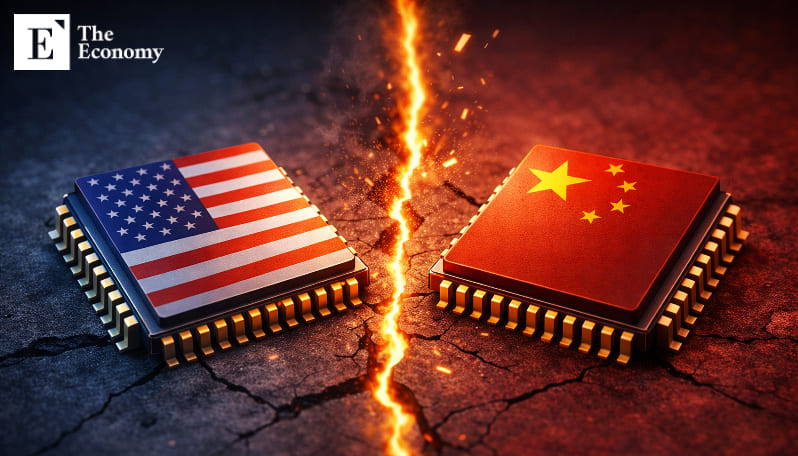
The U.S. government is moving to crack down on China’s efforts to bypass semiconductor restrictions. Investigations are gaining momentum amid mounting allegations that multiple Chinese companies are accessing Nvidia’s most advanced chips through so-called “neocloud” arrangements. At the same time, Washington is tightening enforcement while easing semiconductor export controls and tariff policies toward China. Markets see this as a contradictory shift, signaling that U.S. China strategy has entered a confused and internally inconsistent phase.
U.S. Launches Probe Into Megaspeed in Singapore
On the 23rd (local time), Bloomberg and Reuters, among other news outlets, reported that the U.S. Commerce Department and law enforcement authorities are investigating Singapore-based cloud services provider Megaspeed International Pte. over suspected illegal diversion of Nvidia chips to China. According to Malaysian and Indonesian customs data obtained by Bloomberg, Megaspeed, founded in 2023, has rapidly emerged as one of the biggest buyers of Nvidia chips in Southeast Asia. The company imported at least $4.6 billion worth of Nvidia hardware and acquired more than 136,000 GPUs.
The problem is that more than half of the volume consists of Nvidia’s newest “Blackwell” chips, and the end users for a significant portion have not been confirmed. When Nvidia recently inspected Megaspeed’s data centers in person, only a few thousand Blackwell chips were found on site. Nvidia said additional inventory was verified at separate warehouses, but it did not disclose specific quantities or locations.
Authorities are also scrutinizing links between Megaspeed and Chinese companies. Megaspeed is said to have spun off from Chinese game firm 7Road, and its founder Huang Le reportedly underwent questioning by Singapore police. Some analysts also argue that a data center rendering shown in investor materials resembles a Yangtze River Delta project near Shanghai. Chinese tech firms including Tencent are involved in that project, and traces have been found suggesting financing by a holding company once owned by Huang Le.
Industry observers are focused on the possibility that Megaspeed exploited loopholes in U.S. export controls through a “neocloud” model. Neoclouds rent out high-performance servers for AI computing. Megaspeed is reportedly leasing Nvidia chips from data centers in Southeast Asia to China’s Alibaba Group. The Commerce Department’s Bureau of Industry and Security (BIS) plans to closely analyze Megaspeed’s ownership structure and trace whether the chips physically crossed into China.
Precedents of China Circumventing Semiconductor Restrictions
Allegations that China has been bypassing restrictions to access Nvidia’s most advanced chips have circulated for some time. The Financial Times recently reported that Tencent secured access to 15,000 of Nvidia’s latest Blackwell B200 GPUs through Japanese data center operator Datasection. The three-year contract is valued at $1.2 billion, with a significant share of Datasection’s available capacity allocated to Tencent. The deal also enabled Datasection to cover $272 million in upfront investment costs required to build out the cluster.
FT sources said Tencent is not alone. Other Chinese tech giants are also training AI models at overseas data centers and reselling excess computing power as part of similar workarounds. A key factor enabling broader access to Nvidia’s advanced chips via neocloud models has been policy change in the United States. The previous Biden administration sought to block cloud-based loopholes with the “AI Diffusion Rule,” but the Trump administration repealed the rule in May, creating a regulatory gap. Under current U.S. law, remote use by Chinese firms of Nvidia chips installed overseas is not prohibited, except in cases involving military applications, leaving the practice in a legal gray zone.
Physical smuggling attempts have also been reported. U.S. tech outlet The Information said on the 10th that Chinese firm DeepSeek has obtained several thousand GPUs based on Nvidia’s latest Blackwell architecture and is developing new models. Sources said Nvidia chips were routed to DeepSeek over the past two years through intermediary countries where purchases were permitted. According to the report, DeepSeek secured non-Chinese-owned data centers in Southeast Asia and procured Nvidia chips through authorized distributors. Once the chips and servers were installed, Nvidia, Dell, Super Micro, and others sent staff on site to inspect equipment and verify compliance with export rules. After inspections were completed, DeepSeek allegedly dismantled the servers and smuggled the components into China. The parts reportedly cleared Chinese customs through false declarations before being reassembled and installed at domestic data centers.
Last month, U.S. federal authorities arrested four men on charges of smuggling Nvidia GPUs into China. Investigators found they had built a sophisticated black-market network routing chips from Alabama through Malaysia and Thailand before delivery to China, generating millions of dollars in profits. The indictment states that two shipments were successfully exported, sending a total of 400 Nvidia A100 GPUs to China between October 2024 and January 2025. A third and fourth shipment were intercepted by authorities, but the seized cargo reportedly included 10 Hewlett Packard Enterprise supercomputers loaded with large numbers of Nvidia H100 GPUs and 50 Nvidia H200 GPUs.
“No Additional Tariffs”: Signals Softer Trade Stance
Markets are focusing on the contrast between Washington’s crackdown on semiconductor smuggling and its gradual easing of trade barriers on Chinese chips. On the 8th, President Trump said on Truth Social that he had informed Chinese President Xi Jinping that the United States would allow Nvidia to ship its H200 products to approved customers in China and other countries, provided that strong national security safeguards are maintained. The Nvidia H200 offers roughly six times the memory capacity, bandwidth, and AI inference performance of the H20, which is designed for the China market. While its advanced inference capabilities fall short of Nvidia’s flagship Blackwell chips, the H200 is considered well suited for large language models and scientific computing. The move significantly expands China’s access to advanced semiconductor technology.
On the 23rd, the United States also put on hold additional tariffs on Chinese-made semiconductors. The Office of the U.S. Trade Representative (USTR) said in a Federal Register notice that its Section 301 investigation found that “appropriate action, including tariffs,” is needed on Chinese semiconductors, but set the additional tariff rate at 0%. The USTR launched the Section 301 probe on December 23 last year under the Biden administration. Any increase in tariff rates was scheduled for June 23, 2027, 18 months later, with specific rates to be announced at least 30 days before implementation. As a result, tariffs on Chinese semiconductors will remain at the current 50% level for the time being.
In its findings, the USTR said China has increasingly relied on aggressive and wide-ranging non-market policies and practices that seriously disadvantage U.S. companies, workers, and the broader economy. It cited massive subsidies, forced technology transfers, intellectual property theft, opaque regulations, wage suppression, and state-led planning that disregards market principles. The agency did not explain why it chose to defer new tariffs. Bloomberg said the move signals the Trump administration’s intent to stabilize relations with China and solidify agreements between the two leaders. Reuters said it reflects efforts by President Trump to ease tensions with Beijing as China tightens controls on rare earth exports.
Similar Post