Signs Detected of Russian Nuclear Submarine Reactor Transfer to North Korea, Prospect of a Strengthened Military Alliance After the Ukraine War

Authored On
Modified
North Korea–Russia military cooperation reaches a new inflection point amid the war
Russian weapons vessel carrying reactor components for North Korea sinks
Proposals emerge to deploy North Korean conventional weapons in the Ukraine war
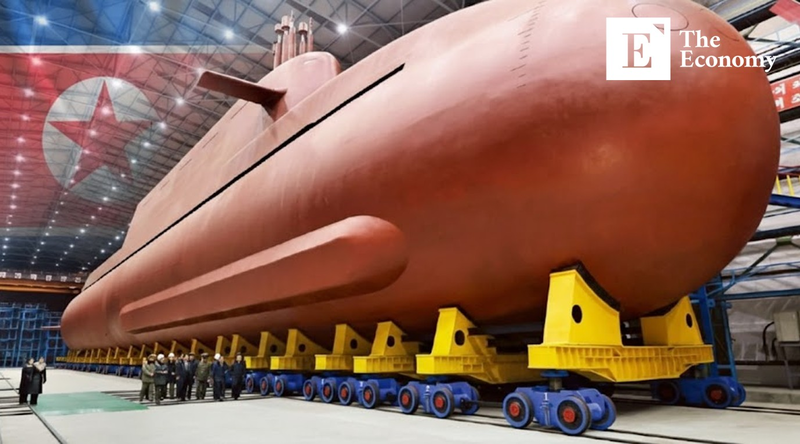
Russia is increasingly being linked to covert transfers of reactor components as part of its support for North Korea’s nuclear-powered submarine program. Recently, North Korea publicly unveiled the exterior of a nuclear submarine under construction, reportedly using a reactor removed from a decommissioned Russian nuclear submarine. At the same time, proposals have surfaced within Russia advocating the use of North Korean conventional military assets in the Ukraine war, reinforcing assessments that bilateral military cooperation is expanding beyond technical assistance into operational-level coordination.
Russian weapons vessel carrying North Korean operatives sinks after explosion
According to major foreign media outlets including the UK’s Daily Telegraph and maritime industry publication The Maritime Executive, a Russian weapons transport vessel, Ursa Major, which sank near Cartagena, Spain, in December last year, was confirmed to have been carrying undeclared oversized cargo. Spanish authorities stated that “the large cargo, covered with tarpaulins at the stern, was highly likely to be naval reactor components without fuel,” adding that “the shipment was presumed to be bound for North Korea’s port of Rason.”
The Ursa Major had originally departed from St. Petersburg on a route via Syria before returning to its base in Vladivostok, but abnormal deviations in its course were detected on December 21. Two days later, Spanish authorities received a distress signal and rescued 14 of the 16 crew members. The two missing individuals are believed to have been operatives affiliated with Russia’s so-called “shadow fleet.” Satellite data analysis indicated that after rescue operations concluded, explosions occurred inside and outside the vessel, causing it to list and sink.
Spanish investigators noted that while the ship had declared it was transporting large cranes and icebreaker components, it was in fact carrying two massive items estimated at 65 tons each. “These objects were abnormally heavy to be standard icebreaker parts,” authorities said. Investigations suggest the cargo consisted of reactor casings from the VM-4SG nuclear reactor, originally developed during the Soviet era for strategic nuclear-powered ballistic missile submarines (SSBNs). The VM-4SG remains in service aboard some Russian Navy Delta IV–class submarines.
Nuclear missiles likely to be deployed on submarine under construction
This is not the first time indications have emerged of clandestine cooperation between Russia and North Korea on nuclear submarine construction. In September, South Korean military authorities obtained intelligence suggesting Russia had provided North Korea with a nuclear propulsion reactor earlier this year. At the time, the reactor was believed to be a module removed from a decommissioned Russian nuclear submarine. According to government sources, North Korea has persistently demanded nuclear submarine technology and next-generation fighter aircraft from Russia since last year. While Moscow was initially reluctant, it reportedly decided to provide related technology and components toward the end of last year.
Against this backdrop, North Korea on the 25th revealed the full exterior of an 8,700-ton nuclear submarine currently under construction. The disclosure is widely interpreted as a preemptive warning amid intensifying South Korea–U.S. consultations on nuclear submarines, while simultaneously showcasing North Korea’s claim to irreversible nuclear-armed status, extending even to underwater nuclear forces. Analysts note that constructing a nuclear submarine requires three core capabilities: large-submarine design and construction expertise, development of a compact nuclear reactor as a power source, and access to enriched uranium fuel. There is growing speculation that North Korea may now meet a significant portion of these requirements.
Experts further assess that while South Korea’s envisioned nuclear submarine would be constrained to a defensive role with conventional armaments, North Korea’s platform is closer to a mobile nuclear missile base designed for military strike purposes. The submarine unveiled by Pyongyang is believed to resemble a Russian-style SSBN capable of operating submarine-launched ballistic missiles (SLBMs). Some analysts caution that if Russia transferred an entire reactor from a decommissioned submarine, it is difficult to rule out the simultaneous transfer of broader submarine construction and operational know-how.
Su-25 fighter jets unveiled for North Korean Air Force’s 80th anniversary
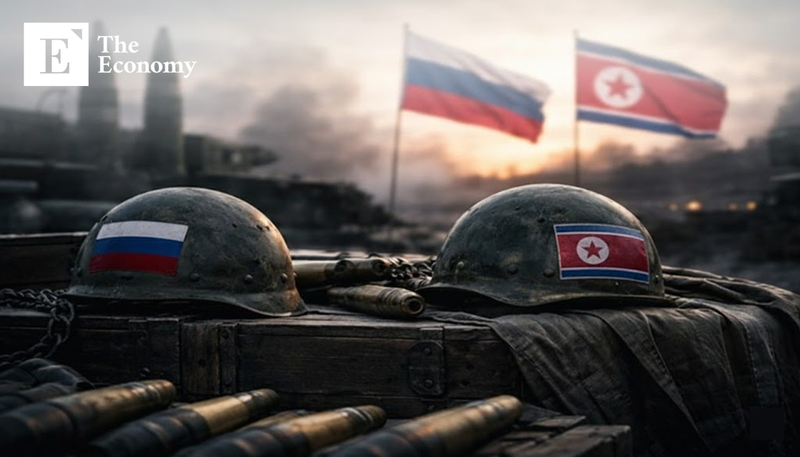
Military coordination between Russia and North Korea is also extending into proposals for direct utilization of North Korean conventional weapons. U.S.-based military news outlet Defense Blog reported on the 29th that Russian military expert Vladimir Khrustalev, known for his expertise on North Korea’s defense industry and nuclear weapons, publicly proposed deploying North Korean Sukhoi Su-25 attack aircraft in the Ukraine war. North Korea had previously showcased Su-25 aircraft equipped with what appeared to be long-range air-to-ground missiles at Wonsan Kalma Airfield on the 28th of last month, marking the 80th anniversary of its Air Force.
Khrustalev’s proposal emerged amid growing skepticism over the combat effectiveness of Russia’s own Su-25SM3 modernization program. Reports indicate that the Su-25SM3 was not designed with precision-guided munitions in mind, and further incremental avionics upgrades have effectively reached their limits under current operational and industrial conditions. The Ukraine war has underscored that in battlefields saturated with modern air defense systems, the aircraft’s survivability and operational efficiency are significantly compromised, fueling broader criticism of its adaptability to contemporary combat environments.
Experts interpret these proposals as revealing structural weaknesses within Russia’s defense industry while signaling that Moscow has reached a stage where it considers North Korean military assets as potential substitute or supplementary forces. Facing prolonged war and Western sanctions that constrain weapons production and modernization, Russia is increasingly viewing North Korea—once merely a recipient of Russian military technology—as a partner capable of reinforcing frontline capabilities. As cooperation expands beyond ground forces into air and potentially space domains, analysts conclude that North Korea–Russia military ties have entered a fundamentally new phase.
Similar Post