Hollow growth: China tops global new-car sales after overtaking Japan, but quality concerns and price wars loom behind the surge

Authored On
Modified
China overtakes Japan to become the world’s largest new-car market, ending a 20-year run
State-led, EV-focused expansion drives rapid volume growth, but quality concerns persist
Oversupply-fueled price war deepens losses, fueling fears of an “Evergrande-style crisis” in autos
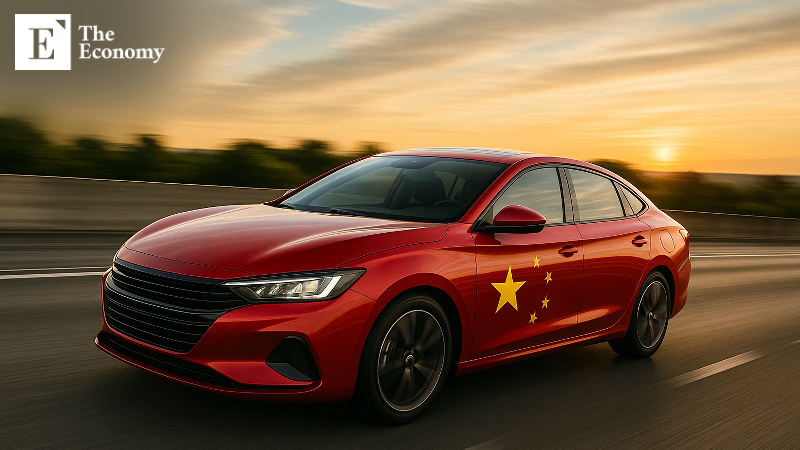
China has overtaken Japan to become the world’s largest new-car market. Backed by government support, a rapidly growing number of electric-vehicle (EV) makers have achieved headline growth by flooding global markets with excess production. Still, the industry faces mounting criticism that deep structural problems remain, including mass production of low-quality products and an increasingly destructive price war.
Chinese cars sweep global markets
On January 5 (local time), Indonesian outlet detikOto and Nikkei Asia reported that the combined sales of Chinese automakers in 2025 surpassed Japan’s for the first time. Based on S&P Global Mobility data and company disclosures, Chinese automakers are expected to sell about 27 million vehicles in January–November 2025, a 17% jump from 2024. Over the same period, Japanese automakers led by Toyota, Honda, and Nissan are projected to sell fewer than 25 million new vehicles. In effect, China has taken the top spot in global automaker sales that Japan had held for more than two decades.
Behind China’s rise is a volume-driven offensive. China is exporting EV supply it cannot absorb at home, pushing surplus vehicles into overseas markets. In Southeast Asia, long dominated by Japanese brands, Chinese car sales last year are estimated at 500,000 units, up 49% from 2024. In Europe, Chinese car sales are expected to approach 2.3 million units, up 7%. China’s footprint is also expanding rapidly in Africa (230,000 units, up 32%) and Latin America (540,000 units, up 33%).
Markets increasingly expect the momentum to continue. UBS, a global investment bank, forecast that Chinese EV makers will capture about one-third of the global auto market by 2030, including internal-combustion vehicles, despite strong trade barriers in the United States and Europe. Chinese EV makers’ global market share last year was estimated at 15%. If UBS’s projection materializes, Chinese brands’ share would roughly double within five years.
Lingering doubts over quality and safety
Still, criticism persists that China’s auto industry has expanded in size without building a solid foundation. Longstanding quality concerns over Chinese-made vehicles have yet to be fully resolved. In one case, a Xiaomi SU7 driving in NOA (navigation-on-autopilot) mode on an expressway in Anhui Province last March crashed and caught fire, killing three occupants. The driver reportedly attempted to intervene in a dangerous situation but was unable to prevent the accident.
In October, another SU7 in Chengdu, Sichuan Province, reportedly lost control while speeding, hit the median greenbelt, and caught fire. Witnesses said people tried to pull the burning car’s doors and even kicked at the windows to break them, but they could not create an escape route for the driver. Firefighters arrived quickly, but the doors ultimately did not open, and the driver died at the scene. Reports pointed to a “hidden-type door handle,” a common EV design, malfunctioning under the impact of the fire and contributing to the fatality.
BYD, one of China’s leading EV makers, has also faced safety issues. In September, BYD recalled about 97,000 EVs including the Dolphin and Yuan Plus, citing risks of electrical leakage, overheating, and potential fire. The company said a closure issue involving the upper cover of the steering control unit could cause micro-cracks in an internal capacitor. Multiple fire incidents have also been reported at BYD showrooms in China, and there have been cases of a Han EV catching fire after a crash.
More recently, BYD carried out another large-scale recall in China covering more than 200,000 vehicles, citing issues in the battery manufacturing process. The recall included major models such as about 89,000 Qin Plus DM-i vehicles and about 44,000 Tang vehicles. Reports said defects were found in core components, including reduced output in the battery pack and sealing-structure problems.
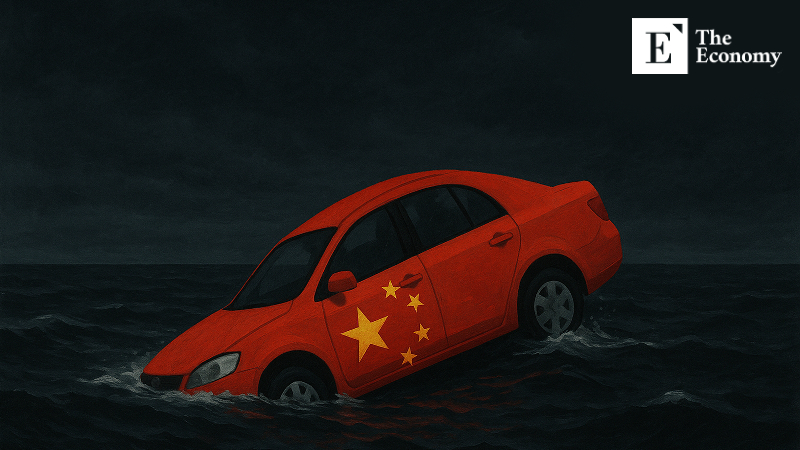
Chicken game in China’s EV industry
Cutthroat price competition is also eating away at China’s EV sector. The industry has grown under a structure skewed toward “volume expansion.” As the center of gravity shifted from large state-owned firms to private players and EV startups sprang up in droves, local government finances and bank lending that had lost an outlet amid China’s property downturn, along with private capital, poured into the sector. That influx fueled a proliferation of EV makers and a severe supply glut.
A report titled “The Paradox of China’s Auto Industry: Neijuan (Involution),” published in November by the Korea Automobile Research Institute, said China’s vehicle production capacity in 2024 reached 55.07 million units a year, more than twice its domestic sales of 26.9 million units. The industry’s average utilization rate, measured for companies above a certain size, was 72.2% in 2024, but when the sample is expanded to all registered manufacturers, the effective utilization rate was estimated at around 50%. In general, a utilization rate below 75% is considered a sign of overcapacity.
As supply far outstripped demand and the market balance broke down, Chinese automakers began cutting prices to defend their positions. The average selling price at major EV makers including BYD fell from $31,000 in 2021 to $24,000 in 2024. Profitability across the auto sector halved from 8.0% in 2017 to 4.3% in 2024, and is estimated to have slipped below 3.5% last year. Consulting firm AlixPartners projected that if this excessive discounting continues, 114 of China’s 129 EV brands could collapse within the next five years.
Industry leaders in China are also on alert. At the China Auto Chongqing Forum in June last year, Geely Chairman Li Shufu said the global auto industry is already saturated and that Geely would no longer build new factories. At the same event, Changan Chairman Zhu Huarong said China has more than 70 local brands alongside dozens of foreign brands, and warned that indiscriminate price wars, misleading advertising, and capital inflows are disrupting market order. Around the same time, Great Wall Motor Chairman Wei Jianjun warned that an “Evergrande of the auto industry” could soon blow up, pointing to fears that China’s auto sector could follow the path of property developer Evergrande, which collapsed in 2021 carrying about $304 billion in debt. As a result, calls are growing for Chinese automakers to focus on fundamentals rather than headline expansion to prevent an industry-wide breakdown.
Similar Post