Global Alcohol Market Shifts as Young Consumers Turn Away From Drinking, Dealing a Direct Blow to Korea’s Beer Makers

Aoife Brennan is a contributing writer for The Economy, with a focus on education, youth, and societal change. Based in Limerick, she holds a degree in political communication from Queen’s University Belfast. Aoife’s work draws connections between cultural narratives and public discourse in Europe and Asia.
Authored On
Modified
Warning Signs Flash for Korea’s Craft Brewers as Failures Mount, Including Amazing Brewing Company and Sevenbrau
Alcohol Consumption Slump Fuels the Downturn, With Only OB Beer Holding Up Behind Cass
“Sober Curious” Trend Spreads Globally as Demand Shifts to Non-Alcoholic Drinks
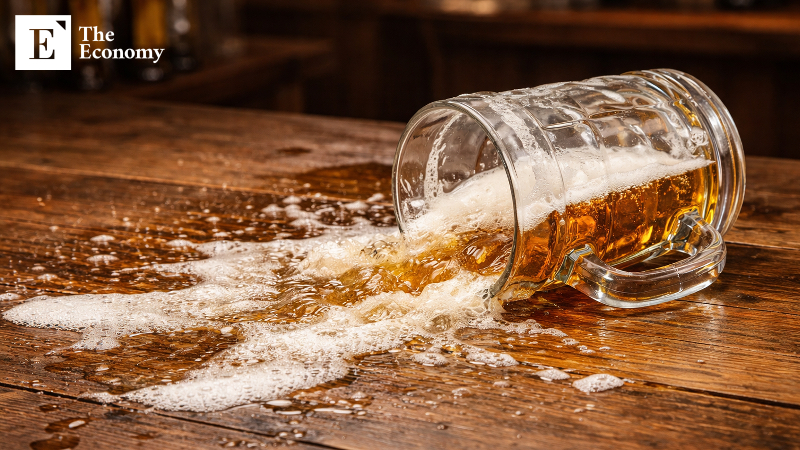
Korea’s craft beer industry is facing a wave of potential failures. As weak economic conditions and shifting consumer tastes drive an overall decline in alcohol consumption, beer makers—unlike soju producers—have been hit especially hard, lacking the kind of global competitiveness needed to withstand the downturn. With similar disruptions taking hold across alcohol markets worldwide, demand from consumers moving away from traditional alcoholic beverages is increasingly shifting toward alternatives such as non-alcoholic drinks.
Korea’s Craft Beer Industry on the Brink
According to the alcohol industry on the 28th, Amazing Brewing Company—once one of the flagship players in Korea’s craft beer market—is expected to enter bankruptcy proceedings. Founded in 2016, the brewer rode the craft beer boom and even signaled plans for an initial public offering in 2021. In recent years, however, growth has slowed sharply, pushing the company into sustained losses. As of the end of 2024, its accumulated deficit stood at about $9.8 million. Although it entered court-led rehabilitation proceedings in August last year, no suitable buyer emerged, and the company ultimately failed to submit a rehabilitation plan by the deadline.
Sevenbrau, often described as a first-generation craft brewer in Korea, must submit its rehabilitation plan by the 6th of next month. The company became Korea’s first craft beer maker in 2011 after becoming the first small and midsize enterprise to obtain a general brewing license. It later led the craft beer boom through collaborations with Korea Flour Mills and convenience store chain CU, launching products such as Gompyo Wheat Beer. Financial difficulties intensified, however, after its trademark agreement expired in 2023. Sevenbrau posted net losses of about $6.4 million in 2023 and roughly $12.1 million in 2024. Rehabilitation proceedings began in June last year, but submission of its recovery plan has been repeatedly delayed.
Hanul & Jeju (formerly Jeju Beer), the first craft beer company to list on Korea’s KOSDAQ, is also struggling amid worsening business conditions. The company was sold to Double H M in 2024, and later that year, semiconductor inspection equipment maker Hanul Semiconductor became its largest shareholder. In November, the top shareholder position briefly shifted to K Partners 1st Investment Association, but the deal ran into complications related to a real estate acquisition, prompting Hanul Semiconductor to take back control.
Y Brewery, which operated the craft beer franchise Bronx, has also applied to enter rehabilitation proceedings this year. The company once ran more than 100 outlets across central Seoul and the Seoul metropolitan area, but is now barely keeping just four locations open, including its Yangjae and Gwangalli branches.
Beer Market Reels as Alcohol Consumption Falls
The downturn is no longer limited to the craft beer segment and is now being observed across major beer makers in Korea. HiteJinro reported third-quarter beer sales of about $160 million, down 8% from a year earlier. Lotte Chilsung Beverage’s cumulative alcohol sales for the first three quarters of 2025 fell 7.4% year on year to roughly $410 million, while cumulative beer sales plunged 38.6% to about $30 million.
The only brewer believed to have maintained growth is OB Beer. While the company is unlisted and does not disclose detailed earnings, its parent, global drinks group AB InBev, pointed to revenue growth in Korea in its third-quarter earnings report last year. The report said revenue per hectoliter rose on the back of revenue management strategies, adding that sales in the Korean market increased by the mid-single digits in the third quarter of 2025. While overall volumes were broadly flat, AB InBev said performance in both on-trade and at-home channels was estimated to have outpaced the industry average, with overall growth led by its mega-brand Cass.
Market watchers point to economic weakness and shifting drinking habits as key factors behind the broader beer market slump. The global spread of the “sober curious” trend—particularly among younger consumers—has taken hold in Korea, reducing overall alcohol consumption. According to the Household Income and Expenditure Survey released by Statistics Korea, household spending on alcohol fell 7.9% year on year in the July–September period.
Within this environment, beer makers have taken a heavier hit to profitability than soju producers, largely due to differences in global competitiveness. Soju, as a distinctly Korean spirit, has room to expand overseas and build export momentum. Beer, by contrast, is dominated by strong local brands in each country, making international expansion far more difficult. Even as domestic demand weakens, brewers have few easy avenues to find growth abroad.
Traditional Alcohol Industry in Decline
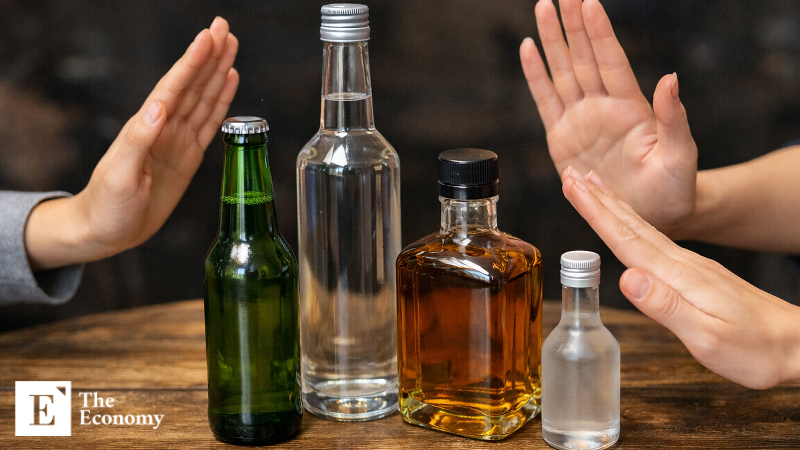
The decline in alcohol consumption is spreading not only in Korea but across the world. OECD data show that per-capita alcohol consumption in many member countries has been on a steady downward trend since 2011. Gallup has also reported that the share of Americans aged 18–34 who say they currently drink alcohol fell from 59% in 2023 to 50% as of August last year. Reflecting this shift, global alcohol sales totaled 47.72 billion bottles in 2024, down about 4% from 49.68 billion bottles in 2018, according to estimates by U.K.-based alcohol market research firm IWSR, based on a standard 500ml bottle.
The impact has rippled through upstream industries such as glass bottle manufacturing. Global bottle maker Ardagh has decided in recent years to shut plants in Drebkau, Germany, and Dalton, Illinois, as falling demand for beer and wine bottles made capacity reductions unavoidable. O-I Glass, the world’s largest glass bottle producer, also closed facilities in Illinois and Ohio between 2024 and 2025. Elsewhere, alcohol-dependent sectors such as the U.K. pub industry are seeing significant job losses, while revenue from alcohol taxes—often classified as a so-called “sin tax”—is declining worldwide. A major structural shift is under way across the traditional alcohol industry.
Consumers exiting the conventional alcohol market in large numbers are increasingly turning to non-alcoholic alternatives. Trends such as “zebra striping,” where consumers alternate between alcoholic and non-alcoholic drinks, are driving demand for substitutes. In response, global brewers have rolled out non-alcoholic versions of flagship brands, including Heineken 0.0, Guinness 0.0, and Budweiser Zero, to capture younger consumers. Diageo entered the market as early as 2019 by acquiring Seedlip, the world’s first non-alcoholic distilled spirit. In Korea, OB Beer is actively targeting the “healthy pleasure” trend with products such as Cass All Zero, which contains no alcohol, sugar, calories, or gluten.
Aoife Brennan is a contributing writer for The Economy, with a focus on education, youth, and societal change. Based in Limerick, she holds a degree in political communication from Queen’s University Belfast. Aoife’s work draws connections between cultural narratives and public discourse in Europe and Asia.
Similar Post