Honda, the ‘Engine Company,’ Exposes EV Competitiveness Gap as It Shuts Down Gasoline Plant in China

Siobhán Delaney is a Dublin-based writer for The Economy, focusing on culture, education, and international affairs. With a background in media and communication from University College Dublin, she contributes to cross-regional coverage and translation-based commentary. Her work emphasizes clarity and balance, especially in contexts shaped by cultural difference and policy translation.
Authored On
Modified
Honda halts operations at its Huangpu plant in China
Reflecting a sharp decline in internal combustion demand in the Chinese market
A consequence of being outpaced by the electric vehicle paradigm

Honda, Japan’s automotive giant, has embarked on sweeping restructuring measures by successively shutting down gasoline vehicle production facilities in China, the world’s largest auto market. Facing record-scale losses driven by the rapid ascent of local electric vehicle brands and a steep drop in internal combustion vehicle demand, the company has opted to slash nearly half of its production capacity. One of Japan’s Big Three automakers, long dominant in the global auto industry, now appears to have effectively conceded in the face of China’s manufacturing prowess.
Closure of Huangpu Plant in June to Cut Gasoline Vehicle Capacity by 20%
According to Nikkei Asia on the 20th (local time), Honda will suspend operations at its Huangpu plant in Guangdong Province this June and is also considering terminating operations at its joint venture plant with Dongfeng Motor. The Huangpu facility, opened in 1999, has been a symbolic production base for Honda in China, manufacturing key gasoline models such as the Integra and ZR-V. With an annual capacity of 240,000 units, the shutdown will eliminate approximately 20% of Honda’s total gasoline production capacity. Honda’s production volume in China last year stood at 680,000 units, marking a roughly 60% decline from its 2020 peak. Sales have also fallen for five consecutive years, dropping to around 640,000 units last year.
According to Japanese media outlets including Asahi Shimbun, Honda is projected to post losses of up to $16.7 billion over the 2025–2026 fiscal years (April 2025 to March 2027). Earlier, the company revised its fiscal 2025 net income outlook from a projected $2.0 billion profit to a $4.6 billion loss. If realized, it would mark Honda’s first net loss since its listing in 1957. For the fiscal year ending in March, the company is expected to report a net loss of $4.6 billion, with losses related to its China joint ventures alone reaching up to $1.0 billion.
Experts largely agree that Honda’s decision to shut down its Chinese plants cannot be viewed merely as an efficiency-driven adjustment. While production cuts had been underway since last year, officially attributed to semiconductor shortages, market observers have consistently pointed to weakening underlying demand as the fundamental cause. Workforce reductions initiated in 2024 are interpreted within the same context. As gasoline vehicle sales in China declined sharply, Honda previously laid off more than 5,000 employees across two joint venture plants in the country.
EV Transition Strategy Falls Apart
The primary cause of Honda’s struggles lies in a strategic miscalculation—its failure to keep pace with the rapid electrification of the Chinese market. Since CEO Toshihiro Mibe assumed leadership in 2021, Honda has pursued aggressive reforms, including a target to transition all new vehicles to electric and hydrogen models by 2040. Mibe emphasized that “leading the world requires taking risks rather than waiting for certainty,” accelerating the company’s push toward electrification in contrast to the more cautious approach under former CEO Takahiro Hachigo. In 2024, Mibe announced a plan to invest $67 billion in electric vehicles and software by 2030, asserting confidence in full capital recovery. Honda’s “Zero Series” symbolized this pivot toward an EV-centric strategy.
However, the company failed to overcome a triple burden: losing price competitiveness against Chinese EV makers such as BYD, tariff shocks stemming from U.S. policy, and the so-called EV chasm reflecting demand stagnation. As a result, Honda has incurred substantial losses. Mibe acknowledged that “a combination of tariff impacts and deteriorating profitability of internal combustion hybrid models has placed the automotive business under severe earnings pressure.” In response, Honda executives, including Mibe, have agreed to return a portion of their salaries for fiscal 2026.
The reasons behind Honda’s lag in the EV sector are clear. The company underestimated the significance of electric vehicles. In the past, Honda launched EV models such as the Fit EV (2012), Clarity Electric (2017), and Honda e (2019) in the U.S. and European markets. These were urban-focused compact city cars with driving ranges less than half that of competing EVs, and their poor cost-performance led to weak sales and early discontinuation. Honda has since repeated a pattern of launching and discontinuing EV models multiple times. Viewing EVs primarily as commuter vehicles limited its ability to accumulate advanced technological capabilities in the segment.
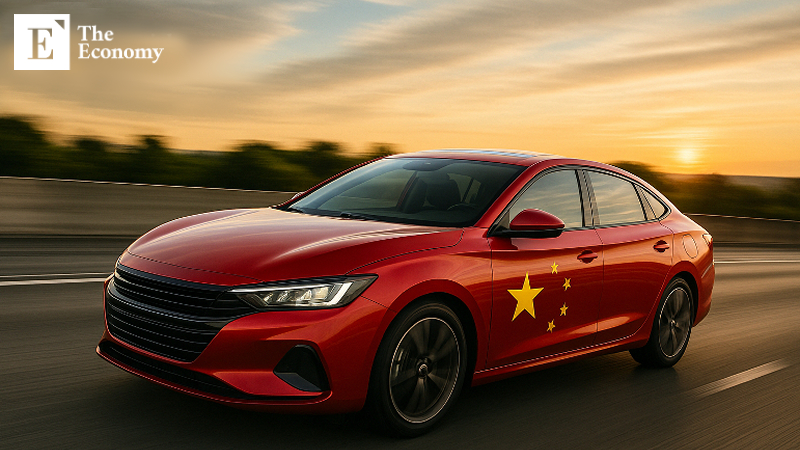
Government Support and Nationalistic Consumption Drive EV Surge
Moreover, Honda’s EV offerings are perceived as lagging behind Chinese consumer preferences in areas such as autonomous driving features and sophisticated interior design. While the market has evolved, Honda’s product strategy has remained largely unchanged. On the supply chain front, Japan also trails significantly. Chinese EV manufacturers have gained a competitive edge through a well-established supply chain, encompassing batteries, electronic controls, and vehicle systems, enabling rapid responses to market demand.
China’s sustained subsidy policies and industrial promotion strategies have further fueled the rise of its EV sector. Strong government-led initiatives have simultaneously eroded the position of internal combustion vehicles and isolated foreign automakers unable to keep pace with the transition. Although Honda established state-of-the-art EV-dedicated plants in Wuhan and Guangzhou at the end of 2024, it has yet to secure sufficient orders to meaningfully raise utilization rates.
The strengthening trend of “Guochao” (nationalistic consumption) among Chinese consumers is also reinforcing purchasing patterns favoring domestic EV brands. This wave of patriotic consumption has resurged amid the U.S.-China tariff war. With retaliatory tariffs expected to drive up the prices of American imports and growing consumer resentment toward repeated U.S. measures targeting China, demand for competitively priced domestic products continues to rise. According to recent reports from outlets including Xin Jing Bao, as of February this year, the average selling price of Chinese-made vehicles stood at approximately $25,000. This compares with around $37,000 in South Korea and $34,000 in Japan over the same period, underscoring China’s significant price advantage.
Siobhán Delaney is a Dublin-based writer for The Economy, focusing on culture, education, and international affairs. With a background in media and communication from University College Dublin, she contributes to cross-regional coverage and translation-based commentary. Her work emphasizes clarity and balance, especially in contexts shaped by cultural difference and policy translation.
Similar Post