“Already Struggling With Oversupply and Restructuring” China Tightens Curbs on Solar Exports to the U.S., Prompting Industry Alarm

Authored On
Modified
China weighs curbs on exports of advanced solar manufacturing equipment to the United States
China’s solar sector, long buoyed by subsidies, reels from overproduction
Government-led restructuring and U.S. tariff pressure leave the industry with little room to maneuver
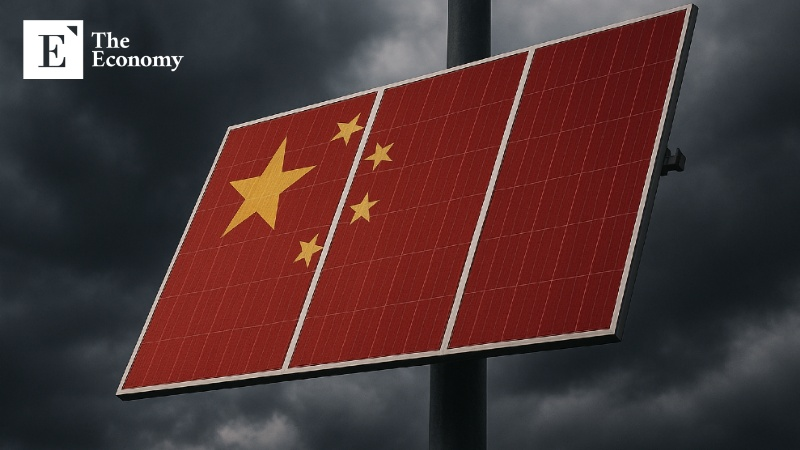
The Chinese government is reviewing measures to restrict exports of domestically produced solar manufacturing equipment to the United States. As Washington accelerates efforts to build a domestic solar ecosystem under the Inflation Reduction Act (IRA), Beijing appears to be weaponizing the supply chain by leveraging its overwhelming market dominance. Market observers say the move could deal a direct blow not only to U.S. companies but also to China’s own solar industry, which is already buckling under overcapacity and restructuring.
China’s Solar Export Curbs Under Review
On April 16, Reuters reported that Chinese authorities had begun discussions with major domestic manufacturers, including Suzhou Maxwell Technologies, on tighter controls over exports of advanced solar equipment to the United States. The move is widely seen as a direct response to the IRA. As the U.S. pushes to lure solar factories onto its own soil through government subsidies, China has chosen to target a critical vulnerability: most of the equipment used in those factories is Chinese-made. China accounts for more than 80% of global solar panel component production and also holds all of the world’s top 10 suppliers in solar manufacturing equipment.
In practical terms, the measure is likely to disrupt a series of expansion plans by U.S. companies seeking to build or enlarge domestic plants. Tesla, in particular, faces immediate exposure through a $2.9 billion manufacturing equipment deal it had been negotiating with Suzhou Maxwell Technologies. Elon Musk, Tesla’s chief executive officer, had earlier pledged to secure 100 gigawatts (GW) of solar manufacturing capacity in the continental United States by 2028, but that goal is effectively unattainable without access to advanced Chinese equipment.
The problem is that the mounting pressure is also reverberating through China’s solar industry. The sector is already suffering a severe downturn driven by persistent oversupply, and the risk of a shrinking export channel is compounding those strains. China’s solar industry expanded rapidly on the back of state support, but profitability has recently begun to collapse as inventory piles up. Companies flooded into the market on the strength of subsidies, sending production capacity spiraling out of control. Huaxia Energy Net, a Chinese energy trade outlet, estimated that nine of the country’s leading solar companies posted combined preliminary losses of as much as $7.3 billion last year. Including smaller firms, total losses are expected to exceed $8.8 billion.
Restructuring Pressure Intensifies Across China’s Solar Industry
The Chinese government’s restructuring drive in the solar sector is also emerging as a major source of pressure. The campaign began with a high-level policy signal in early July last year. At the time, authorities said at the sixth meeting of the Central Commission for Financial and Economic Affairs that disorderly low-price competition among companies must be brought under control in accordance with laws and regulations. Later that month, China’s Ministry of Industry and Information Technology (MIIT) convened 14 solar companies and industry associations for a symposium, presenting a sweeping cleanup of price-cutting competition, quality upgrades, the elimination of outdated equipment, and stronger industry self-regulation as the central pillars of the restructuring agenda. The blueprint was further specified in August through a policy aimed at restoring order to competition in the solar industry. Restructuring had, by then, moved beyond a simple industry message and taken shape as a formal policy framework.
During the second half of last year, tangible signs of industrial consolidation began surfacing across the sector. A representative example was the announcement by 10 solar glass manufacturers, including Xinyi Solar and Flat Glass, that they would cut output by 30%. Restructuring talks through integration and acquisitions also gathered momentum. Major domestic polysilicon producers, including Tongwei, GCL, Daqo, Xinte, East Hope, and Asia Silicon, agreed to establish a $7.3 billion fund and use it to acquire and idle low-quality facilities equivalent to roughly one-third of China’s total polysilicon capacity, or about 1 million tons.
As of April 1, China also fully abolished export tax rebates for 249 product categories, including solar panels. The export tax rebate system, under which the government reimburses taxes paid during the production and distribution process of export goods, had served as one of the core pillars underpinning the price competitiveness of Chinese solar companies, alongside production subsidies and research and development support. Chinese solar firms had been receiving cash rebates equal to 9% of export value and using that support to lower prices. The termination of those rebates implies that overall export costs will rise, accelerating a shakeout across the industry.
U.S. Sharpens Focus on China’s Indirect Solar Exports
The United States has also continued tightening restrictions on Chinese solar products. In April last year, Washington finalized anti-dumping and countervailing duty (AD/CVD) rates of as much as 3,400% to 3,500% on solar cells and modules imported from Thailand, Vietnam, Malaysia, and Cambodia. The measure followed a request from the American Alliance for Solar Manufacturing Trade Committee. Those countries had served as transshipment hubs that China began using in the late 2010s to circumvent existing U.S. AD/CVD measures. In effect, tariff barriers have now largely sealed off that traditional export route into the United States.
Last month, the U.S. also issued preliminary countervailing duty determinations on solar cells and modules imported from India, Indonesia, and Laos. The provisional countervailing duty rates came in at 125.87% for India, 104.38% for Indonesia, and 80.67% for Laos, with final rates due to be confirmed in July. Separately, the U.S. is also investigating whether products from those countries were dumped, raising the prospect of additional anti-dumping duties depending on the outcome. The countries under investigation have effectively become new export bypass routes for Chinese suppliers displaced from Thailand, Vietnam, Malaysia, and Cambodia. According to Reuters, U.S. imports of solar cells and panels from India, Indonesia, and Laos totaled $4.5 billion last year, accounting for roughly 67% of total U.S. solar cell and panel imports.
As Chinese solar companies rapidly lose ground in the U.S. market, some analysts believe South Korea could emerge as a beneficiary. Korean solar manufacturers have steadily expanded their production footprints in the United States over the years. Hanwha Solutions has invested more than $2.0 billion since 2023 to build its Solar Hub production base in Dalton and Cartersville, Georgia. OCI Holdings is also investing in a solar value chain in Texas, while Hyundai Energy Solutions and others are expanding module sales and project development aimed at North America. At a time when Chinese firms’ market grip is beginning to loosen, these companies, armed with established local manufacturing capacity, have moved into a comparatively advantageous competitive position. The rebound in global module prices driven by China’s restructuring has also begun to accelerate improvements in profitability.
Similar Post