The Median Voter Myth in Polarized Politics

Working across research, policy, and data-driven analysis, the Editorial Board ensures that published pieces reflect a consistent institutional perspective grounded in quantitative reasoning and long-term structural assessment.
Authored On
Modified
Two-party politics can deepen division
Elections often sharpen polarized rhetoric
Democracy may need new incentives

The old promise of two-party democracy was that competition would push politicians toward the middle. Many citizens still like to believe this. But a new body of evidence is giving something else a boost. A huge cross-national analysis of 3.4 million tweets sent by 367 populist and non, populist political leaders in 21 democracies shows that we should expect to see increased polarization in the two quarters before elections, but that we actually see the opposite and that polarization actually peaks after elections have taken place. The very period where traditional theory suggests politicians should be reaching for the middle is often when they are reaching for the edges. And this matters because these are not some outlier groups, but rather leaders, elections and full-fledged democratic competition. So it is not just that countries are divided, but that modern-day elections seem to reward the very type of politics that democracy is meant to eliminate.
Polarized politics and the broken promise of the center
There have been two enduring stories about competition in political science. The first is that spatial story so familiar to readers of Harold Hotelling and, subsequently, to voters in Anthony Downs. Two parties compete for the same voters by moving toward the center. An older version of this model, more practiced than formalized, suggests that parties don’t necessarily seek to win over the same people. They want to activate partisans at home, shuffle identities and turn the opposing camp into something repellent. When this occurs, polarized politics is not a system failure, but a deliberate strategy. The question is not why leaders so often drift from the median by chance, but rather, why on earth they would stick close to it. Multiple parties, a polarized media environment and campaign stakes create a reason for differentiation that a broad appeal cannot accomplish.
That is the better way to read the current evidence. Pew has demonstrated that the gap between Democrats and Republicans in Congress remains the widest in 50 years. The previous overlap zone is no more. No ideological overlap has existed in the House since 2002 and it hasn't in the Senate since 2004. Pew believes eight in ten Americans think that Republican and Democratic voters disagree on core facts. That is not a narrow fissure at the boundary of political life. It's a market. The middle is fragile, faith is more fragile and the benefit of appealing to everyone simultaneously is less than most canonical models suggest.
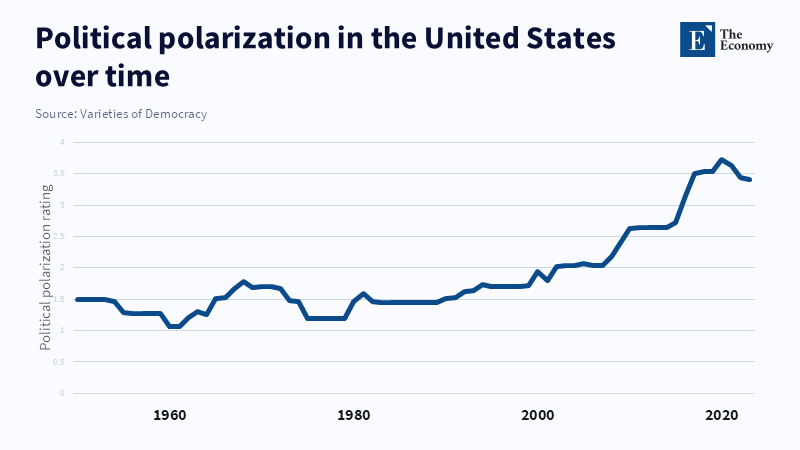
Again, we must be careful not to laugh off an older theory: the median voter logic was persuasive precisely because it reflected something true about mass democracy. If voters distance themselves from issues, both parties are competing for the same set of voters and turnout isn’t heavily influenced by alienation or identity, convergence makes perfect sense. But those circumstances are quite demanding. They imply a shared audience and a shared issue space, neither of which describes the modern media world very well. Instead, different media channels attract different identity groups, parties can calibrate messages to various subgroups and activists punish softness more quickly than mass voters reward moderation and the median becomes a less attractive destination.
The reasons why elections exacerbate polarized politics
The newest evidence doesn't come from the manifesto text. It comes from the very stage at which leaders see their language challenged, before the audiences of competing parties. Using Twitter/X data from 2013 to 2022, Tito Boizi et al. (2026) demonstrate that rhetorical division peaks around elections and disappears in their wake. The effect peaks when the line falls between populist and non, populist leaders. The effect is, happily, most intense in a systematic plurality and presidential systems, where electoral competition takes on the form of a two-camp struggle. As reads go, the message seems to be: mix the advanced rhetoric, dividing on how they divide the issue that breaks out around elections, with the modulation of public speakers that makes their offers vary. Leaders are not converging on the median voter. They are dividing between distinct voters; dividing on topic and dividing on how they summarize the topic.
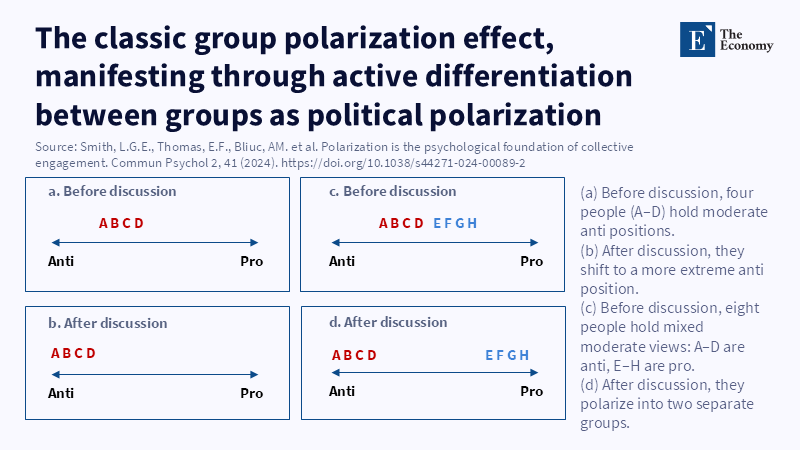
The broader psychology of polarization helps tell us why. Contemporary trends in Communications Psychology suggest that polarization involves more than just distance on policy. It involves actively creating in-group/out-group distinctions. By talking with those who share their beliefs, they can build group pride and forge an us, them " mentality. That motivation can serve to build communal identity and propel people to action. Thus, some observers are correct when they claim polarization not only entails inert dispersion; it also can energize. Yet that very factor complicates treating polarized politics as a nonspecific market failure that simply evaporates when the campaign has cleared. Elections can intensify those group motives, making group distinctions appealing.
A more modest critique: social media is only a part of politics. Tweets aren't laws or party manifestos or private strategy memos. They can over, in an emboldened style. They can privilege performance. And attributions of leaders or messages are never completely accurate. Still, the evidence does matter here for two reasons. One, this is now a key arena of political competition, particularly for agenda setting, media uptake and mobilization of the base. Two, the research isn't based merely on anecdotal observation. It incorporates high-frequency data sets, bias correction methods created for text analysis and an additional test of rhetorical heterogeneity that converges on the same conclusion. That doesn't close the argument. But it does create a higher standard of evidence for anyone who insists that election cycles are always centrist.
The two-party system changes the market
A neater way to state the problem here is this: the two-sided model relies on the scope of competition being limited to a common, absolute stake and common, absolute rules. In Hotelling’s trivial model, the worker cares about distance. In politics, distance is not only about ideology; it is also about identity, privilege, grievance, trust and turnout. In Race, the "cost of travel" (both in the sense of effort and of political capital) in modern campaigns is probably not so much the policy distance between me and the parties on some axis, but rather, as in Prummer, between myness and the campaign’s penetration, that is, whether my existence is ephemeral, visible, or intrusive. As campaigns are able to hyper-target, personalize and test message effects in real time, the temptation to speak beyond the median voter intensifies. Prummer's attempts to formalize this insight suggest that the more precise and perceptive the targeting technology, the more incentives there are to become more ideologically distinct.
That also helps to clarify why the dominant system can exert even more heat than older centrist models predicted. The new data doesn't argue that two-party systems will necessarily engender divisiveness, only that they won't necessarily produce moderation. In some contexts, they will have the opposite effect. A recent American Political Science Review article on voting mandates takes that argument even further. In those contexts, the article demonstrates that, where alienated voters can credibly choose to stay at home, parties are better off sharply diverging from the median voter. Meanwhile, settings that raise turnout and diminish the strategic significance of alienation can force parties back to the middle ground. And it is important to emphasize that 27 nations have already adopted these modes of voting. We need not interpret this research as an appeal for national mandates. We should interpret it as evidence that institutions do matter because they determine whether broad persuasion will emerge as the most rewarding strategy.
The pattern across countries is important too. Boeri et al. (2026) do not find the same syndrome on every side of every ideological divide. The result that is strongest for is not (as we might have expected)the traditional ideological first vs. second cabinet path. It is the populist vs. not populist divide, at precisely the place where high electoral competition pushes parties toward the winner-takes-all endpoint. That point has importance. It indicates the possibility that polarized politics is built more through style, identity, anti-elite framing and issue emphasis than by traditional programmatic distance. Put another way: parties do not necessarily polarize because they want to. They may do so because they stand to benefit from antagonistic politics as a representative story of the competition. And once that is accepted as campaign 'truth,' real negotiations on policy may not reduce conflict. They may actually facilitate strategic rhetorical differentiation.
Democracy beyond the median voter myth
This is where the potential clarity of the policy argument should come in. Disagreement should not be eliminated; there should be no unconflicted democracy. It would be vacuous, possibly dishonest. Even critics of polarization acknowledge that bringing differences to the surface makes competition more accountable, commonwealth, broadening and energizes cynics to become partisans. The problem begins when polarized politics stops being an effect rather than a cause of choice. When it stops being merely the route to victory. When candidates win by appealing to linked, separate emotions. When the boundaries of the common commonwealth begin to collapse. When politicians speak to their own party, they speak in their own dialects of issues, facts and trust. Then the elections happen, but the judgment of what the people, all of the people, should collectively believe becomes a little more remote.
Hence, the revision is not to give up on democracy but to restore our expectations for common audiences. It might require institutional reforms that exclude market segments from politics. It might require institutions that make uncompetitive bases less lucrative. It might require reforms that dampen some incentives to treat every election as a tug of war of identity. The exact recipe will vary from country to country, but the ingredients are clear. Exclusionary turnout schemes, institutional reforms so that district boundaries have less effect, diminished incentives for cloistered intra-elite turf wars and an arena of the public sphere that punishes and excludes cloistered communication between group interests, that is what should command more immediate attention than it gets. The new evidence highlights that voters are not irrational; rather, certain institutions and media environments rationalize polarized politics as a strategic campaign choice.
The strongest objection to this view is easily laid out. Polarization may seem unhealthy, but it may sometimes just be honest conflict. If inequality, migration, cultural issues and constitutional debates split the body politic, why pretend otherwise? That objection has some force. Politics without contrast can mute social realities and bolster ossified elites. But that is not what the recent evidence finds. The problem is not only that leaders talk past each other, but that they become more prone to sorting audiences, differentiating agendas and escalating divided identities as elections approach. That is not pure democratic candor. It is strategic differentiation. That distinction is important because a system can sustain major policy differences without systematically reaping the benefits of unyielding opposition.
The most important piece of evidence remains that first chart. When elections are close, politicians tend not to converge toward the median; they tend to diverge. This single piece of evidence should be enough to cause a reevaluation of one of democracy's oldest assumptions. The median voter theorem remains a good starting point. But it is no longer a good default description of political life in highly sorted media, saturated two-party democracies. Researchers should consider it an exception, not the rule. This oversight is one reason why so many democracies appear to have gone astray and why certain reforms are commonly proposed. Politicians should find the tougher question to ask about every electoral system and every campaign technology: What benefit does this system see in rewarding politicians who unite the public rather than those who divide it? Until the tougher question becomes as central to the debate as the statistics, polarized politics will continue to appear to be the failure of democracies when, too often, it is an electoral instinct.
The views expressed in this article are those of the author(s) and do not necessarily reflect the official position of The Economy or its affiliates.
References
Boeri, T., Nikiforova, N. and Tabellini, G. (2026) ‘When and why political leaders polarise rhetoric: Evidence from Twitter/X’, VoxEU, 10 April.
DeSilver, D. (2022) ‘The polarization in today’s Congress has roots that go back decades’, Pew Research Center, 10 March.
Downs, A. (1957) An Economic Theory of Democracy. New York: Harper & Brothers.
Hotelling, H. (1929) ‘Stability in competition’, The Economic Journal, 39(153), pp. 41–57.
Oprea, A., Martin, L. and Brennan, G.H. (2024) ‘Moving toward the median: Compulsory voting and political polarization’, American Political Science Review, 118(4), pp. 1951–1965.
Prummer, A. (2020) ‘Micro-targeting and polarization’, Journal of Public Economics, 188, 104210.
Shearer, E. (2025) ‘Most Americans say Republican and Democratic voters cannot agree on basic facts’, Pew Research Center, 30 July.
Smith, L.G.E., Thomas, E.F., Bliuc, A.-M. and McGarty, C. (2024) ‘Polarization is the psychological foundation of collective engagement’, Communications Psychology, 2, article 41.
Working across research, policy, and data-driven analysis, the Editorial Board ensures that published pieces reflect a consistent institutional perspective grounded in quantitative reasoning and long-term structural assessment.