Gig Worker Social Security Cannot Wait for the Employee Test

Working across research, policy, and data-driven analysis, the Editorial Board ensures that published pieces reflect a consistent institutional perspective grounded in quantitative reasoning and long-term structural assessment.
Authored On
Modified
Gig work is growing faster than worker protection
The US is still fragmented; India is moving toward broader coverage
The real issue is basic security for flexible workers

In New York, some app food delivery workers were earning only $5.39 an hour before tips under the previous system, and that’s not a campaign leaflet statistic or a sum in a courtroom; it’s one piece of city compliance data. It uncovered the real problem with the entire gig work debate. Too many policies still try to categorize whether platform workers are "really" employees or "really" freelancers, as if the truth isn't clear until one side gets proven rightwhen it's hard to see the point, given how carefully workers are managed, secretively paid, and tasked with shouldering the costs of fuel, insurance, waiting time, and social risk. The crucial issue isn't whether gig workers are neatly in the employee model of work; it's whether any modern labor market can sustain itself if millions of workers providing essential services are left without a secure floor of income, health care, and economic security.
Why does this matter now? The developed world has spent years debating the employee versus independent contractor classification without settling on a solution. The U.S. has experienced extensive litigation, federal rulemaking, municipal minimum-wage measures, and transparency initiatives, all to no avail, leaving no comprehensive, stable national system for gig workers' social security. In contrast, India has tried a different strategy: it's not yet offering complete coverage, and its plan has flaws, but it has started considering registration, social welfare funding, and portable benefits in their own right, rather than treating battles over worker categorization as a proxy. This more realistic view makes better sense. Many gig workers are part-time, self-employed, or multitasking app users, and perhaps prefer to be so. But social security depends on observable worker reliance and risk, not employee label. More than labor ministers and courts should realize that this shouldn't only be a lesson for the twenty-first-century workforce; public policy schools and workforce agencies should be applying it too, instead of teaching twenty-first-century labor using twentieth-century models.
The United States has regulated gig worker social security by patchwork
So what's been done in the U.S.?A lot, just not cohesively. The federal Department of Labor issued a final rule in 2024 to reduce misclassification by adopting a broader "economic reality" test for the Fair Labor Standards Act; this was implemented by March. However, it proposed its withdrawal in February and replacement with a test very much like its 2021 predecessor; that one,take a shot captures the federal absolute. Overall, the federal government appears to believe that gig worker protections revolve mainly around misclassification, and partisan divisions heavily influence the classification standards introduced by each administration or Congress. For now, narrower measures like the 2025 Human Rights Watch proposal, designed to make pay systems that hide pay more easily challengeable, are all we seem to have. For the moment, the most promising development is the portable, "floorless" social security system.
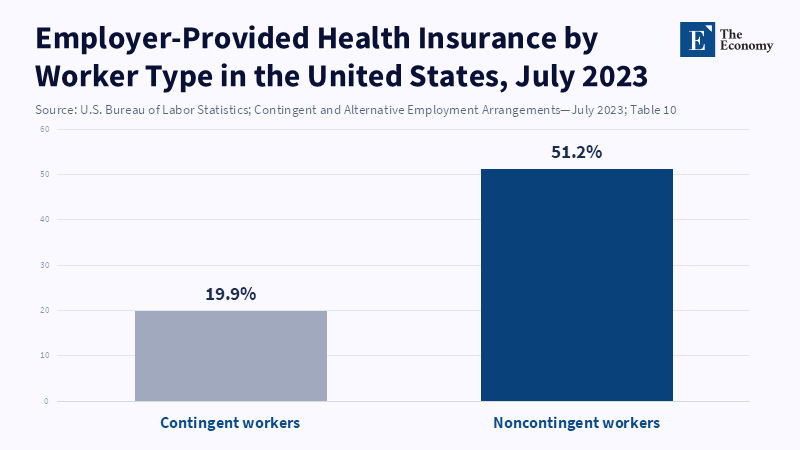
On lower levels, some cities and states have stepped in. New York City, for example, increased its app-based delivery service minimum pay to $21.44 in 2025 and $22.13 in 2026. Estimates suggest that since implementing this policy, over $700 million has been added to the pay of 60,000+ workers. Seattle employed a different tactic: its app-based worker laws, which not only guarantee a dollar a mile and a dollar a minute but also require pay transparency, paid sick and safe leave. While they are meaningful benefits, they also show that the American approach to the gig economy allows for creative adaptability: depending on location, platform, or occupation, gig workers may or may not receive a pay floor or sick pay. Is it fair that a potential gig food courier in one city might benefit from these initiatives, while another, right down the road, might be left unprotected? Not at a time when a country as affluent as America shouldn't have to make such high-stakes, postcode lotteries.
India is building gig worker social security without full employee status
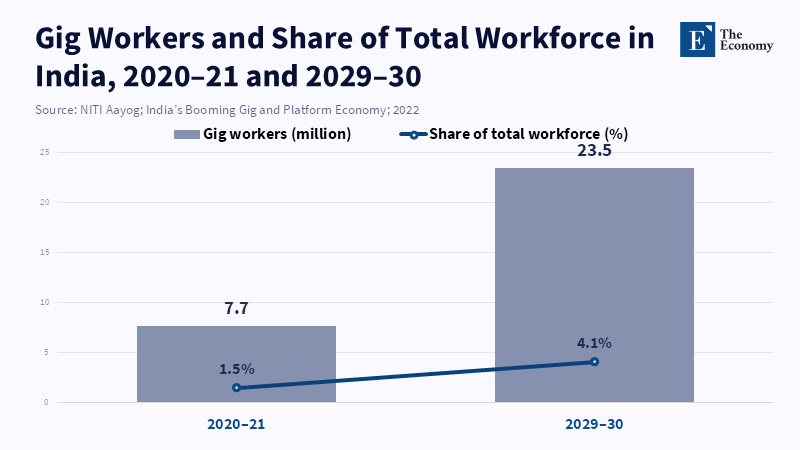
The recent course of action taken by India is important because it reframes the debate. Over many years, Indian policymaking has concluded that the focus should be on forcing platform workers into employee status. It is now establishing a welfare delivery route for workers who work outside the complete employer-employee framework. The NITI Aayog, the government think tank, can estimate that 7.7 million Indians within the gig economy existed in 2020,21, but envisioned this could grow to more than 23.5 million in 2029,30, a jump from 1.5%of the country’s workers to 4.1%. Likewise, the Ministry of Labor announced in 2025 that the 2024,25 gig economy would
Give employment to over one crore workers. In this year, in its Union Budget, India's Ministry also promoted e-Shram registration and identity cards and Ayushman Bharat PM, JAY health insurance coverage for platform workers, with a goal of providing benefits to nearly one crore of those workers, evidently recognizing gig worker social security as an administrative and budgeting challenge, not merely a theoretical dilemma.
The policy path played out state by state. Rajasthan’s 2023 legislation, currently affirmed, provided registration, grievance redress, and a social security and welfare fund; Karnataka’s 2025 bill preset a framework: a unique identifier, speaker, aggregator registration, disclosure rules, automated scrutiny, mandatory providers, discretion to reject, grievance systems, and dedicating 1,5% ofpayouts during the powers of migration to a welfare budget. Not yet a total reform, official eyeballing can be powerless without a strong means of enforcement, especially for gig workers. The proposed set of rights isn't entirely on par with traditional employment rights, but public administrators can deliver data that might be stronger, and platforms can prevent rules from being broken. Still, even if not a perfect plan, India's strategy affords a clear recognition of real work that provides public benefits regardless of the outcome of lawsuits challenging whether those benefits are being conferred on "workers."
Gig worker social security needs a portable floor, not a legal fiction
The takeaway: lawmakers and judges need to stay out of the gig economy as a new playground for broader, market-oriented reform. Undeniably, some gig work in the present day is traditional work, and abuses should be punished. Properly, enforcement has a hand. But as the rise of Jobs and the Opt Out Economy shows, even more gig workers are embarking on even more conceptually fuzzy work: we need to establish a portable workforce pay and benefit floor, so that workers who share the risks and benefits of such uncertain jobs can wield more informational influence. Platforms should be required to contribute to benefit funds based on the hours, earnings, or transactions they process, just like they pay taxes. Benefits should be portable and accessible wherever they move between apps. And they should be established early, regardless of the worker’s influence, that is, database communication and vehicles for payment, PCTO, and similar. To policymakers, that is transparent measures of contributions that match how much Hercules powers the system and how much they can shift where workers should work. To the lawyer, turned educator, it means the end of practicing run-of-the-mill gig economy law, as if one day we'll all just automatically transition into an entirely new market free of existing labor institutions, just give it some time.
The common argument is that a considered, extended gig worker security system will hamper the gig economy's flexibility. But that premise is easily dismissed. Cities such as New York and Seattle have achieved desirable work conditions without compromising employment flexibility. And the Warnings of Sarah Levine teach us that employment has grown to be an increasingly vague and shrinking feature of economies: perhaps it is more reasonable to believe in the magic of an Italian fit. The bigger risk is that the opposite occurs, no accommodation at all, for there will be no means for the economy to rationalize the actual costs of subsidizing jobs, even if they are low. Continued insulation of gig workers from the uncertainty of the traditional model of work will create a class of workers who are excessively dependent on their AI-enabled employers, a scenario that won't produce freedom; it will produce private comfort with publicly underwritten risk. That $5.39 an hour in New York shouldn't be considered an outlier but a reference point. As that market begins to fairly price existing jobs, social protection will no longer be up for debate but a value, adding feature one, ironically, that we could compare to India. One is still arguing whether workers are really workers; another is still protecting them as active members of an actual marketplace.
The views expressed in this article are those of the author(s) and do not necessarily reflect the official position of The Economy or its affiliates.
References
Bacciarelli, A. and Simet, L. (2025) The Gig Trap: Algorithmic, Wage and Labor Exploitation in Platform Work in the US. New York: Human Rights Watch.
Board of Governors of the Federal Reserve System (2025) Economic Well-Being of U.S. Households in 2024: Employment and Gig Work. Washington, DC: Board of Governors of the Federal Reserve System.
Government of India, Ministry of Labour and Employment (2025a) Ministry of Labour and Employment Urges Platform Workers to Register on e-Shram Portal for Formal Recognition and Access to AB-PMJAY Benefits. New Delhi: Press Information Bureau.
Government of India, Ministry of Labour and Employment (2025b) Says Social Security for Gig Workers a Transformative Step. New Delhi: Press Information Bureau.
Hatayama, M. and Maj-Swistak, D. (2024) The Regulation of Platform-Based Work: Recent Regulatory Initiatives and Insights for Developing Countries. Washington, DC: World Bank.
International Labour Organization (n.d.) Platform Based Gig Workers (Registration and Welfare) Act 2023. Digital Labour Platform Tracker. Geneva: International Labour Organization.
Lee, M.H. (2025) ‘Reimagining Workers’ Rights in the Gig Economy: Bridging the Gap Between Independent Contractors and Employees’, New York State Bar Association, 5 August.
Levine, S.M. (2025) ‘Gig-Economy Myths and Missteps’, The Yale Law Journal Forum, 31 January.
NITI Aayog (2022) India’s Booming Gig and Platform Economy: Perspectives and Recommendations on the Future of Work. New Delhi: NITI Aayog.
New York City Department of Consumer and Worker Protection (2026) Minimum Pay Rate for Delivery Workers. New York: DCWP.
Office of the Mayor of New York City (2025) Mayor Adams Announces Full Minimum Pay Rate for App-Based Restaurant Delivery Workers Is Now in Effect. New York: Office of the Mayor.
PRS Legislative Research (2025) The Karnataka Platform Based Gig Workers Social Security and Welfare Bill, 2025. New Delhi: PRS Legislative Research.
Saiyyad, K. (2026) ‘India’s Gig Economy Is Growing Faster Than Its Protections’, East Asia Forum, 9 April.
Seattle Office of Labor Standards (2026a) App-Based Worker Minimum Payment Ordinance. Seattle: City of Seattle.
Seattle Office of Labor Standards (2026b) App-Based Worker Paid Sick and Safe Time Ordinance. Seattle: City of Seattle.
Simet, L. and Bacciarelli, A. (2025) ‘New Bill Could Curb Exploitation of US Gig Workers’, Human Rights Watch, 29 July.
Sripada, C. (2025) ‘Revitalising Worker’s Rights for the Gig Economy’, Executive Perspectives, Indian School of Business Executive Education, August.
U.S. Bureau of Labor Statistics (2024) Contingent and Alternative Employment Arrangements—July 2023. Washington, DC: U.S. Department of Labor.
U.S. Department of Labor (2024) Final Rule: Employee or Independent Contractor Classification Under the Fair Labor Standards Act. Washington, DC: U.S. Department of Labor.
U.S. Department of Labor (2026) US Department of Labor Proposes Rule Clarifying Employee, Independent Contractor Status Under Federal Wage and Hour Laws. Washington, DC: U.S. Department of Labor.
Working across research, policy, and data-driven analysis, the Editorial Board ensures that published pieces reflect a consistent institutional perspective grounded in quantitative reasoning and long-term structural assessment.