Gender Representation in Politics Is Not the Same as Gender Equality

Working across research, policy, and data-driven analysis, the Editorial Board ensures that published pieces reflect a consistent institutional perspective grounded in quantitative reasoning and long-term structural assessment.
Authored On
Modified
More women in office does not automatically produce better outcomes for women
Legislative behavior is shaped by ideology, party structure, and local social norms, not gender alone
The real test is not who enters the room, but what the institution does once power is exercised
Women are now responsible for 27.5% of all politics around the world. Sounds like a consistent upward trend until you consider the growth rate: one-tenth of a percentage point, the same sluggishness seen from 2025 to 2026. That’s the conventional difficulty with talking gender in politics. The public sees a female prime minister, a more gender-balanced parliament, a more conspicuously female cabinet and assumes, in its naivety, that the administration works toward equality. But balance is not progress. An assembly can look more likely to do right by women while still having incredible inequality in pay, family policy, violence prevention, home law, work rights, or political entry. It can bring women into full view of the cameras and leave the machine as deeply rooted as ever. This is the problem: it is too easy for us to treat gender as a proxy for policymaking progress. It is not. Gender politics affects equality, legitimacy and voting access. But it does not and cannot, on its own, foretell which attorneys of some cause will codify which interest in law.
Why did gender provide a shortcut to progress?
The whole rationale for more women in office, making for a better government for women, wasn't just hatched out of thin air. Instead, it rested on a commonsensical argument. If men have been in charge, then gender, based exclusion of women from politics has been the rule. More women should broaden the range of their experience, throw the power of numbers behind neglected issues and erode the logic of men's privilege. That tradition should weaken, not strengthen, men's priorities as the benchmark. That argument still has a good deal of persuasive force. It can be invoked to account for the importance of visibility, the virtue of quotas and the democratic logic of symbolic breakthroughs. Clearly, a male monopoly is a bad way to organize the political process; opening the process to women is better. But that isn't where the argument ends; it is simply where it begins.
Begins when a legitimate democratic argument is converted from a subtle and thoughtful nuance into a bludgeoning political truism. Gender begins to stand in for the issue. You go to the bathroom because you're a woman; you've got a better shot at representing the interests of women. You go to the bathroom because you're a guy; you'd better have a better shot of representing women's interests. Too many things are stacked into an easy signifier. It's a provocation that lets us forget social norms and coalition, bargaining, ideology and donors, local sociabilities and institutional pressures. It lets us forget something plainly visible, too: women politicians are not all one thing. Neither are women voters. Some women in Parliament will push to expand reproductive rights and infant and child services. Others will push to reinforce marriage, masculinity and motherhood. Some guys in Parliament will do more to promote women's interests than the chances are the feminists in their own ranks ever will. Politics takes sex into account in who gets listened to. But it does not automatically tell us what the group will say when their power is on.
What the recent data actually found
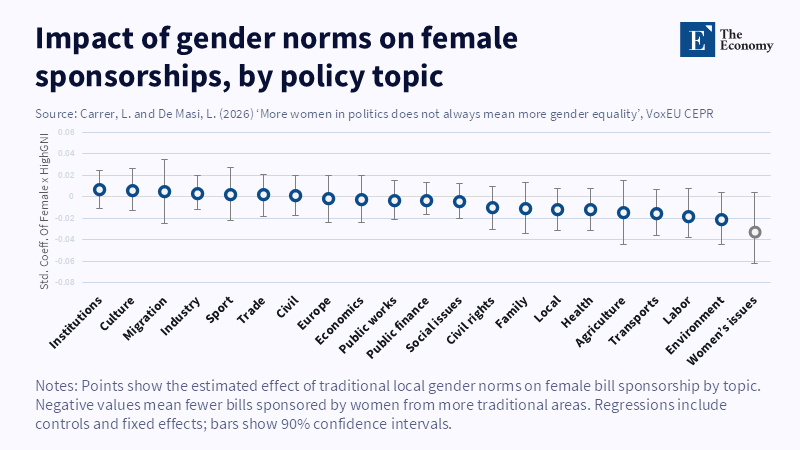
The most important empirical contribution is anything but an argument about whether gender in the office matters. Instead, they begin by reporting that the gender effect is susceptible to interaction. This claim alone is both more serious and more surprising. Carrer and De Masi make this point very explicitly in the case of Italy. Their analysis finds that women legislators whose origins are within a traditionalist space, measured by the more conservative nature of their respective local town councils, sponsor less legislation on gender issues than women from less reinforced political environments. And the gap is not trivial. On average, women from conservative regions are responsible for about 1 fewer sponsor of gender,related legislation for each legislative session. This difference is about fifteen percent of the average number of gender related bills sponsored by female legislators, even controlling for some contextual effects of district and party. This basic fact injects an important strut in the shoes of the (relatively) naive theory of comparative descriptive representation; it demonstrates that the behavior of female legislators in office does not change per se. Instead, local social cues are ingrained in the legislators. The same label, "female legislator," conjures up quite different policy-minded states of an individual, depending upon her even more socially determined origins.
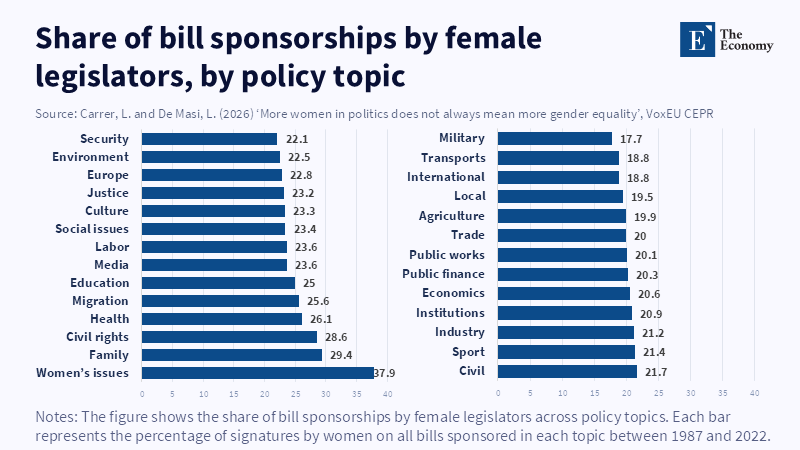
Other ongoing work offers similar lessons. In 2025, Jones and colleagues studied 7, 77 of the Swiss parliamentarians 53, 665 votes and found that female members of parliament were no more likely than men to represent the views of women according to national statistics. There were only significant differences in social policy votes. Elsewhere, even controlling for party and constituency preferences, female members of parliament were no more likely than their male colleagues to be representative of the knowledge of women voters. Another Canadian report conducted in 2024 was similarly invalidating. Based on survey data of 3, 750 sample voters and 867 elected politicians, Jones found no advantage for women at all in predicting the opinions of their female districts. Descriptive representation does have a connection to substantive representation. However, it is not proximately related to the substance of policies in a predictable way. That is what the electorate must continue to be told. Their mere presence on a seat does not predicate policy substance.
In simple terms, where ideology, institutions and power reign:
If we get past the realm of gender alone, it's easy to find what other things explain the variation. Ideology. Party. The institutional settings in the country. An analysis by Caskey and coworkers in Chile in 2025 has revealed that while female Deputies will, all other things equal, respond to underprivileged colleagues when in office, they also respond to a clear identity, based on ideological variation. Leftist Deputies respond better. This is exactly the kind of outcome that political reporting wants to confuse: it is much easier to praise women for simply leaning into executive power than it is to see them succeed at whatever is their base identity, working through parties that reward equality, or working through other parties that use non-egalitarian avenues to reach their goals. As much as gender would seem to bribe entry into power, parties and issues still lead the way in the substantive decision processes.
System, wide cross, national data says the same thing. Quotas continue to enable expanding figures: of the twenty countries that reaccessed chambers in 2005, nations that established quotas experienced, on average, 30.9 percent of their parliament members being female versus 23.3 percent for those that didn't. But numbers do little to reveal where real power resides. Worldwide, as of January 1, 2025, women possessed 22.9 percent of ministers' positions. Still, that remains below a quarter. And the configurations of substance,aggregating portfolios indicate that women still have ascendancy over family and social justice portfolios, while lagging behind in foreign policy and military portfolios. That's why a photo of a woman prime minister may give a false impression. A nation can appear more equitable without being wealthier. It can have appointed a woman as prime minister without shifting the power dynamic in foreign, financial, or military decision-making. The case of Takaichi, the first woman prime minister of Japan, highlights this tendency. When she assumed office on October 4, 2005, she appointed two women to a nineteen-member cabinet. Reuters also observed that she remained quite conservative, reverting to a socially traditionalist, anti, feminist premise. In a strange juxtaposition, a first woman cannot be enough.
How can the reformers, media and politicians commit this?
The first must be to keep in mind that there is no panacea called gender politics. It is good in itself. But it does not replace harder, more restrictive and more objective questions. What lands women in relatively safe seats or pushes them into what, at least in appearance, are unwinnable districts? Who gives women ministerial posts of justice, work and family services, interior, law enforcement and foreign relations? Who confines women to safe but ultimately non-controversial speech, writer positions? Where do campaign committees come from that supervise the budget, monitor appointments and direct the legislative agenda? Which candidates are legislators-sponsored, which are voters-selected? What mandates do legislators propose to do with regard to equality and which mandates do voters submit to? These are not secondary inspections. They are conclusions. If you ignore the intricacies of symbolic and equitable access, you will never know who actually commands authority.
The second will be to demand that the media and institutional language settle down. All the conventional commentaries are oversimplifications. When a woman jumps to the top of the political ladder, the press cheers it as an indication of how far the system has come! When a lady candidate or leader of the opposition, who is genuinely annoyed for being considered a restroom, says that she would jump into the race, we believe women in politics truly don't matter! Neither is a sensible way of viewing. As a principle, the perspective to adopt is that women's entry into politics is a prerequisite for legitimacy, but far from sufficient to achieve policy outcomes. Coalitions should be fashioned on these four bases: electoral strength, appointee strength, candidate programs and legislative record. These should be evaluated not only on the basis of women's recruitment but also on the basis of whether the recruited women held power and reinforced gender scholarship. Gender politics on people's minds is a matter of justice in the end. It is only an aid for good governance and equality. Until we disconnect quantitative numbers and qualitative power, feminist activists and equal rights advocates will continue to focus on too narrow fields.
The views expressed in this article are those of the author(s) and do not necessarily reflect the official position of The Economy or its affiliates.
References
Carrer, L. and De Masi, L. (2026) ‘More women in politics does not always mean more gender equality’, VoxEU CEPR, 10 April.
Dockendorff, A., Gamboa, R. and Aubry, M. (2025) ‘Do Women Legislators Represent Disadvantaged Groups More Actively? Evidence from Chile’, Latin American Politics and Society, 67(4), pp. 63–79.
Franceschet, S., Lucas, J. and Rayment, E. (2024) ‘Do Women Politicians Know More about Women’s Policy Preferences? Evidence from Canada’, Politics & Gender, 20(3), pp. 579–597.
Inter-Parliamentary Union (2026) Women in parliament in 2025. Geneva: Inter-Parliamentary Union.
Inter-Parliamentary Union and UN Women (2025) Women in Politics: 2025. Geneva and New York: Inter-Parliamentary Union and UN Women.
Kläy, Y., Eichenberger, R., Portmann, M. and Stadelmann, D. (2025) ‘Substantive Representation of Women: Empirical Evidence’, British Journal of Political Science, 55, e32.
Komiya, K. (2025) ‘Japan’s new PM Sanae Takaichi makes history, but women ask what changes now?’, Reuters, 21 October.
Working across research, policy, and data-driven analysis, the Editorial Board ensures that published pieces reflect a consistent institutional perspective grounded in quantitative reasoning and long-term structural assessment.