“Thought It Was a Genuine Samsung Product” Counterfeit Memory Products Resurge as Overheated Market Conditions Create an Opening

Authored On
Modified
Indications Emerge of Counterfeit Samsung 990 Pro Distribution, With “Subpar Performance”
Fake Samsung and SK hynix Memory Products Remain a Chronic Industry Headache
Surging Memory Demand Fueled by the AI Boom Also Ignites Counterfeit Sales
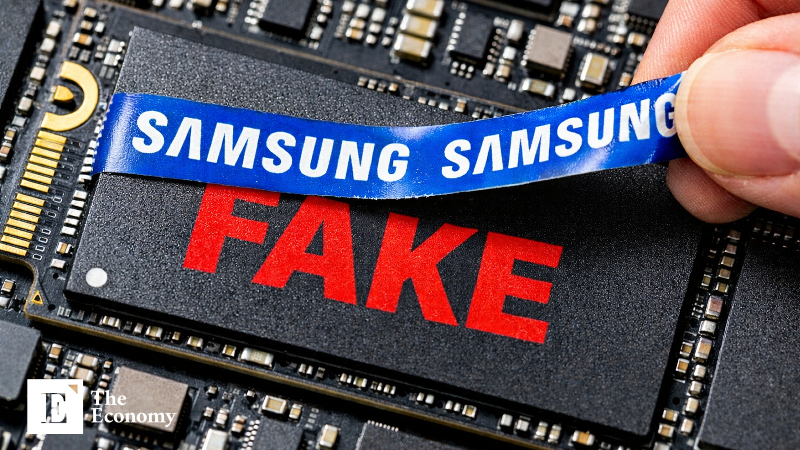
A counterfeit version of Samsung Electronics’ flagship Solid State Drive (SSD), the 990 Pro, has been discovered after being meticulously replicated. As demand for memory products, including NAND flash, has surged amid the rapid growth of the artificial intelligence (AI) industry, attempts to distribute counterfeit goods by exploiting market supply-demand imbalances have begun in earnest. Market participants broadly believe that, given the strong likelihood of a prolonged memory supply cliff, the resulting market dislocation is effectively unlikely to be resolved in the near term.
Distribution of Counterfeit Samsung SSDs
On April 16 local time, U.S. IT outlet Tom’s Hardware reported that counterfeit versions of the Samsung 990 Pro were being distributed through local retailers in Europe, including Austria. While the external design of the counterfeit closely resembles Samsung’s genuine product, its internal finish was found to be markedly crude. Whereas authentic Samsung 990 Pro products use the company’s signature black printed circuit board (PCB), removing the sticker from the counterfeit reveals a shoddy blue PCB. In effect, low-end components were pieced together to imitate only the outward appearance.
Running Samsung Magician, Samsung Electronics’ SSD management utility, makes it easier to verify whether the product is counterfeit. Samsung Magician recognizes the fake as an SSD 990 Pro, but simultaneously flags it as a non-Samsung product. Features provided for genuine Samsung products, including diagnostic scans, also fail to function properly. In the general-purpose utility CrystalDiskInfo, the counterfeit’s capacity is at times displayed as the abnormal figure of 1,099.5GB. Cases have also been reported in which errors occurred during the formatting stage for data writing when the product was actually installed in a PC.
Its performance is also severely inferior to that of the genuine product. According to analyses by major IT outlets including TechSpot, the performance gap between the two products does not show up clearly in initial benchmarks. Under CrystalDiskMark, the counterfeit posted sequential read speeds of about 7,200MB/s and write speeds of 6,000MB/s, broadly similar to the genuine product. However, in sustained-performance tests such as large-file copying, the counterfeit recorded an average speed of only about 261MB/s. That is roughly seven times slower than the genuine product’s approximately 1,800MB/s, underscoring that the counterfeit adopted a structure designed to inflate only short-term performance by leveraging SLC cache.
Past Cases of Fake Memory Seizures
This counterfeit memory issue has persisted for decades. A representative case came in 2002, when counterfeit products misusing the SK hynix name, then Hynix Semiconductor, were uncovered in countries around the world. Most of the fake products discovered at the time were 128MB PC133 module products, manufactured by combining illegally leaked low-grade wafers from multiple producers before being distributed in China, Europe, and elsewhere. The case was presumed to have been a scheme by illicit Southeast Asian operators to disguise cheap, low-grade memory products as those of well-known companies in order to pocket the price differential.
In 2007, counterfeit Samsung NAND products were also discovered. Fake Samsung 1GB NAND chips being brought from China into South Korea were intercepted by customs authorities. Samsung stated that the products had been forged using a “remarking” method, in which the serial numbers on genuine Samsung products manufactured several years earlier were erased and new manufacturing numbers were marked over them. In effect, older genuine inventory or recovered products had been dressed up and circulated as newer supply.
In 2023, counterfeit Samsung 980 Pro products also spread widely in China. According to reports posted at the time on a forum on China’s Baidu, the counterfeit 980 Pro used not Samsung’s Elpis controller but a third-party controller, the Maxio MAP1602A, along with YMTC’s 128-layer TLC NAND flash from China. Performance test data released alongside those reports showed that the counterfeit delivered read speeds of about 4,800MB/s and write speeds of about 4,400MB/s. The genuine product, by contrast, offers read speeds of up to 7,000MB/s and write speeds of up to 5,000MB/s.
NAND Demand and Prices on a Steep Climb
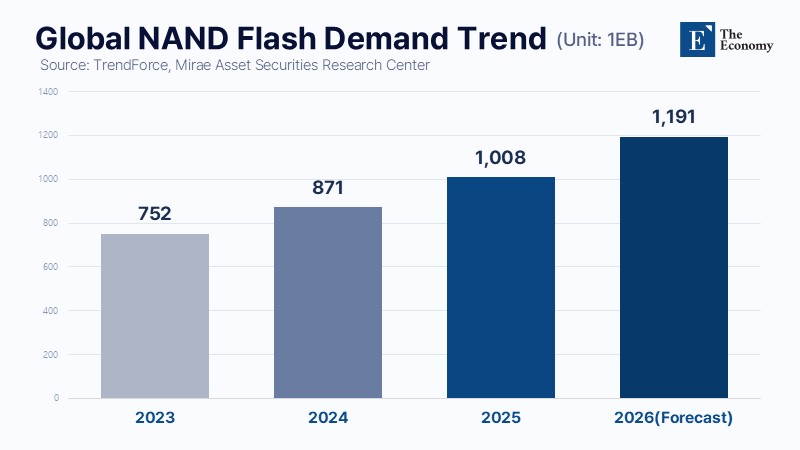
The renewed surge in this counterfeit problem in recent months stems from the sharp rise in prices for memory products, including NAND. According to market research firm DRAMeXchange, the average fixed transaction price of general-purpose NAND products last month, specifically 128Gb 16Gx8 MLC for memory cards and USB devices, was $17.73. That represented a 39.95% increase from the previous month’s $12.67 and was roughly eight times higher than the $2.18 recorded in January last year. Prices have surged as the AI industry has expanded rapidly, driving steep growth in demand for NAND-based enterprise SSDs (eSSDs). Market research firm TrendForce and Mirae Asset Securities projected that global NAND demand would expand from 752EB in 2023 to 1,191EB this year.
The problem is that recent market supply has failed to keep pace with demand. Global NAND manufacturers had already been implementing production cuts over the past two to three years amid an industry downturn, and since the AI boom became visible, they have been concentrating capital expenditure (CAPEX) on relatively more profitable high-bandwidth memory (HBM) and next-generation DRAM. That means the absolute volume of NAND supply itself is insufficient. According to TrendForce, NAND output this year is expected to rise by only 15% to 25%. Given that a single AI server currently requires more than 20TB of SSD capacity, that is effectively an extremely weak figure.
Industry sources expect this supply cliff to persist for some time. Major companies are expanding NAND-related investment, but a meaningful increase in actual output will take considerable time. In fact, SK hynix’s Dalian plant expansion, Micron’s investment in Singapore, and Samsung Electronics’ P5 investment are not expected to begin making a full contribution to supply until after 2028. Against that backdrop, NAND demand is likely to increase further. That is because the center of gravity in the AI market has begun shifting from model training to inference. Since inference functions operate through a structure that continuously loads and processes large-scale models and user data during service delivery, the importance of high-capacity memory is bound to become more pronounced.
Similar Post