Social Mobility After Growth: Why the Old Ladder May Not Survive AI

Authored On
Modified
Growth can support social mobility, but only when economies open real paths upward
Latin America shows how inequality can block mobility long before the labour market begins
AI may weaken the old promise that education and effort alone can secure upward movement

The OECD evidence on social mobility in 2026 has one number that should end any easy talk about merit: in most OECD countries, adults born to high, educated parents earn nearly 30 percent more than those born to low, educated parents. That is not a minor aside. It shows that family background continues to matter even in prosperous economies that like to think of themselves as progressive and free. According to a recent study by Neidhöfer and colleagues, increased economic growth in Latin America is consistently linked to higher social mobility, showing that expanding opportunities do, in fact, make inherited privilege less permanent. Growth is important. But growth alone does not generate social mobility. Institutions do. And put OECD side by side with Latin America, and the difference is stark. In one part of the world, the ladder is real but bumpy. In the other, the ladder is often shaky even before the upward step begins.
What you can take away from social mobility research is familiar. Education works. Work ethic still counts. Wealthier families can still buy an advantage, but good policy can help narrow the gap. That lesson is not wrong. It is only part of the story. The real lesson is that social mobility is not a straightforward reward for effort. It is a test of how open an economy really is. It is not just about whether the talented can get ahead, but whether those born away from money, information, and a safe network of contacts can make a learning economy pay. Framed like this, the Organization for Economic Cooperation and Development (OECD) and Latin America comparison is important because it reveals two very different opportunities. One still leaves too many people at the mercy of birth. The other greatly constrains the weakest signals, the weakest industries, the weakest labor markets, and the highest inequality into a trap. It is probably AI that will now extend the same trap into places where birth once mattered less.
Growth doesn't equal social mobility at the top. It's markets, more than growth, that matter
Across the OECD, then, the story is pretty clear. People from highly educated families are not only earning more, but they are also earning far more. They are much more likely to be working in the upper end of the earnings distribution. On average, people with highly educated parents are more than twice as likely to be in the top, earning fifth as those with low-educated parents. According to the OECD, in some European countries children from the most disadvantaged backgrounds can expect to earn up to 20 percent less as adults compared to those from more privileged backgrounds, though the size of this gap varies between countries. It tells us where social mobility actually is. It does not reside in truisms about equal opportunity, but rather in whether an economy allows talent to roam across the entire earnings distribution, and if it does so without family connections as some sort of concealed fee for introduction. Reducing the penalties that come with a poor start does not kill ambition. It simply broadens the field of opportunity to those who can afford to take the risk. That is precisely what a just market should do.
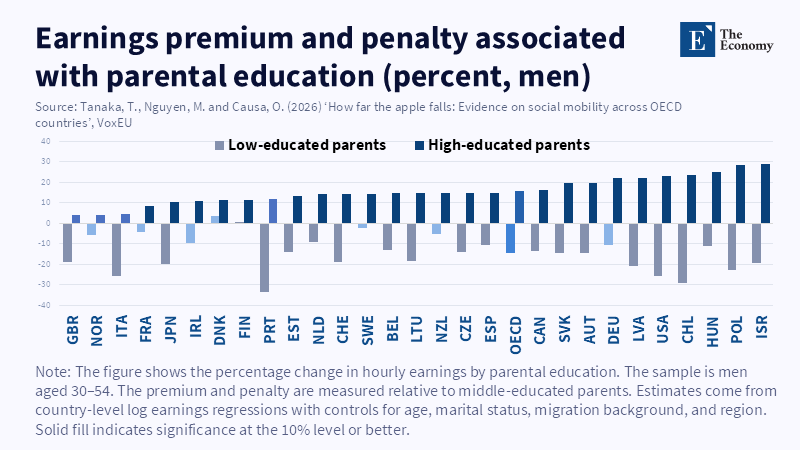
This is where the growth story needs to be rewritten. It is tempting to surmise that high-growth economies are more socially mobile; they have more to share. Sometimes that is true. But OECD data reveal a sobering distortion: Growth is positively associated with competition, openness to entry, and innovation; the more dynamic the economy, the more mobile its social package. To put it simply, social mobility is greater when the economy is open enough to dislodge new firms, new occupations, new ideas, and new status from the shackles of inherited advantage. Growth performing as entry and diffusion is conducive to mobility; growth happening in protected sectors is not. The same rate of change can have quite different implications for social status. Where the market is unfettered, occupations are accessible, and the workforce is integrated, growth can impoverish all or enrich the elite without extending any entree into the economic kitchen.
Social mobility in Latin America was blocked sooner and more abruptly
Latin America reveals the consequences of inequality and weak skill formation further up the chain. The OECD's review of Latin America and the Caribbean in 2025 stated that those in the top decile earn 12 times more than the bottom 10 in Latin America, while that ratio in OECD countries stood at around four. Poverty declined, and inequality temporarily fell over the last twenty years; however, according to the report, that progress has now slowed since the beginning of the 2010s. This is important for social mobility because extreme inequality influences factors throughout people's lives, not only in adult earnings. It influences what children learn, how much risk families are able to take in relation to potential setbacks, and whether early disadvantages become entrenched. Many features have already been embedded by the time there is competition in the labor market. In these systems, education matters, but it does not necessarily do so as a ladder but as a filter.
The skills evidence is, by itself, more obvious. In the four Latin American countries the OECD examines in detail from the first PIAAC round (Chile, Ecuador, Mexico, and Peru), only one in eight adults scored at the higher levels of proficiency (out of a total 44.6% among all OECD countries) and the overwhelming majority of Latin Americans (more than 50%) were classified as having the lowest scores; scores in those countries were well below the OECD average. The report's blunt conclusion: Skill levels are lower. They are closely related to people's social origins. They can be explained by people having lower productivity and increased involuntary participation in the informal sector. This, again, resonates with the existing literature on Latin America. Empirical studies with long-term historical data show us a high degree of persistence in educational attainments across generations of households in the region. The point is not that education is of little value; it is that Latin America has too often failed to preserve the variety of reliable, broad skill bases that can ultimately allow education to serve as mobility instead of inheritance.
Social mobility still flows through education, but education is not enough
Some stark warnings are contained here for education systems, notably those in countries where expansion of access is conceived as a pure mobility strategy. The new OECD work on social mobility across rich countries reminds us that education is still the main way that parental advantage is transmitted. Being born to a highly educated family greatly increases the likelihood of attending a tertiary institution, and decreases the chance of attending one if born to a low- educated family. But the important paper also shows that closing the education gap does not fully close the inherited advantage gap. Parental background, even for those with the same years and type of education, continues to shape economic outcomes. That is a fact that cannot be ignored. It goes to show that social mobility is not guaranteed when a student makes it to university, or earns their first degree, or chooses the high-skills track; family networks, confidence, information, location, or quality of school,to work transitions continue to play a role. Education opens doors, but does not guarantee access.
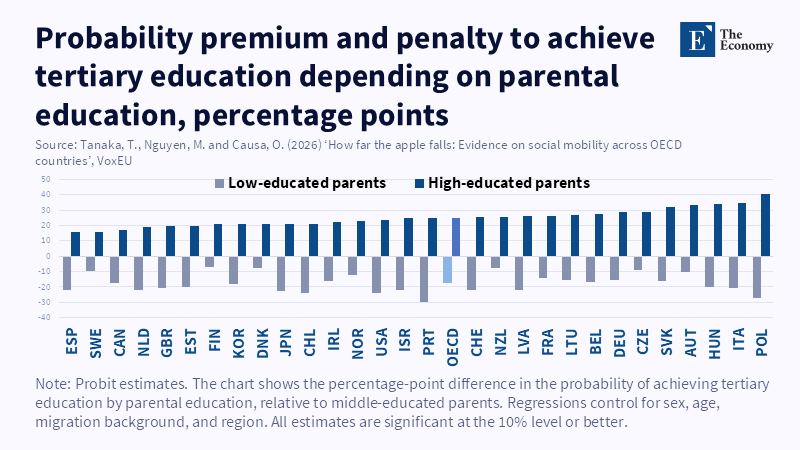
That is why the policy message should be broader than "more education". For teachers, the challenge is not just to get more but to reduce the 'unseen costs of climbing'. Students from poorer homes may require increased advice, clearer pathways into high-return areas of study, and an increased intensity of support as they transition from education into employment. For administrators, the challenge is not just increased participation but successful outcomes: higher skills, more graduates, and more decent employment at equivalent rates for disadvantaged students. For the Minister, this requires supporting early action, smarter investments in schools, intensive mentoring and counseling, and closer links between jobs and education rather than simply trusting the market to effectively sort its way to credit,worthy highs. As the OECD paper notes: "…a well-working schooling system; well-targeted resources in particular communities, and well-functioning transitions from education to work can lessen the influence of the conventional biases of parental background. The bottom rung matters. The upper steps matter less. First jobs matter too. So do advice, networks, and pathways in.
Social mobility and AI may shatter the old compacts
This is perhaps where the next decade will veer off from the last fifty. The old dynamic of mobility relied on education, patience, painstaking effort, and meeting a sufficiently large labor market to equip new entrants. That calculation now appears flimsy. According to the IMF, nearly 40 percent of worldwide jobs are vulnerable to the rise of AI, and that proportion jumps to 60 percent for wealthy countries. The World Economic Forum notes that 40 percent of companies planning to deploy AI intend to downsize them, while planning similar employment growth. The OECD's estimates from looking at broader automation risks suggest that occupations facing the highest risk represent about 27 percent of employment in OECD nations. None of those numbers means that mass unemployment is inevitable. Instead, they illustrate that the old way of thinking about opportunity and mobility may no longer be valid to the same extent. If lower cognitive level jobs disappear, education might still be necessary, but less and less.
The easy answer is that every major technology shock has created new work in the end. That is true, but that is not enough. The biggest policy concern today is no longer whether new jobs will be created somewhere, but whether they will be created quickly enough, in enough places, and with sufficiently open routes of entry to sustain social mobility for broad swathes of the population. While AI might still boost productivity and standards of living, it would also raise the return to capital, intensify the artificial concentration of advantages in always,primed firms and shave off the bottom rungs of lower,middle white,collar ladders that once enabled first,generation white,collar work to take off. The IMF states that advanced economies face a "trilemma" of being more susceptible to AI but better placed to benefit from it, and less well-equipped economies facing a "downward spiral of competitive disadvantage". This presents a chilling scenario whereby, by the end of the decade, the bonus of being a diligent student would depend, to a greater degree, on whether states and institutions keep pathways from education to employment open. Otherwise, even without the welfare, wrecking lag of output growth, social mobility will simply grow narrower.
And let me leave you with that first fact. Because if we still see a 30 percent earnings premium for parental education across much of the OECD, then the social mobility story was never quite as rosy as many claimed. But the OECD implications for Latin America will sound even more stark. High growth and more schooling do not endow equal opportunity. What does it mean whether societies open markets, strengthen skills, provide workable guidance, and foster genuine pathways into formal, upward jobs? Latin America costs a lesson if it does not get going early. The OECD costs a lesson if even wealthy societies are not clear and easy terrain. But AI changes the game. Because it may dampen the number of stable landing points we have always depended on for upward mobility. The straightforward, fair question for the decades ahead is simple. Does our institutional framework increasingly propel ordinary individuals into security and advancement through education? If not, growing affluence will not bring greater fairness, only higher income and narrower doors.
The views expressed in this article are those of the author(s) and do not necessarily reflect the official position of The Economy or its affiliates.
References
Causa, O., Nguyen, M. and Tanaka, T. (2026) Intergenerational social mobility across OECD countries: Does the apple fall far from the tree? OECD Economics Department Working Papers, No. 1858. Paris: OECD Publishing.
Cerutti, E.M., Garcia Pascual, A.I., Kido, Y., Li, L., Melina, G., Tavares, M.M. and Wingender, P. (2025) The Global Impact of AI: Mind the Gap. IMF Working Paper No. 25/76. Washington, DC: International Monetary Fund.
Neidhöfer, G., Ciaschi, M., Gasparini, L. and Serrano, J. (2024) ‘Social mobility and economic development’, Journal of Economic Growth, 29(2), pp. 327–359.
OECD (2023) OECD Employment Outlook 2023: Artificial Intelligence and the Labour Market. Paris: OECD Publishing.
OECD (2024) ‘Competition and market dynamism’. OECD Topics, 1 July.
OECD (2025) Social Mobility and Inequality in Latin America and the Caribbean: Insights from Education and Skills. Paris: OECD Publishing.
Tanaka, T., Nguyen, M. and Causa, O. (2026) ‘How far the apple falls: Evidence on social mobility across OECD countries’, VoxEU, 8 April.
World Economic Forum (2025) The Future of Jobs Report 2025. Geneva: World Economic Forum.