"China Is Expanding, the U.S. Is Depleting": Shifting U.S.-China Missile Balance Raises Uncertainty Across Taiwan Strait

Oliver Griffin is a policy and tech reporter at The Economy, focusing on the intersection of artificial intelligence, government regulation, and macroeconomic strategy. Based in Dublin, Oliver has reported extensively on European Union policy shifts and their ripple effects across global markets. Prior to joining The Economy, he covered technology policy for an international think tank, producing research cited by major institutions, including the OECD and IMF. Oliver studied political economy at Trinity College Dublin and later completed a master’s in data journalism at Columbia University. His reporting blends field interviews with rigorous statistical analysis, offering readers a nuanced understanding of how policy decisions shape industries and everyday lives. Beyond his newsroom work, Oliver contributes op-eds on ethics in AI and has been a guest commentator on BBC World and CNBC Europe.
Authored On
Modified
China Sharpens Missile Production Capacity Amid Aggressive Expansion Drive
U.S. Missile Stocks Depleted by Iran War, Fueling Alarm in Washington
Taiwan Strait Faces Greater Volatility as U.S. Deterrence Comes Under Strain
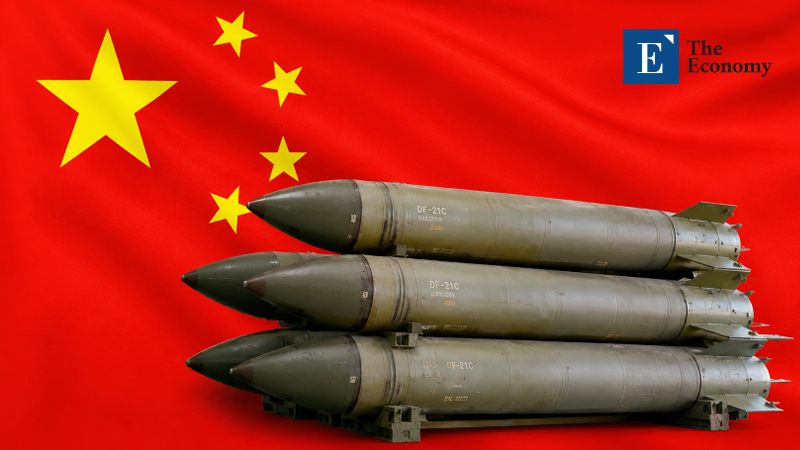
An analysis has found that China’s missile output has expanded sharply, confirming tangible results from Beijing’s years-long push to strengthen production capacity. Experts warn that this trend could pose a critical risk to the United States, which has expended large volumes of missile inventory during the Iran war. As military tensions around the Taiwan Strait continue to intensify, concerns are growing that weakening U.S. deterrence in the Indo-Pacific is exposing a strategic vulnerability.
Acceleration in China’s Missile Force Expansion
Bloomberg reported on the 13th, local time, that China’s missile production last year expanded at the fastest pace since Chinese President Xi Jinping came to power, based on a comprehensive review of disclosures by listed companies involved in China’s missile industry supply chain. To track China’s opaque defense sector, Bloomberg analyzed roughly 400 companies affiliated with China Aerospace Science and Industry Corporation (CASIC) and China Aerospace Science and Technology Corporation (CASC), then identified listed firms directly involved in missile production and core component supply.
According to Bloomberg’s data, the number of Chinese companies producing key missile components more than doubled from 32 in 2013 to 81 last year, with about 40% of them posting their highest revenue since Xi took office. Their combined revenue surged about 20% year on year to $27.8 billion. Bloomberg assessed that the growth reflected large-scale new orders placed by the Chinese government to expand missile production.
China has indeed focused heavily on strengthening its missile production capacity in recent years. A combined analysis of satellite imagery, government documents and map data released last year by CNN and The Business Times found that about 60% of China’s 136 missile-related sites, including missile manufacturing plants, research and testing facilities, and People’s Liberation Army Rocket Force (PLARF) bases, had expanded between 2020 and the time of analysis. Among missile industry facilities linked to the PLARF, 65 of 99 sites grew in scale, while development activity was detected at 22 of 37 PLARF bases. A DF-26 intermediate-range ballistic missile production site near Beijing also expanded its footprint by roughly 50% after 2020.
Warning Lights for U.S. Missile Stockpiles
Experts say China’s moves will place heavy pressure on the United States, which remains locked in military tension with Beijing. The concern stems from the large-scale depletion of U.S. missile stocks during the recent war with Iran. Last month, The Wall Street Journal, citing U.S. government officials, reported that the United States had used more than 1,000 long-range Tomahawk missiles and 1,500 to 2,000 key air-defense missiles, including THAAD, Patriot and Standard missiles, during the Iran war. In a report published the same month, the Center for Strategic and International Studies (CSIS) assessed that “the Iran war depleted 27% of Tomahawks, two-thirds of Patriot interceptors, and 80% of Terminal High Altitude Area Defense (THAAD) interceptors,” adding that “shortages of defensive interceptors are particularly severe.”
The White House denied the reports, saying, “The United States maintains sufficient weapons inventories to carry out the commander-in-chief’s orders anywhere in the world.” Yet actual concern inside the U.S. appears substantial. The U.S. Department of War has recently been urging defense contractors to boost production to secure additional munitions. It has even diverted interceptor missiles originally intended for European countries to replenish domestic stocks. In addition, the U.S. government has asked Congress to include $350 billion for munitions stockpiling in the fiscal 2027 budget.
Washington is also stepping up pressure on China’s missile industry. On the 8th, the U.S. government imposed sanctions on 10 companies and individuals in China, the Middle East and Eastern Europe for allegedly assisting Iran’s military procurement. The Chinese entities are accused of supplying components, raw materials and satellite information needed to produce Iran’s Shahed suicide drones and ballistic missiles. The sanctions took the form of financial and transaction restrictions. The sanctioned companies’ U.S. assets will be frozen, while transactions with U.S. financial institutions and companies, as well as access to dollar payment networks, will be effectively blocked. A foreign affairs expert said, “The latest U.S. sanctions have the effect of pressuring vulnerabilities in China’s missile supply chain, including high-performance semiconductors, aerospace-grade specialty materials, precision optical equipment and satellite sensors,” adding that “the strategy is aimed less at damaging missile manufacturing capacity itself than at raising production costs and inducing supply delays.”
Deepening Confrontation in the Taiwan Strait
These shifts in the missile balance between the two countries could become a decisive variable in reshaping the Taiwan Strait conflict. The Chinese Communist Party has long defined the Republic of China government’s relocation to Taiwan after the 1949 civil war as a continuation of that conflict. Taiwan’s unification is therefore directly tied to the CCP regime’s concept of “territorial integrity.” At the same time, Taiwan is a strategic chokepoint in the contest for maritime dominance. China’s navy is currently constrained to a significant degree within the so-called first island chain connecting Japan, Taiwan and the Philippines. If China gains control over Taiwan, it would be able to break through that constraint, expand naval power into the western Pacific, and fracture the U.S.-led Indo-Pacific containment network.
China has set a goal of completing PLA modernization by 2027 and is increasing direct military pressure by sharply expanding military aircraft and naval activity around the Taiwan Strait. Major institutions have issued successive warnings that “the possibility of conflict in the Taiwan Strait is becoming increasingly real.” CSIS, RAND Corporation and the U.S. Office of Naval Intelligence (ONI) have assessed that China could attempt a blockade of Taiwan or limited military action around 2027. Foreign media outlets including the Financial Times and The Economist have also projected a high likelihood that China could begin gray-zone operations within the next several years, including maritime blockades, cyberattacks and missile coercion.
In response, the United States is accelerating efforts to reinforce bases in Japan, the Philippines and Guam while expanding joint drills with allies. Washington officially recognizes the “One China” policy, yet continues to provide Taiwan with weapons and military support under the Taiwan Relations Act enacted in 1979. Against this tense backdrop, the recent issue of depleted U.S. missile inventories is bound to become a major variable. U.S. deterrence against China has so far effectively rested on ample munitions stockpiling capacity. U.S. security experts believe China could interpret the current situation as a strategic weak point for Washington. Some analysts also expect the United States to order large-scale missile production increases in Japan or seek to expand South Korea’s long-range strike capabilities to preserve its influence in the Indo-Pacific.
Oliver Griffin is a policy and tech reporter at The Economy, focusing on the intersection of artificial intelligence, government regulation, and macroeconomic strategy. Based in Dublin, Oliver has reported extensively on European Union policy shifts and their ripple effects across global markets. Prior to joining The Economy, he covered technology policy for an international think tank, producing research cited by major institutions, including the OECD and IMF. Oliver studied political economy at Trinity College Dublin and later completed a master’s in data journalism at Columbia University. His reporting blends field interviews with rigorous statistical analysis, offering readers a nuanced understanding of how policy decisions shape industries and everyday lives. Beyond his newsroom work, Oliver contributes op-eds on ethics in AI and has been a guest commentator on BBC World and CNBC Europe.
Similar Post