China Industrial Policy Is a System, Not a Subsidy

Working across research, policy, and data-driven analysis, the Editorial Board ensures that published pieces reflect a consistent institutional perspective grounded in quantitative reasoning and long-term structural assessment.
Authored On
Modified
China’s industrial rise is not built on subsidies alone
Its real advantage is the link between factories, finance, schools, labor, and state planning
The West can copy parts of China industrial policy, but not the full national system behind it

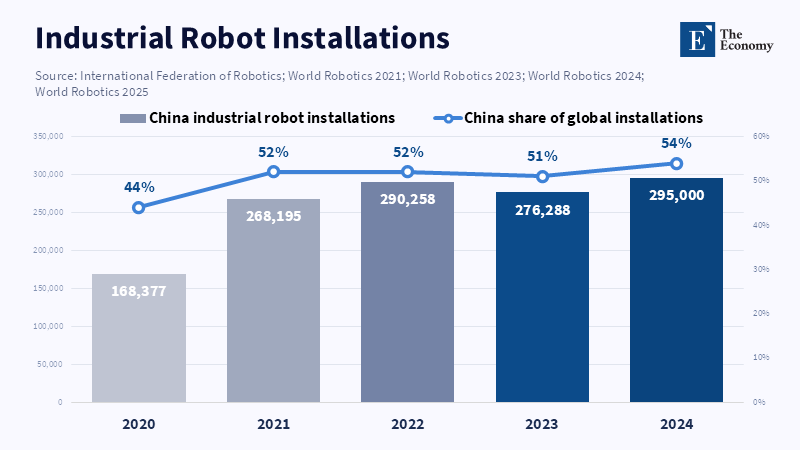
One industrial fact illustrates the narrow frame of China's industrial policy debates. In 2024, factories in China installed 295,000 industrial robots, equal to more than half of new industrial robot installations worldwide. The story is far beyond just "cheap state money." Factories require plants, suppliers, engineers, technicians, electrical networks, local authorities, flexible bankers and training schools that produce skilled workers quickly enough to maintain the system. While subsidies play a role in lowering risks and allowing companies to survive, the real lesson is about China's full social machine of industrial policy. The West may be able to replicate grants, subsidies and strategic business protection. However, the dense national convergence of finance, education, labor, local government and business requirements is hard to replicate.
China's industrial policy isn't merely subsidies
The standard story says that China gained industrial strength from excessive subsidies and subsequently exported low-cost goods to the global market. While not entirely false, this narrative is incomplete. China does indeed support targeted industries through financial aid (grants, tax reductions, low-interest loans), public procurement, land use, incentives at the local level and patient state-linked financial support. Recent studies on official subsidy announcements reveal a significant increase in active Chinese industrial support programs, from 85 in 2001 to 446 in 2022. While the IMF estimate on direct and indirect support for industrial policy places it at approximately 4% of GDP, narrow measurements focusing solely on direct fiscal support fall closer to 0.8% of GDP. This discrepancy highlights that China's industrial policy is not merely a single budgetary line item; rather, it is a multi-layered system where public funds, loans, policy guidelines and local competition interlock.
This leads to the conclusion that the most successful Chinese enterprises cannot be simply regarded as extensions of the state's will. Many are highly competitive, adaptable and innovative. Electric vehicles serve as a prime example: with 21 million units sold globally in 2025 and China's electric car sales surpassing half of all domestic car sales, this achievement isn't the result of direct state intervention in every product's design. Rather, it's a testament to fierce competition among companies based on factors such as price, battery range, software and export potential. The state has provided the playing field and companies have competed, with some faltering and others succeeding due to extended financial backing in less strict market environments. In this way, Chinese companies have been pressured domestically before venturing into the global arena, helping them develop world-leading expertise.
Therefore, the real lesson in industrial policy is a difficult one for both sides of the argument. While critics are correct to point out that protection of strategic industries can distort global markets and allow companies that should have failed to survive due to perceived state support (which reduces borrowing costs and prolongs their existence), the success of such policies is not solely due to subsidies. If low-cost financing were the key, many more countries would have world-class battery, solar, robot, shipbuilding and rail companies; China, however, is the exception. China's industrial policy works where subsidies are combined with efficient production. This middle ground is often overlooked in Western policy debates.
This perspective is particularly relevant as the next phase of industrial competition moves beyond finished goods into the underlying production components, such as minerals, separators, software, testing equipment and recycling for batteries, or sensors, reducers and control systems for robots. Advanced manufacturing is not an isolated sector but rather an interconnected network. China's industrial policy has become powerful because it addresses this network holistically. In contrast, Western policy tends to focus on individual factories, companies, or products for support, a much less encompassing view of modern manufacturing.
China's industrial policy relies on skilled labor
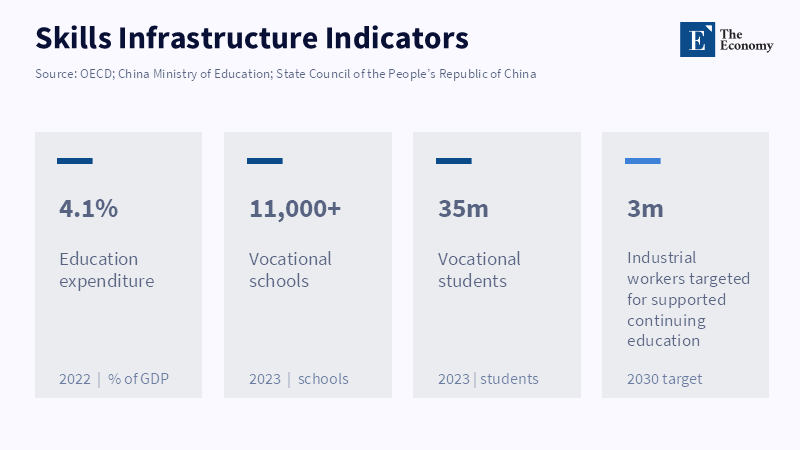
Factories are not solely powered by capital. The smooth operation of machinery depends on skilled workers who can install and maintain equipment, interpret process data, troubleshoot problems and adapt to changes in supplier components. This is where China's industrial policy intersects with education policy. For over a decade, China's national spending on education has remained above 4% of GDP, with over 80% of that spending coming from the state. Although this investment isn't always equitable and gaps between urban and rural areas persist, vocational education still carries a social stigma. Nevertheless, the emphasis on education as a national asset, rather than merely a personal advancement route, is evident.
The connection between school and work is crucial. China has developed the world's largest vocational education system, enrolling over 30 million students and graduating approximately 10 million annually according to recent reports. New reforms aim to foster collaboration between schools, businesses, trade unions, ministries and local authorities for training purposes. One national plan introduced in 2025 intends to provide financial assistance to over 3 million industrial workers for continuing education by 2030, with at least 2 million being migrant workers. It also promotes the establishment of joint training centers by companies and schools. This is not a supplementary element of industrial policy but rather the labor supply chain behind it.
While Western countries have successful models of cooperation between companies and schools, such as the apprenticeship programs in Germany, Austria and Switzerland, or the responsiveness of US community colleges to local businesses and clusters in European regions, these efforts are often limited in scope, localized, or dependent on individual companies. They lack the coordinated national planning that aligns education, credit, procurement and local development with a shared industrial objective. A grant for a battery factory, for example, will have a diminished impact if the local training system cannot produce sufficient technicians, or if migration policies, housing costs and university incentives draw talent away from production jobs.
China's industrial policy is not replicable without social consent
The more fundamental challenge is that China's industrial policy draws on institutions and social arrangements that many Western societies may find unacceptable. China can achieve rapid alignment between public banks, local governments, state firms, private enterprises, universities and vocational schools. It can also impose considerable pressure on the labor force through high work intensity, long hours and flexible job assignments, which in turn helps control costs and scale up operations. These are not just technical factors but are fundamentally social choices. A Western government cannot simply replicate these conditions by passing a subsidy law, nor perhaps should it.
This is not to suggest that China has found an ideal model. The same capacity for rapid resource allocation can lead to inefficient use; local governments compete for similar industries, banks may keep lending to unprofitable firms and strategic labels can shield underperforming companies from market discipline. In such cases, industrial policy can become a barrier to productivity rather than a driver of progress. The warning signs are evident in sectors where production capacity has outpaced demand. When prices fall due to efficiency gains, it is a sign of progress. But when prices decline due to competition between localities, each backing an unprofitable venture, it represents a hidden tax on the system.
The West typically reacts in one of two ineffective ways: either moral outcry, which suggests that since China is cheating we should implement tariffs; or imitation, which suggests that the West needs its own state-industrial policy like China, so we should implement subsidies. In either case, they miss the difficult question. Tariffs may purchase us some time, but they do not create worker pipelines, supplier networks or manufacturing capability; subsidies attract firms, but without social infrastructure they are often only expensive press releases, ribbon-cutting ceremonies, and announcements. Moral outrage that China is cheating, or so some claim, can lead only to tariffs. Tariffs alone can do little to build worker pipelines, supplier networks, or manufacturing competence. Mechanical replication that the West needs an industrial policy of its own means more subsidies. Subsidies divorced from social infrastructure become a high-cost performance: announcing subsidies, celebrating ribbon-cuttings and filing press releases. When the subsidized firms arrive, they lack technicians, permits, transformers, grid connections, willing suppliers and reliable demand; industrial development is not fostered, but fiscal stimulus is generated.
This is also why Chinese industrial policy doesn't travel well. In democracies, voters may favor clean energy, chips, or advanced manufacturing, but they will still ask who will pay, who will benefit and who will bear the disruptive burden. The courts, the unions, local residents, environmental reviews, opposition parties-all impose constraints that slow down policy making. These constraints are inconvenient, but also a source of legitimacy. The goal isn't to eliminate the constraints but to design an industrial policy that can work within them. Western industrial policy must be more transparent, more accountable, and geared towards capability, not rescued firms.
China's industrial policy requires a new test from the West. A better Western response would begin by asking the correct question: Is the social system supporting the sector capable of translating government support into learning? Without suppliers, technical training, localized problem-solving, and export discipline, subsidies will only translate public money into private balance sheets; they will not do what Chinese industrial policy does at its best. The true measure should not be the scale of the subsidy but the quality of the institutional support system that will be built around it.
Technical training must be better linked to the real economy, but without being tied solely to job-specific training. Schools need to cultivate the kind of foundational skills that allow workers to switch between jobs, technologies, and organizations: understanding electronics, data handling, processes, safety, materials, logistics, maintenance, and problem-solving. Administrations must build stable partnerships, not short-term programs. Training centers must be tied to local industrial road maps, updated by business needs, but must remain flexible to promote students' future careers. Priority should be given to the undramatic parts: instructors, equipment, apprenticeships, transportation, housing, certification, and career services. Such resources lack the glamour of a major factory, but they are far more vital.
Trade policy is the other lesson. Western governments should challenge the distortions created by state-backed firms dumping excess production on the global market. But such trade defense must also be complemented with domestic capacity building. Tariffs and duties can buy time, but they will not develop engineers, export controls will not train technicians, and procurement policies will not solve inadequate school-to-work programs. The real struggle involves defending fair competition while rebuilding the social foundation of industry. That will be slower than enacting tariffs or unveiling subsidies but far more effective.
The opening figure captures the real choice. The world's installed factory robots increased by more than half last year, not solely because one government paid subsidies. That expansion occurred because China's industrial policy functions within a broad national system connecting machines, capital, schools, workers, companies, and local ambition. While Western governments should not condone every Chinese subsidy or ignore the negative impacts of the Chinese model, they should not accept that strength in industry can be purchased only by subsidization. The contest for industrial primacy will be won by countries with capable public systems that facilitate and shape production. The question now is not whether government should support industry, but whether governments can develop the social infrastructure that allows support to become leverage.
The views expressed in this article are those of the author(s) and do not necessarily reflect the official position of The Economy or its affiliates.
References
Boullenois, C., Black, M. and Caruso, A. (2026) China’s Next-Generation Industrial Policy. New York: Rhodium Group.
DiPippo, G., Mazzocco, I., Kennedy, S. and Goodman, M.P. (2022) Red Ink: Estimating Chinese Industrial Policy Spending in Comparative Perspective. Washington, DC: Center for Strategic and International Studies.
East Asia Forum Editorial Board (2026) ‘Learning the right lessons from China’s industrial policy’, East Asia Forum, 11 May.
García-Herrero, A. (2026) ‘What the world can and can’t learn from China’s industrial policy’, East Asia Forum, 10 May.
Garcia-Macia, D., Kothari, S. and Tao, Y. (2025) ‘Industrial Policy in China: Quantification and Impact on Misallocation’, IMF Working Paper, No. 2025/155. Washington, DC: International Monetary Fund.
International Energy Agency (2025) Global EV Outlook 2025. Paris: International Energy Agency.
International Energy Agency (2026) Global Energy Review 2026. Paris: International Energy Agency.
International Federation of Robotics (2025) World Robotics 2025 Report: Industrial Robots. Frankfurt: International Federation of Robotics.
Lu, W. (2025) ‘“No Less Than 4%”: A Policy Review of China’s Fiscal Spending on Education, 2000–2020’, ECNU Review of Education, 8(3).
McGowan, E. (2026) ‘The Impact of Chinese Industrial Subsidies on Global Competition’, The Economy, 8 January.
Xiang, S., Yin, X. and Zi, Y. (2025) ‘Two Decades of Chinese Industry Subsidies’, IHEID Working Papers, No. 18-2025. Geneva: Graduate Institute of International and Development Studies.
Zhu, J., Yang, J., Ma, C. and Yan, Y. (2025) ‘The Evolution of China’s Vocational Education Policy With Regard to the Integration of Industry and Education: A Combined LDA and Word2vec Approach’, SAGE Open.
Working across research, policy, and data-driven analysis, the Editorial Board ensures that published pieces reflect a consistent institutional perspective grounded in quantitative reasoning and long-term structural assessment.