China’s Ethnic Unity Law and the New Admissions Question

Working across research, policy, and data-driven analysis, the Editorial Board ensures that published pieces reflect a consistent institutional perspective grounded in quantitative reasoning and long-term structural assessment.
Authored On
Modified
China’s ethnic unity law shifts fairness toward shared national rules
The U.S. affirmative-action debate follows a different path, shaped by race and historic inequality
Both systems must balance equal access with dignity, identity, and real disadvantage

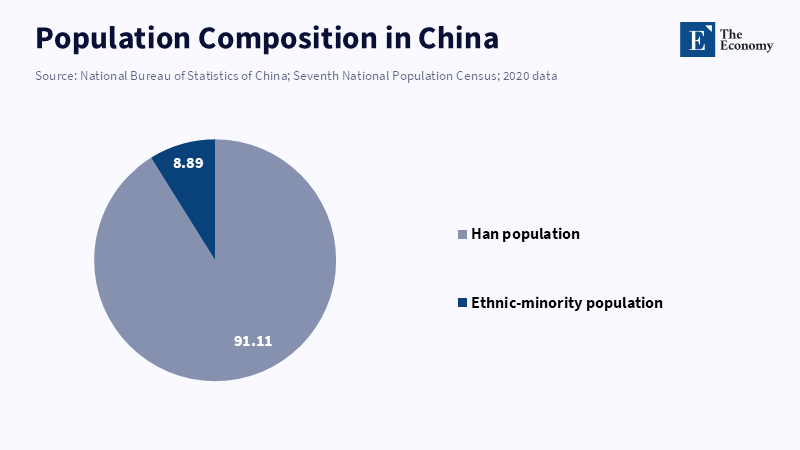
China now has 125.5 million people counted as official minorities. That is almost nine percent of all people in China. And it's larger than the populations of most countries in the world. So it is impossible to read the ethnic unity law as only a narrow border law, or as a rule for a few distant schools. Instead, the ethnic unity law is really an education law, in all but the title. It decides what language leads the classroom. It dictates to families what kind of national feelings should be transmitted. It demands that universities, in deciding future admission, shift the priority from general ethnic status to a uniform, shared national identity. The central question is not if China and America are debating equality (they both are). It is also important to know why they are taking two opposite ways of approaching it. China is heading toward one unified system in which minority status has less formal weight, and the U.S. continues to debate whether history is to inform access in an ordered society founded on a framework of racial conflict.
The ethnic unity law redefines equality
The ethnic unity law marks a turning point in Chinese policy. The law upholds the official claim that all ethnic minorities are equal, while at the same time, it reinforces the obligation for all schools, officials, families and public institutions to establish and promote a single national identity of the Chinese people. Its main function regarding education is to define language. Schools in China are being asked to make Mandarin, the national common language and common script, the principal medium of instruction. Mandarin is also being promoted aggressively at the preschool level. Official signs and notices may still include minority languages, but the signs will be ordered as follows: the national language first, followed by the minority language, where both exist.
Proponents can argue that it is about equal treatment. A shared language can resolve tangible barriers that prevent minority students from Tibet, Xinjiang, Inner Mongolia, Guangxi, or Yunnan from crossing their home provinces and competing in national markets and national universities. The argument is valid. The ability to use a national language has tangible benefits and students should not be restricted to poorly developed local schools while the major part of the economy is driven in a different language. However, critics are concerned that the ethnic unity law could reduce equal opportunity by narrowing cultural identity. The issue is not the language itself. It is whether Mandarin acts as a tool that can elevate minority students or a barrier that denies them entry. Ladder enables new abilities without sacrificing existing identities, while barrier does nothing but label minority languages, religions and histories as problematic and needing correction. Thus, education policy starts shifting towards an identity policy.
Timing is a crucial factor, especially because China has already started decreasing special privileges to minorities in admissions. For years, certain minorities have been granted bonus points on the gaokao (national college entrance examination), intended as an attempt to redress perceived inequities from disparities in school quality, remote geography and historical disparities. But the policies have been controversial and unpopular when they were seen as primarily tied to ethnicity. Several provinces have recently rescinded or reduced general minority bonus points. Only minority students from more remote, pastoral areas are being given narrower privileges, or they are being phased out altogether. The trend is clear: a decrease in automated ethnic preferences, a more precise focus and an increase in shared rules. The ethnic unity law simply tells this trend in a national narrative, that the nation should move toward a single national identity from its diversity.
The ethnic unity law and America's affirmative-action conflict
This is where a comparison with the United States helps. America follows a unique moral and judicial trajectory. Its affirmative-action policy has roots in the history of slavery, racial segregation, exclusion and the subsequent efforts to enroll diverse students in prestigious universities. Race-conscious admissions were justified as being necessary to establish a diverse learning community, to fulfill old promises. But the Supreme Court's ruling in 2023 prohibits direct consideration of race in admission decisions at institutions like Harvard and the University of North Carolina. However, this decision does not resolve social conflict. It only takes away direct racial admissions. Schools still allow students to share their individual experiences of discrimination, poverty, disadvantaged neighborhoods, poor schools and other forms of adversity. The conflict is shifting from explicit ethnic-based preferences to indirect preferences that account for disadvantages.
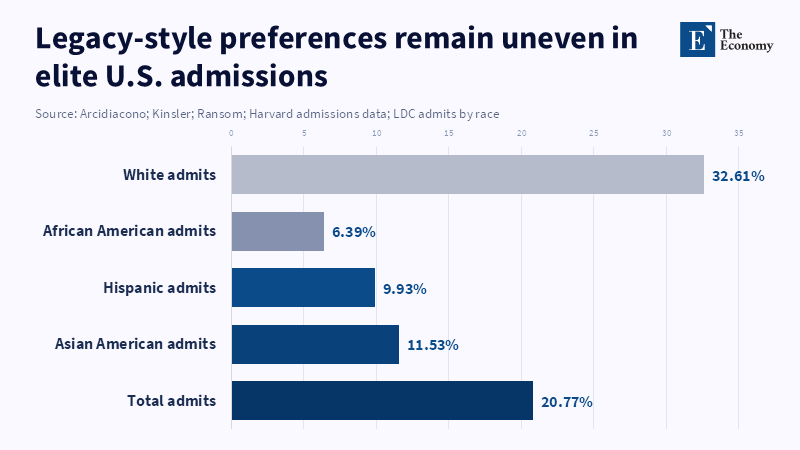
The second major reason behind American opposition is a sense of injustice that has been raised by certain Asian-American families. These parents complained that the race-based admissions at elite schools harmed their children; while others argue that the use of Asian Americans as an ideological weapon was intended to divide and weaken the black and Latino communities, while more connected and richer applicants maintained quiet advantages. Both viewpoints point to a trust problem. A rejected student might see her application failure as proof of an unfair admissions process if the admissions seem to work based on some unspoken deals between racial groups. Data on elite admissions have shown that legacy, donor status, athletic preferences and child of staff benefits significantly increase the admission rate for many white students. One study of Harvard admissions found that more than 43% of admitted white students were athletes, legacies, dean 's-interest-list applicants, or children of faculty and staff, compared with less than 16% of admitted Black, Hispanic, and Asian American students. It is not equitable in terms of race.
Therefore, China and the United States are not just comparing "equal China" and "unequal America," or vice versa. They are taking two different approaches and risking distinct consequences. China is trying to reduce minority identities' salience by emphasizing the role of one dominant national identity in schooling and in public life. After the Supreme Court ruling, America is still attempting to reduce racial preferences in admissions while confronting systemic inequality in schools, wealth disparity and enduring racial tensions. China's risk is cultural erosion; America's risk is continued denial. Cultural erosion means minority students are offered access to a central place in exchange for losing their uniqueness; denial suggests that a race-neutral policy is fair when the channels through which people enter a university remain unequal.
Admissions cannot be fair based on simple identity alone
The ethnic unity law demands that what admission fairness ought to measure be rigorously scrutinized. If a minority student from an urban school receives a bonus point just for her ethnic background, it is quite vulnerable to attacks: it would appear to be unfair to Han students from impoverished inland provinces or to other candidates with weaker school resources. However, a student from an underdeveloped border region may well warrant a bonus because their schools are underdeveloped and the local language access and income level are low. This is not ethnic favor. It is needs-based redress. China's own reforms in gaokao have seemed to reflect this awareness. In several provinces, the use of blanket identity-based bonuses has been gradually replaced by smaller, more specific bonuses that are awarded based on location and area rather than on identity, as it aims to compensate for actual disparities in schooling quality and economic opportunities. This reform could truly represent a positive change if the intention is to serve students who are disadvantaged by a lack of opportunity.
But this better formula does not fix the more fundamental language issue. A school system can get rid of ethnic points and still be unfair if it undermines the student's first language before providing fluency in Mandarin. It can claim impartial rules, while already placing the runners at uneven starts. The right standard should be simple: teach Mandarin effectively because it's the working tool of the nation; protect other languages because they are neither private obsessions, nor merely dialects of thought, but ways of family and locality. When students graduate as competent Mandarin speakers while still in command of other languages, the system has enlarged them. If they graduate as proficient in Mandarin but estranged from their grandmothers, local literature and traditions, religious and cultural, it has shrunk them for the sake of progress.
The US faces the flip side of the issue: Having abandoned overt race-based preferences, universities can’t pretend each candidate is competing on an equal individual basis. That sounds neat, but it often hides inherited advantages. A more equitable approach would bring hidden advantages into view, assessing how much privilege is carried by legacies, private-school backgrounds, private sports, unpaid internships, test prep courses and networks of recommendations and critically, by a race-neutral approach to admissions. A California-based study found that ending racial preferences led to the "balkanization of the state's university system," as many qualified minority students enrolled in less-prestigious colleges and ended up with lower earnings than if they had been admitted. Formal neutrality failed to overcome the inequality of preparation.
Fairness starts before admissions
The ethnic unity law demands a better policy test. To educators, it means evaluating equity not just at admission but from preschool language choices to teacher quality, curriculum and parental support. Under the law, schools should support Chinese education while ensuring students do not learn that their home languages are a liability; they should be multilingual and use locally produced educational materials and results must be tracked by region, institution type and students' language backgrounds. Dropout rates and students' mental health must also be monitored, as should family trust and university completion. In the end, the success of a national Mandarin policy should be measured not just by test scores, but by the cultural pride of the next generation. Similarly, support for minority languages, unless tangible and concrete, cannot form a substantial basis for equal citizenship.
The US is similarly tasked with creating a non-race-based admissions system that doesn’t disadvantage disadvantaged students. This means looking at income, neighborhood, school poverty and first-generation status, among other factors and challenging preferences that solely serve wealth while claiming to advance merit. While critics of affirmative action are often right to call for standards that treat everyone equally, they ignore the fact that opportunity and standards are not the same. Admissions must acknowledge each applicant's background and what they've had to overcome. Elite universities must demonstrate that their definitions of merit are not merely reflective of privilege.
The ultimate question is what new frame of fairness, beyond race, do we need in both countries? Labels can be clumsy. They may remedy historic wrongs but risk further exclusion if they remain long after their expiration date, or if they do not identify the truly disadvantaged. Absolute neutrality may seem just, but it can allow old power structures to persist when pathways to advancement already favor some. A good policy, China's or the US's, should aim to identify a real barrier to opportunity, nurture the student’s sense of dignity and selfhood and maintain transparency with publicly verifiable outcomes and clear processes for reevaluation. While the Chinese law addresses the barrier of linguistic assimilation, it remains unclear if it meets the second criterion. The post-affirmative action US model addresses the political anger generated by racial preferences, but it's not clear whether it can address the disadvantage that has long been rooted in socio-economic status.
The opening number matters again. The 125.5 million minority citizens of China should not be treated as an appendix to a national educational system, but as an education system within the education system. The ethnic unity law could decrease one type of resentment in the admission process, should racial preferences and broad incentives diminish and be replaced with precise support. Conversely, it could widen the loss if "equality" means loss of cultural capital. The US's ending of affirmative action may be decreasing racial sorting, but the persistence of wealth- and legacy-based preferences means the ghost of race is likely doing the same work in the shadows. Judgment should be cautious and be wary of any solution without transparency and nuance. The task ahead for both nations is to craft both admissions and language policies that acknowledge and actively respond to real barriers in education, supported by public data and respect for individual humanity. Justice is not eternal preference. It’s also not erasing people.
The views expressed in this article are those of the author(s) and do not necessarily reflect the official position of The Economy or its affiliates.
References
Arcidiacono, P., Kinsler, J. and Ransom, T. (2022) ‘Legacy and athlete preferences at Harvard’, Journal of Labor Economics, 40(1), pp. 133–156.
BBC News (2026) ‘China approves “ethnic unity” law requiring minorities to learn Mandarin’, BBC News, 12 March.
Bicker, L. (2026) ‘China approves “ethnic unity” law requiring minorities to learn Mandarin’, BBC News, 12 March.
Bleemer, Z. (2022) ‘Affirmative action, mismatch, and economic mobility after California’s Proposition 209’, The Quarterly Journal of Economics, 137(1), pp. 115–160.
China Law Translate (2026) ‘Ethnic Unity and Progress Law’, China Law Translate, 12 March.
Dirks, S. (2023) ‘Affirmative action divided Asian Americans and other people of color. Here’s how’, NPR, 2 July.
Minzner, C. (2026) ‘China’s New Ethnic Unity Law: From Autonomy to Assimilation’, Council on Foreign Relations, 26 March.
National Bureau of Statistics of China (2021) Communiqué of the Seventh National Population Census. Beijing: National Bureau of Statistics of China.
Philip, L.K. (2023) ‘How Asian Americans got wrapped up in the affirmative action debate — and why many want out’, WBEZ/NPR Illinois, 7 June.
Reuters (2026) ‘China passes new ethnic minority law, prioritises use of Mandarin language’, Reuters, 12 March.
Spivey, B. (2026) ‘China’s new ethnic unity law codifies its assimilationist shift’, East Asia Forum, 11 May.
Students for Fair Admissions, Inc. v. President and Fellows of Harvard College (2023) 600 U.S. 181.
The Editors (2026) ‘Ending Racial Bias in Admissions’, National Review, 11 May.
Yuan, J. and Zhang, A. (2025) ‘The imperial examination and the college entrance examination from the perspective of affirmative action: assistance to disadvantaged examinees in China’, Humanities and Social Sciences Communications, 12, Article 1053.
Zhao, Y. (2024) ‘Additional points policy gets tougher’, China Daily, 21 May.
Working across research, policy, and data-driven analysis, the Editorial Board ensures that published pieces reflect a consistent institutional perspective grounded in quantitative reasoning and long-term structural assessment.