Completed Semiconductor Bet by Arm Targets PC CPU Market Dominated by Intel and AMD Through Nvidia Alliance

As one of the youngest members of the team, Tyler Hansbrough is a rising star in financial journalism. His fresh perspective and analytical approach bring a modern edge to business reporting. Whether he’s covering stock market trends or dissecting corporate earnings, his sharp insights resonate with the new generation of investors.
Authored On
Modified
Arm focuses on finished-chip business with unprecedented compensation package
Challenge extends to PC market long dominated by x86 architecture, with Nvidia partnership in place
Market-share race led by Intel and AMD faces potential upheaval from Arm camp offensive

British semiconductor intellectual property company Arm is strengthening its push into the fabless business of directly designing and selling finished semiconductors. As the artificial intelligence supercycle continues, the company is making aggressive bets to capture higher-value markets. Arm is also entering the PC market through partnerships with Nvidia, Microsoft and others, mounting a challenge to the existing competitive order built around x86 architecture.
Arm’s Business Expansion Strategy
According to The Guardian, which cited U.S. Securities and Exchange Commission documents it obtained on May 31, Arm is pursuing a structural shift that adds a finished-chip product business to its traditional licensing-centered model. The strategy is to maintain its semiconductor IP business while adding a proprietary chip lineup to target the high-value AI data-center semiconductor market. Intel Chief Executive Rene Haas reportedly presented a plan to increase the company’s revenue more than fivefold through this transition.
Arm’s board, in line with that strategy, proposed one of the largest performance-based compensation packages in British corporate history for Haas. Under the plan, Haas would receive stock awards worth up to $800 million if Arm reaches a market capitalization of $1 trillion by 2029 and surpasses $2 trillion by March 2031. The package represents a high-risk, high-reward incentive structure premised on the continuation of the AI supercycle. The bold bet is widely seen as reflecting internal confidence in the business. At its earnings presentation last month, Arm projected combined 2027–2028 revenue from its self-developed AI chips at $2 billion, nearly double the forecast presented in March.
A key variable, however, is that U.S. regulators have begun scrutinizing Arm’s moves. Bloomberg reported last month that the U.S. Federal Trade Commission had opened an antitrust investigation into Arm’s semiconductor technology licensing practices. The FTC reportedly notified Arm of the probe earlier this year and requested preservation of relevant documents. Such document-preservation orders are typically evidence-gathering steps taken ahead of a full investigation. Regulators are expected to focus on whether Arm restricted access to central processing unit design technology or provided it on discriminatory terms to certain customers.
The FTC probe originated with complaints from Qualcomm. In 2024, Qualcomm asked the FTC and other major regulators to investigate Arm, alleging that the company blocked semiconductor firms’ access to core technologies and arbitrarily changed licensing policies in ways that undermined competition. The dispute between the two companies, triggered by Qualcomm’s 2021 acquisition of CPU design firm Nuvia, has shown little sign of resolution. Arm has claimed Qualcomm used Nuvia’s Arm license without proper approval, but a U.S. federal court in Delaware last year ruled in Qualcomm’s favor on key issues. Arm is currently appealing the decision and argues that Qualcomm’s FTC complaint is merely an attempt to gain leverage in a commercial dispute.
Full-Scale Supply of PC CPU Technology
Arm is also attempting to expand its position on multiple fronts beyond its own chip development. The PC market is a prime example. According to reports by Axios, Reuters and other outlets on May 30, Nvidia and Microsoft are expected to unveil Windows PCs powered by Nvidia chips at Computex 2026 in Taipei this month and at Microsoft’s Build developer conference. Axios, citing sources, said Nvidia chip-based PCs are expected to be included in Microsoft’s Surface lineup and products from major manufacturers such as Dell.
Nvidia has reportedly been designing CPUs using Arm technology to run Microsoft’s Windows operating system, with the chips expected to take the form of a system-on-chip integrating an Arm-based CPU and Nvidia graphics processing unit. Arm architecture, long used mainly in smartphones, is now beginning to expand its influence in the PC market in earnest. Industry observers say this shift could allow the Arm camp to intensify its offensive against the PC market long anchored in x86 architecture.
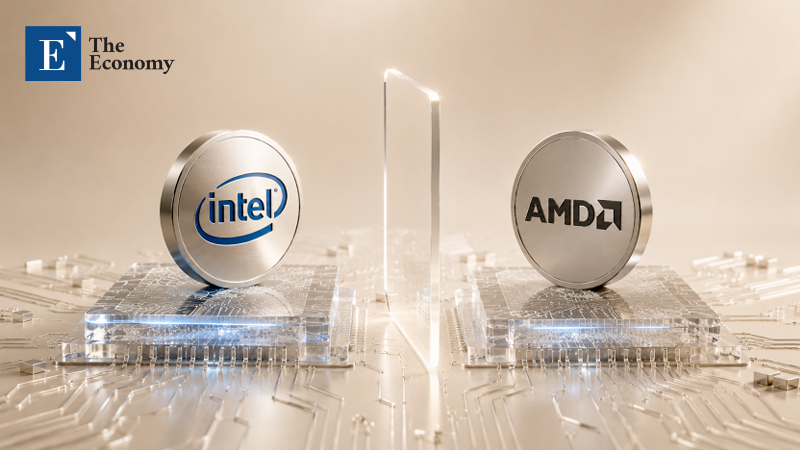
x86 is an instruction set architecture developed by Intel and has served for decades as the foundation of the PC industry alongside the Windows operating system. At present, most major programs, including enterprise applications, productivity software and games, are optimized for the x86 environment, while leading PC manufacturers such as Dell, HP and Lenovo continue to build their lineups largely around x86-based products. Intel and AMD are the representative companies that have led the market on the strength of this ecosystem. Intel has long reigned as the dominant force in PC processors, while AMD has been rapidly expanding its share with its Ryzen series and server products.
Potential Upheaval in the CPU Competitive Order
The existing CPU market has also been shaped primarily around Intel and AMD. AMD’s rapid pursuit of Intel has gradually altered the market landscape. According to market researcher Mercury Research last month, AMD’s revenue share in server x86 CPUs reached 46.2% in the first quarter of this year. That marked an increase of 6.8 percentage points from a year earlier and 4.9 percentage points from the previous quarter, setting a quarterly record. AMD’s presence has become more pronounced as cloud and enterprise customers increasingly adopt its Epyc server CPU lineup. Its Instinct server GPU lineup is also helping drive demand growth for AI-related server products.
During the same period, AMD’s revenue share in consumer x86 CPUs reached 31.4%, up 4.8 percentage points from a year earlier and 0.2 percentage point from the previous quarter. Its overall CPU revenue share, including server and consumer segments, rose to 38.1%, up 6.5 percentage points year on year. Intel, pressured by AMD’s rapid growth, is seeking opportunities to strengthen its position by leveraging the deeply embedded Xeon ecosystem across large enterprise, public-sector, telecom and financial data centers. Its strategy is to restore its in-house manufacturing base and combine it with its existing ecosystem to cement its role as a core pillar of the U.S. data-center supply chain.
The rapid growth of the Arm camp could significantly unsettle this structure. Competition is expanding from “Intel versus AMD” to “the x86 camp versus the Arm-based AI infrastructure camp.” An industry expert said, “As the Arm camp has recently made major improvements in software compatibility within the Windows environment, the CPU market landscape is changing rapidly. If the perception spreads that Arm-based chips can run reliably in both PC and server markets, Arm could bring an even greater shift to the market than AMD once did when it eroded Intel’s market share.” The expert added, “AI data centers are growing rapidly, and power efficiency has emerged as a core competitive factor in the CPU market. If Arm-based processors, whose strengths lie in low power consumption and high efficiency, begin attracting serious attention, AMD, now positioned as a challenger, could itself end up being pursued.”
As one of the youngest members of the team, Tyler Hansbrough is a rising star in financial journalism. His fresh perspective and analytical approach bring a modern edge to business reporting. Whether he’s covering stock market trends or dissecting corporate earnings, his sharp insights resonate with the new generation of investors.
Similar Post