EU Defence Strategy After America’s Discount

Working across research, policy, and data-driven analysis, the Editorial Board ensures that published pieces reflect a consistent institutional perspective grounded in quantitative reasoning and long-term structural assessment.
Authored On
Modified
Europe can pay more for defence
But money without strategy will fail
Europe needs deterrence, not waste
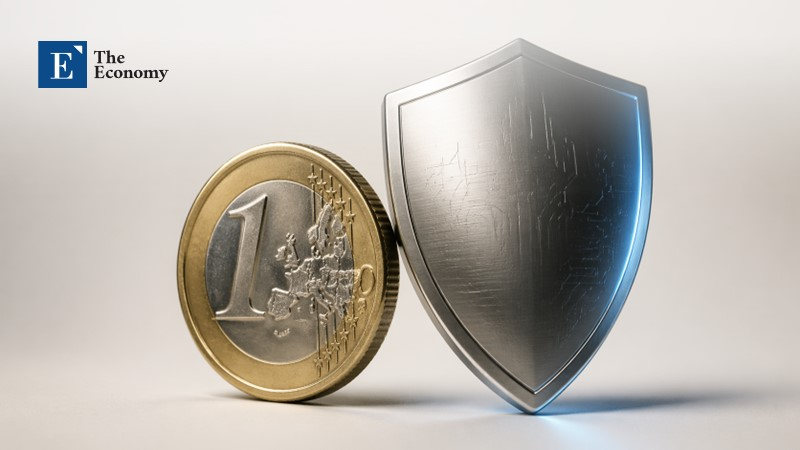
In 2025, EU states are likely to allocate more (on average) just under 1 billion dollars in defense expenditure than Russia (averaging just under 600 million dollars in 2024). Europe's economy is around 19.5 trillion dollars (compared to around 2.17 trillion for Russia); looking at these stats, there could really be no argument about who can afford what. Europe indeed has the economy and the wealth to afford the money and the responsibility for its own security; however, it is really not a question of simply throwing money at the problem. The problem is how the Europeans buy, plan and deploy their military capability. EU defense strategy cannot be implemented without a clear budget; but instead, if the budget is dealt with as a scale, a design and a political discipline, then there is a glimmer of hope. Europe could afford to spend more on defending itself against Russia; however, it could not afford to overspend, to do it without planning, or to leave it for too long to prepare.
The Case for an EU defense strategy is also based on a defined spending
One must be careful not to assume that an increased budget necessarily indicates a good European security strategy. In many respects, Europe is already making a great effort. The EU spent $343 billion on defense in 2024 and will be spending $381 billion in 2025, representing roughly 2.1 percent of its GDP. However, while this is a notable achievement in a short space of time, Russia has not calculated for peace: only for war. The SIPRI figures have Russia spending 7.1 percent of GDP in 2024 and the IISS foresaw this changing to 7.5 percent of GDP by 2025. At a purchasing power parity, however, the IISS draws attention to the fact that the scale of Russia's effort looks very different; any European defense strategy must not just consider figures but production, stockpiles, repair facilities, as well as command infrastructure.
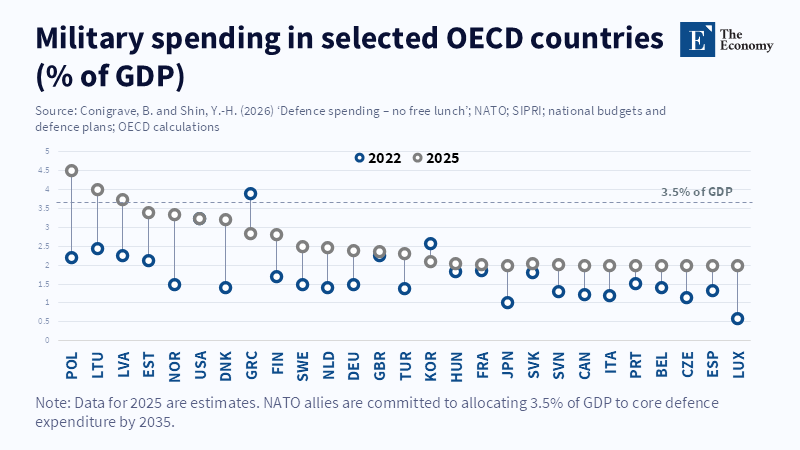
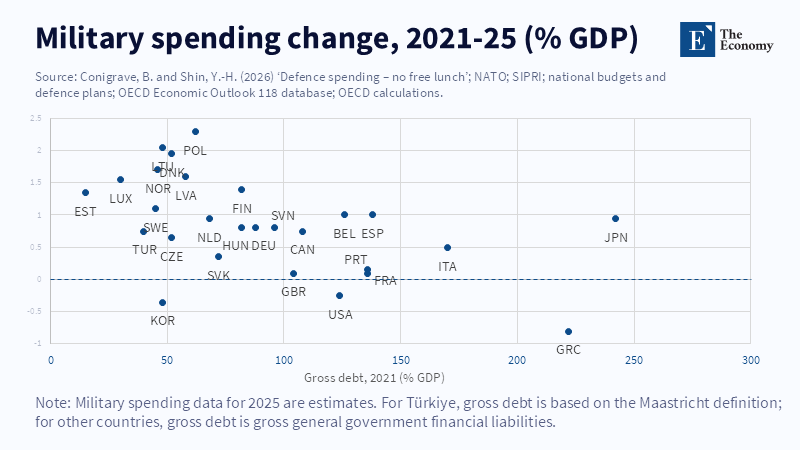
The second is that money will somehow flow into the system magically. It won't, the 2009 OECD report on the possible short-term economic boost from higher defense spending will also add to the fiscal strains faced by the government, leaving a choice of either increased taxes or cuts in non-defense expenditure. This point is made by the IMF projections of euro area government expenditure pressures from pension and interest payments, the green transition in combating climate change, energy security and defense. The projection is that by 2050, the annual expenditure pressure will be 4.4% of GDP. Even for the euro area excluding Germany it is will balloon from 99% of GDP to 102%of GDP by 2030.this does not mean that Europe should restrict itself from spending on defense, but it does point to a need for realistic priorities to be set, rather than dream time aspirations so that expenditure is not focused on status acquisitions, but on ammunition, air defense, drone and scalable capabilities, logistics and reach.
This brings us to our third mistake of viewing fragmented national mechanisms for acquisition and development, often identified as sovereignty, as a realistic and practical solution. This is, however, the crux of Europe's industry- the consequences for Europe of insecurity: fragmentation leads to small orders, to duplication and to slow system delivery. Europe appears independent but is in fact dependent and it has to be about identifying structural strengths and weaknesses and making money go further and about economies of scale, standardization and longer-term binding commitments in the production process.
Using Japan and South Korea to illustrate the case for an EU security strategy
It is valid to compare Europe to Japan and South Korea, as the U.S. Alliance paradigm has been put on the burden-sharing issue, especially during Trump's presidency. This topic is reflected also in the 2025 U.S. National Security Strategy, which requires from Japan and South Korea to increase their investments in defense; but, this should not be interpreted as the U.S. state's awareness of the cost, but as the alliance based on shared strategic interests, as Japan and South Korea have understood since long ago: according to some reports, for instance, Japan is to spend $211 billion over 2022-2026 in host nation support, this sums up to $226.8 billion for the FY2025, Japan has budgeted $8.475 trillion for the ongoing defense build up, while South Korea's new Special Measures Agreement with U.S. for the 2026-2030, has the same country committed to about $1.19 billion in 2026.
Europe cannot mirror the strategies of all these Asian states precisely, as their strategic interests, geographies and institutions are different. Europe needs to learn from its examples where its strategy is separated from politics; they both spend a lot on defense, they are both the host nation and they both still see their alliance relations as the basis of their deterrence strategies. They do not think that an increase in spending will free them of America's patronage and do not see their current 'gradual' dependency as an indefinite state of affairs by making alliance management part of their national strategies. Europe needs to mirror these examples. If the U.S. feels it is unfairly shouldering the burden of Russia, Europe needs to do its share to shift the situation, but not by double numbers.
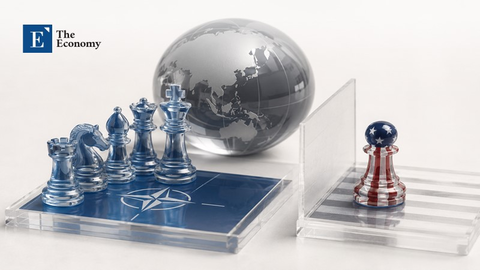
Having a weak EU defense strategy would mean that Europe is actually faced with a Hobson's choice: either remain dependent on the U.S. or try to go all the way toward autonomy. In the first scenario, you are at the mercy of U.S. politics, while in the second, you are wasting resources trying to duplicate what has been done by NATO. The best path for the EU to take would be a strategy of partial autonomy within a strong alliance: Europe should shoulder most of the burden for the conventional component of its defense (ground forces, stockpiles, air defenses, transportation, manufacturing) but should also remain linked to U.S. expertise and enablers (intelligence, airlifting capacity, nuclear), not as a weakness, but as a wise strategic choice.
A realistic EU defense approach to Russia
The stakes are extraordinary and time is not on Europe's side. In 2025, the IISS warned that, absent a U.S. Presence on the continent, Russia could pose a real danger to NATO allies in the Baltic states by 2027 following a halt-fire. This, according to IISS, would require Europe, with a population of 470 million, to backfill up to 128,000 US forces through a wide NATO undertaking at a 25-year cost of 1 trillion dollars and would take place in a bit less than a quarter century of European lifecycles. These numbers are profound, but need to be read not as Europe will fail without the U.S., but just as a rapid replacement is unachievable, and Europe should determine to do well by 2030 rather than fall for the mirage of instant not needing the U.S.
That means picking off those domains with the potential to deliver rapid deterrence first. Readiness 2030 and the European Commission’s SAFE program are crucial as they are pushing the EU system towards joint demand, joint financing and joint production. The SAFE program, for example, offers a 150 billion euro loan facility to promote joint defense projects. The new European Defense Industry Program, endorsed by the European Parliament in 2025, which has a 1.5 billion euro budget in 2027 for defense projects designed to support joint purchase and higher European content requirements, is a step in the right direction. But they are not enough, given the size of the problem. A real EU defense strategy would push joint procurement from a crisis response measure to normal European arms procurement practice in everything from shells and missiles to drones and air defense systems to secure communications and replacement parts. Big budgets are no good if long-term contracts are not in place. Industry cannot put new production lines in place on an adrenaline spike.
A broad approach would also pool support for Ukraine into a European defense budget as opposed to setting it aside as a separate issue. This is also where "not charity but strategy" applies. Each Russian unit bogged down, shot out, or effectively neutralized in Ukraine is one less Russian unit waiting in the wings to depend on in order to deter in NATO territory. Europe is already catching on. While EU arms contributions to Ukraine skyrocketed in 2025, the Kiel Institute notes that total commitments remain below annual averages in recent years, partly due to a full US drawdown. It is extraordinarily cheap for Europe to deter Russia, compared to rearming itself on its own territory after a war with Moscow. With Ukraine, Europe is already taking steps to rectify this situation, enabling itself to inflict costs on Russia by supporting Kyiv's war effort, while building up its own forces through accumulated years, boosted supplies and increased military coordination.
Financing such a strategy would demand more than lip service. The initial costs could be partially financed through borrowing, especially in an environment where national debt levels are low and the EU fiscal stance is expanding, but loaning could not be the long-term EU defense paradigm. What is needed is a burden-sharing agreement not only between the EU and the US, but among the EU member states. The Eastern European countries should not be expected to pay the entire price of continental deterrence. The most developed EU economies with large capital markets and in particular Germany and France, must shoulder a greater share of the costs of capital-intensive buildup, procurement and maintaining long-term forces. Poland is demonstrating the sense of urgency that is needed, but not all EU members have this ability. A push for joint borrowing for well-defined public good defense goods, joint procurement within agreed-upon standards and a more critical approach toward redundant and low-value national programs would serve both as an effective and equitable measure of burden-sharing. It would recognize that personnel training and preparation and depth of reserve forces are part of the equation and not inconsequential sideshows, once final decisions about hardware procurement are made. This does not mean every defense decision needs to be made in Brussels, but it does mean ending 27 Treasury Departments trying to solve the same national security problem in 27 different ways.
Hence, the EU strategy for defense needs to be order-based, rather than theater-based. The first remains true: Europe is sufficiently wealthy to be able to spend more. The second is not yet proven: will Europe be able to spend in a way that will buy it time, unity and credibility? Japan and Korea are already showing the potential of security cooperation and alliance partnership offsetting each other, while Russia is an effective case-study of what it means to budget peace as a constant discount. The US is now showing that it will sustain protection at an ever-increasing cost. Europe should then make a deal: higher national outlays, increased joint procurement, enhanced aid to Ukraine, more strategic industrial planning and, above all, fewer illusions. With this, Europe will accomplish what it needs most: a real EU strategy for defense that will prevail on Russia and will allow it to express and share with a partner that Europe can live with, markets and alliance dynamics accordingly.
The views expressed in this article are those of the author(s) and do not necessarily reflect the official position of The Economy or its affiliates.
References
Barry, B., Barrie, D., Boyd, H., Childs, N., Gjerstad, M., Hackett, J., McGerty, F., Schreer, B. and Waldwyn, T. (2025) Defending Europe without the United States: Costs and Consequences. London: International Institute for Strategic Studies.
Chiusa, S. (2025) ‘Can Europe’s Military Go It Alone against Russia?’, Geopolitical Monitor, 22 April.
Chun, I.-b. (2026) ‘Alliance is not charity. It’s strategy’, The Korea Times, 20 April.
Conigrave, B. and Shin, Y.-H. (2026a) ‘Defence spending – no free lunch’, VoxEU, 19 April.
Conigrave, B. and Shin, Y.-H. (2026b) Fiscal and macroeconomic impacts of defence spending. OECD Economics Department Working Papers, No. 1861. Paris: OECD Publishing.
Eble, S., Pitt, A., Bunda, I., Adilbish, O.E., Budina, N., Hong, G.H., Malak, M.T., Mohona, S., Myrvoda, A. and Primus, K. (2025) Long-Term Spending Pressures in Europe. IMF Departmental Paper No. 2025/002. Washington, DC: International Monetary Fund.
European Commission (2025) White Paper for European Defence – Readiness 2030. Brussels: European Commission.
European Defence Agency (2025) Defence Data 2024–2025. Brussels: European Defence Agency.
European Parliament (2025a) ‘European defence industry programme: MEPs reach deal with Council’, News, 16 October.
European Parliament (2025b) ‘Reinforcing EU defence through joint purchases’, Topics, 10 December.
Longo, D.J. and Sokol, K. (2025) U.S.-South Korea Special Measures Agreements (SMAs): Legal and Policy Issues for Congress. CRS In Focus IF13050. Washington, DC: Congressional Research Service.
McGerty, F. and Dewey, K. (2026) ‘Global defence spending continues to grow amid geopolitical uncertainty’, Military Balance Blog, International Institute for Strategic Studies, 24 February.
Ministry of Defense, Japan (2025) Progress and Budget in Fundamental Reinforcement of Defense Capabilities: Overview of FY2025 Budget. Tokyo: Ministry of Defense.
Ministry of Foreign Affairs of Japan (2021) ‘Special Measures Agreement (SMA) and Related Measures’, press release, 21 December. Tokyo: Ministry of Foreign Affairs of Japan.
Stockholm International Peace Research Institute (2025) Trends in World Military Expenditure, 2024. SIPRI Fact Sheet, April 2025. Stockholm: SIPRI.
The White House (2025) National Security Strategy. Washington, DC: The White House.
Trebesch, C. and Nishikawa, T. (2026) Europe Steps Up: Ukraine Support After Four Years of War. Kiel Policy Brief 02/2026. Kiel: Kiel Institute for the World Economy.
World Bank (2026) World Development Indicators: Data for European Union and Russian Federation. Washington, DC: World Bank.
Working across research, policy, and data-driven analysis, the Editorial Board ensures that published pieces reflect a consistent institutional perspective grounded in quantitative reasoning and long-term structural assessment.