Tech Inequality Starts Before Mass Adoption

Working across research, policy, and data-driven analysis, the Editorial Board ensures that published pieces reflect a consistent institutional perspective grounded in quantitative reasoning and long-term structural assessment.
Authored On
Modified
Tech breakthroughs create winners and losers
Tech inequality starts before mass adoption
Policy must shape who benefits early

In 2023, U. S. private sector investments in AI totaled $67.2 billion. That pales in comparison to funding in the second nation, China, where $7.7 billion was invested. On a world scale, 27 percent of the people in low-income countries have access to the Internet and in high-income economies, it is 93 percent. The 19 percentage points of difference are telling. These statistics demonstrate the reality of a tech divide. In all likelihood, the benefits will be taken out of the market space before a new innovation is even made openly available to the masses. Access and domination go to the people who own the chips, be it the cloud, or the data, the patents and those dedicated research facilities who know how to efficiently rivet the tool into society. All others in the world from the outskirts will follow as late participants with less power and less robust infrastructures. Such is why, while every innovative improvement may increase overall productivity, each cycle increases the gap. That is why many analysts now warn that AI may widen global inequality. The issue is not in ideation; it is in its deployment.
Tech inequality starts before mass adoption
The inequality in tech starts before diffusion. It should not be a matter of what happens when a tool diffuses through society, but whether the building blocks of that tool- talent, investment, cloud and data- cluster in a handful of firms and cities. The inequality in tech stems from how talent, investment, cloud and data were clustered in a handful of firms and cities (only one country can build state-of-the-art models, while others can just get a good WiFi connection). Cities now compete for investment, talent and innovation through ranking-driven signals. The IMF AI Preparedness Index measures how far apart those who are ready and those who are not are assessed in one cluster and it assessed developed countries at 0.68 on average, whereas low-income nations at 0.32. This is why innovation rankings have become strategic tools for national economic policy. The AI Index by Stanford University 2024 reiterated this pattern when it shows that 61 crucial AI models were created by one company based in the United States in 2023. This is not merely a neutral stat-it shows how the next set of markets, standards and revenues will be zapped into the few hands of current owners, with the uninformed masses only able to take part after the role is established and the ownership of a set of products secured.
Hence, standard policy approaches may be falling short. Many policymakers suggest just taxing victorious firms after the fact. While Capital taxation indeed has a role in leveling the odds, it is a band-aid, not a preventative measure. Tech inequality is occurring upstream and tax cash is not enough to deal with the access issues to computing resources, internet affordability and the data creation that customizes technology services to meet a nation's needs. In 2024, the ITU concluded that a single monthly internet subscription costs nearly a third of the median monthly income in lower-income countries, compared to the UN affordability goal for developed ones. A technology can only be called universally available when the minimal requirement to connect to it is freely affordable to any person.
Tech inequality grows when automation beats diffusion
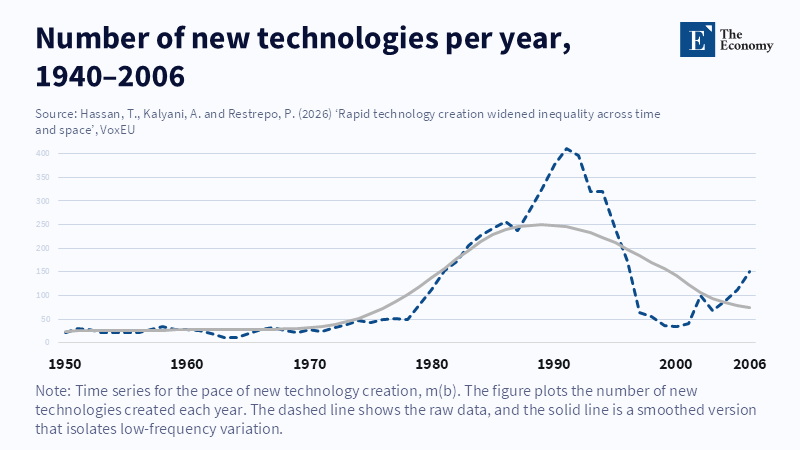
The increase of inequality didn't come more from diffusion than from the ability of a new tool to replace human work and labor. History showed that productivity growth and higher benefits don't come inevitably without the intervention of means to share those benefits. When companies lower their cost of labor more rapidly than their ability to create jobs, wage inequality rises. In a study by Acemoglu and Restrepo, approximately 50-70% of the wage inequality within the U.S. between 1980 and 2016 was derived from the replacement of workers who do non-skilled, repetitive work. This study showed that the most essential point of new technologies is not whether productivity rises, but what tasks are created, for whom they are created and whose Power is compromised with their creation. It is neither invention nor creativity that is problematic, but the reward system of firms that substitute workers, thus producing class inequality.
The effects of this may increase the divisions between countries, too. While the IMF estimates that around 60% of jobs in developed countries will be affected by the arrival of AI, countries will face different problems in adapting to these. Developing countries will lack many of the essential social institutions and access to financial resources that will enable developed countries to address the effects of AI and to harness it. The World Bank’s 2024 World Development Report echoes the concern that developing countries do not possess the capital, infrastructure and educational systems to progress, while a capital process takes hold: more than 6 billion people in 108 countries remain classed as middle-income, unable to build further due to a lack of capital and educational and institutional capacity.
However, this hypothesis has been challenged by evidence that, in some circumstances, AI could have a relative benefit to those with lower skills. In one instance, a study on customer support agents found that the use of AI tools was associated with an overall improvement in performance of 14% and an increase in productivity of 34% for the novice as well as the low-skilled worker. Along similar lines, a recent study by the OECD, among several others, shows that AI usage tends to close the wage gap across different types of jobs by reducing the differences in the proportion of tasks completed by skill level. While encouraging, this latest research also confirms that the advantage of AI usage is conditional on the existence of the right tools as well as the right institutions to augment its diffusion.
Tech inequality is about power, not just skill
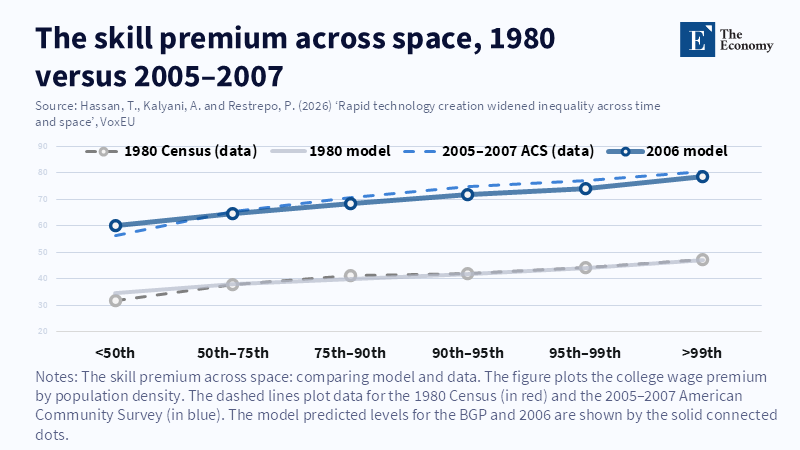
A skills-only and skills-development approach is also insufficient to address tech inequality. While such messaging can encourage empowerment, it also places the onus of addressing systemic inequities on the individual. 'Messaging on a skills-only approach can be co-opted to foster a sense that workers and businesses must adapt, education systems need to keep up with the times and all citizens should be equipped for the modern economy,' rather than a systemic change that determines whether 'any improvement becomes universally beneficial.' Countries are unlikely to experience real change when only training consists of training every citizen to use a certain technology and the profits of a new invention will only trickle down to those who were the initial owners when a fiat corporation controls access to innovation, while others do not. But the World Bank's report cautions that as AI is integrated into regular activity, it might give more to only a small set of well-connected, rich governments, people, places and privilege an 'elite community of well-trained users' at the expense of 'less resourceful' groups and countries. This implies that tech inequality isn't only about knowing how to use something but also about the design, development, operation and profit. Recent cross-country research shows that technological innovation can exacerbate income disparities.
Is this clear for teachers and administrators? It is a bigger problem than just education. But universities, colleges and schools can think about far wider goals than simply exploring a specific problem when they act as diffusion agents. They can boost wide digital fluency, data soundness and tough practical thinking. They can support consumers to explore how technologies can change actual jobs in healthcare, logistics, finance, information and civic sectors. They can step up liaising with local sectors and civic agencies so that learning doesn't just strengthen the vendor's hype but can be oriented toward actual use. What's a decision for administrators now? To get the tool is, in North America, a policy decision. The management isn't between cheap and fast, but whether to bolster communities locally, raise data security and give workers the chance to work more effectively and not fewer. The easy option of buying a ready-made automation wholesale without developing a community of practice will only deepen the technical divide in the systems that should be revealing an opportunity.
Tech inequality will not shrink on its own
What might that response from the public look like if taxes are not enough? First, the state needs to start treating broadband, access to the cloud, reliable power and shared data systems as growth-generating assets. They are now essential growth determinants. Second, competitive policy needs to be brought to the forefront of tech policy. National competitiveness indices are now part of economic policy reform debates as well. A few companies have stakes in chips, cloud, AI models and distribution systems. Any state move to redistribute benefits will run into this business structure. Third, public procurement needs to be aligned to purchase labor-in-demand and labor-enhancing systems for health, education, transport and administration. If we only publicize products that eliminate jobs, businesses will keep creating them. Innovation does not have an inevitable course; policy enables a course. Fourth, diffusion policies have to be relaunched. OECD work on some of the world's best performing models of dominant firms suggests that innovation and diffusion of technology help raise productivity levels above the frontier and also increase the coupling between growth and labor demand, by: subsidizing research and development sites; establishing shared testing facilities; facilitating buy-in to common platforms; providing public-access advisors to small firms; and subsidizing finance to help laggards adopt good systems. Fifth, here has to be some provision for mobilizing labor institutions successful long-term growth (as opposed to the accumulation of an advantage over others for an indeterminate time) should involve providing gains to workers, borne risks by firms, shared benefits, temporary offset to lower wages, portable benefits, bargaining in order to generate better match quality, etcall without in any way impeding growth.
Another reason for a rapid response is that AI may threaten the development ladder from two ends simultaneously. For many developing nations, driving growth has required transitioning from low-paid manufacturing work to higher-paid services. The impact of AI will threaten both of these stances at once. In the 2025 World Bank Report on Digital Progress and Trends, there was apprehension over what would happen if AI were adopted unevenly, a move that could cause 'early de-professionalization', implying a decline in employment for highly-skilled and highly-paid jobs for developing nations. That same report noted that AI jobs that paid more still clustered around specific companies, locations and nations, while lower-paid AI jobs clustered in the gig economy. This is an extremely negative situation for countries seeking to move up the development ladder, which are threatened both by the removal of manufacturing jobs to automation and by the pervasive adoption of AI models that assume basic digital work. Therefore, the least sensible recommendation is not to chase every new gadget, but instead to create industries that are customizable to local needs, dialect, regulations, etc., otherwise the reason for purchasing that which must depend on local caplocal capacity.
A common rebuttal is that all advanced technology eventually leads to inequality and then saturates. This is partly true. Cell phones started very narrowly and soon there were cellular networks everywhere. The software industry started small and is now everywhere. Internet access was once confined to a few wealthy nations and now it's worldwide. But this is not the same as the spread of power. Technologies can be widespread while their benefits sit in the hands of a few. In that sense, technology can widen inequality through uneven access and profit-driven deployment. Everyone can be online, but some of us are still more important to the network. Technological "advance" can be extraordinarily unequal and the important question for policy is how to keep it from translating into income and influence. It is certainly too late if policymakers are only concerned with tech inequality once it begins to translate into the housing market, political debates and growth rates. The best course would be to move preemptively: in broadening access, regulating complementary goods, encouraging local innovation and redirecting research to human-purposeful uses. It is not the case that the pace of technological innovation inevitably produces stratification, but active opposition to that result is essential esseitial, or it can be avoided.
The views expressed in this article are those of the author(s) and do not necessarily reflect the official position of The Economy or its affiliates.
References
Acemoglu, D. and Restrepo, P. (2022) ‘Tasks, Automation, and the Rise in U.S. Wage Inequality’, Econometrica, 90(5), pp. 1973–2016.
Brynjolfsson, E., Li, D. and Raymond, L.R. (2023) Generative AI at Work. NBER Working Paper No. 31161. Cambridge, MA: National Bureau of Economic Research.
Cazzaniga, M., Jaumotte, F., Li, L., Melina, G., Panton, A.J., Pizzinelli, C., Rockall, E. and Tavares, M.M. (2024) Gen-AI: Artificial Intelligence and the Future of Work. IMF Staff Discussion Note SDN/2024/001. Washington, DC: International Monetary Fund.
Georgieff, A. (2024) Artificial Intelligence and Wage Inequality. OECD Artificial Intelligence Papers, No. 13. Paris: OECD Publishing.
Georgieva, K. (2024) ‘AI Will Transform the Global Economy. Let’s Make Sure It Benefits Humanity’, IMF Blog, 14 January.
Hassan, T.A., Kalyani, A. and Restrepo, P. (2025) New Technologies and the College Premium. Working Paper 2025-022. St. Louis, MO: Federal Reserve Bank of St. Louis.
Hassan, T., Kalyani, A. and Restrepo, P. (2026) ‘Rapid technology creation widened inequality across time and space’, VoxEU, 16 April.
International Telecommunication Union (2024) Measuring Digital Development: Facts and Figures 2024. Geneva: ITU.
International Monetary Fund (2024) AI Preparedness Index (AIPI). Washington, DC: International Monetary Fund.
Maslej, N., Fattorini, L., Perrault, R., Parli, V., Reuel, A., Brynjolfsson, E., Etchemendy, J., Ligett, K., Lyons, T., Manyika, J., Niebles, J.C., Shoham, Y., Wald, R. and Clark, J. (2024) Artificial Intelligence Index Report 2024. Stanford, CA: Stanford Institute for Human-Centered Artificial Intelligence.
Melina, G. (2024) ‘Mapping the world’s readiness for artificial intelligence shows prospects diverge’, IMF Blog, 25 June.
Schellekens, P. and Skilling, D. (2024) ‘Three Reasons Why AI May Widen Global Inequality’, Center for Global Development Blog, 17 October.
Sustainability Directory (2026) ‘How Does Technology Widen Inequality?’, Sustainability Directory, 4 February.
World Bank (2024) World Development Report 2024: The Middle-Income Trap. Washington, DC: World Bank.
World Bank (2025) Digital Progress and Trends Report 2025: Strengthening AI Foundations. Washington, DC: World Bank.
Xiao, A., Xu, Z., Skare, M., Qin, Y. and Wang, X. (2024) ‘Bridging the digital divide: the impact of technological innovation on income inequality and human interactions’, Humanities and Social Sciences Communications, 11, article 809.
Working across research, policy, and data-driven analysis, the Editorial Board ensures that published pieces reflect a consistent institutional perspective grounded in quantitative reasoning and long-term structural assessment.