IMF Warns of Global Debt Spiral as U.S. and Europe Struggle Under Fiscal Strain

Aoife Brennan is a contributing writer for The Economy, with a focus on education, youth, and societal change. Based in Limerick, she holds a degree in political communication from Queen’s University Belfast. Aoife’s work draws connections between cultural narratives and public discourse in Europe and Asia.
Authored On
Modified
The IMF Warns: “Global Markets Growing Complacent Amid Rising Risks”
Major economies weighed down by fiscal deficits and debt
Trade conflicts and the Russia–Ukraine war add to mounting strain
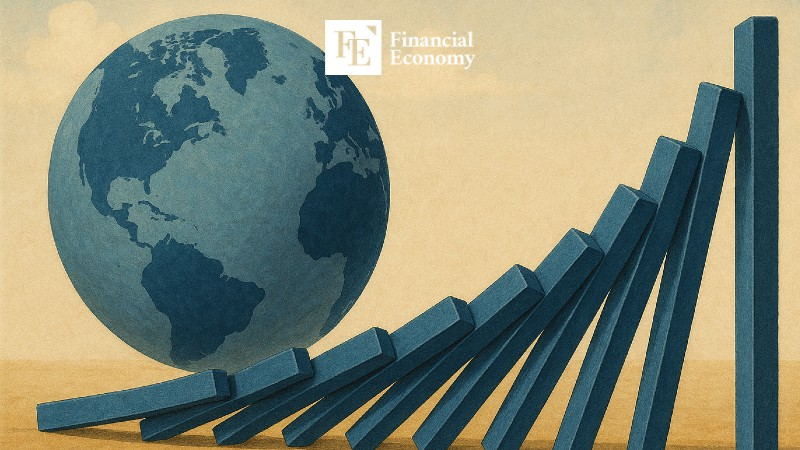
The International Monetary Fund (IMF) has projected that by 2029, global government debt will reach the equivalent of 100% of the world’s GDP. The organization warned that fiscal deficits and debt burdens across major economies could expand rapidly in the coming years. The report cited several underlying risks — including an overheated rally in AI-related tech stocks, escalating trade disputes fueled by U.S. tariffs, and rising geopolitical tensions stemming from the Russia–Ukraine war.
IMF Raises Concern Over Global Economic Stability
On October 14 (local time), the International Monetary Fund (IMF) released its Global Financial Stability Report, warning that “global markets have grown complacent amid a combination of trade conflicts, geopolitical tensions, and widening fiscal deficits.” The IMF cautioned that asset prices are significantly overvalued, heightening the risk of a “disorderly market correction.”
The report noted that “stock markets in major economies have surged to record concentration levels, driven by large AI-related tech firms,” adding that “the rally in technology shares has far outpaced real economic fundamentals, and a sharp price correction could occur if projected profits fail to materialize.” The warning came shortly after U.S. President Donald Trump raised the possibility of additional tariffs on China, which rattled investor sentiment. Following his remarks, U.S. equities plunged, and the prices of cryptocurrencies such as Bitcoin also declined sharply.
Rising fiscal deficits and mounting debt across nations were also highlighted as key vulnerabilities. The IMF projected that by 2029, the ratio of global general government gross debt (D2) to GDP will exceed 100%. D2 includes not only central and local government debt (D1) but also liabilities of non-profit public institutions — a broader measure often used for cross-country comparison. The report warned that “this outlook reflects a higher and steeper debt trajectory than what we anticipated before the pandemic.”
U.S. Feels the Strain of Its Own Tariff Policies
The United States has emerged as one of the countries most affected by mounting fiscal pressures. According to the U.S. Treasury Department, the federal budget deficit for fiscal year 2025 reached $1.775 trillion, down about $41 billion from a year earlier. The modest improvement came as spending on education was cut and tariff revenues under President Donald Trump’s trade policy partially offset rising costs for healthcare, pensions, and interest payments on government debt.
However, the IMF expects this trend to be short-lived. It projects that the U.S. general government overall balance, as a share of GDP, will deteriorate from –7.4% in 2025 to –7.9% in 2026, –8.0% in 2027, –8.1% in 2028, and –7.7% in 2029 — among the lowest levels across the 37 advanced economies classified by the Fund. The IMF also forecasts that the U.S. general government gross debt-to-GDP ratio will climb sharply from 125.0% in 2025 to 140.1% by 2029.
At the heart of the worsening outlook is the instability of the global trade environment. The tariff war ignited by Washington has thrown international trade into turmoil. The ongoing rift between the U.S. and China continues to deal a heavy blow to economies worldwide. Both countries have recently escalated their trade restrictions — China announced sweeping export limits on rare earth metals critical to semiconductors, smartphones, and wind turbines, while the U.S. responded with plans for an additional 100% tariff on Chinese goods. Both sides have also imposed retaliatory increases in port entry fees on each other’s vessels.
The conflict has since evolved into a global divide, fueling a resurgence of protectionism across markets. Mexico, one of the largest importers of Chinese-made cars, imposed a 50% tariff on Chinese vehicles following intense U.S. lobbying. Meanwhile, India has moved to restore ties with China after facing U.S. sanctions over imports of Russian crude oil. In August, Prime Minister Narendra Modi visited China for the first time in seven years to attend a security and economic summit, pointedly stating that “India has many allies beyond the United States.”

Major Economies Sound the Alarm: Europe’s Slowdown Deepens
Europe’s leading economies are facing mounting strain as growth stagnates under the weight of rising fiscal burdens. Expanding welfare spending, trade risks, and the ongoing Russia–Ukraine war have combined to accelerate the region’s economic crisis. Germany, for instance, recorded two consecutive years of negative growth, shrinking by 0.9 percent in 2023 and 0.5 percent in 2024. Although GDP briefly grew 0.3 percent in the first quarter of this year, it fell back by 0.3 percent in the second quarter. Government spending continues to rise across defense, infrastructure, and energy subsidies, yet most of the outlays have been absorbed by pension, healthcare, and welfare costs, producing little stimulus effect. The growing burden of structural expenses tied to an aging population is rapidly undermining the country’s fiscal stability.
The United Kingdom is also under pressure. Its budget deficit at the end of 2024 stood at 5.7 percent of GDP — the third highest among 28 European advanced economies and the fifth highest among 36 globally. Public debt reached 94 percent of GDP, ranking sixth after Japan, Greece, Italy, France, and the United States. Pandemic-related emergency spending and energy crisis relief programs inflated public finances, while generous corporate and household support packages left the government heavily indebted. Attempts at tax hikes and spending cuts repeatedly failed, leaving Britain with little fiscal capacity to absorb future shocks.
France, meanwhile, is seen as facing the most severe fiscal crisis in Europe. Pandemic recovery costs, rising pension obligations from an aging population, ballooning social security spending, and energy transition expenses — compounded by the fallout from the Ukraine war — have pushed public finances to the brink. Austerity measures aimed at reining in the deficit instead fueled political unrest, leading to an unprecedented four changes of prime minister within a year. Amid persistent instability, Fitch Ratings downgraded France’s sovereign credit rating on September 12 from AA- to A+.
Aoife Brennan is a contributing writer for The Economy, with a focus on education, youth, and societal change. Based in Limerick, she holds a degree in political communication from Queen’s University Belfast. Aoife’s work draws connections between cultural narratives and public discourse in Europe and Asia.
Similar Post
















