Samsung and Micron Step Up HBM Race, Challenging SK Hynix’s Lead

Authored On
Modified
Samsung Boosts Competitiveness With Major Gains in Logic Die Yields
Micron Claims 11 Gbps per Pin With Efficiency-Focused Architecture
As HBM4 Nears Commercialization, Is SK Hynix’s Dominance Fading?

Competition in the high-bandwidth memory (HBM) market is intensifying rapidly. As SK Hynix continues to dominate, rivals such as Samsung Electronics and Micron are accelerating their technological advancements — signaling the start of a major market shake-up.
Samsung’s HBM4 Competitiveness
According to industry sources on October 21, Samsung Electronics’ foundry division has achieved a yield rate exceeding 90 percent for logic dies produced using its 4-nanometer (nm) process. A 90 percent yield signals a stable technology mature enough for full-scale mass production. With Samsung’s memory division already mass-producing HBM4 samples for clients such as NVIDIA and AMD, the foundry arm is now ramping up output of logic dies to meet growing demand.
The stable yields are being hailed as a significant milestone as the industry prepares to enter the era of “customized HBM.” Market watchers expect that beginning with the seventh-generation HBM (HBM4E), chipmakers will increasingly tailor memory solutions to the specific AI applications of their customers. Achieving this requires foundry capabilities to design and manufacture logic dies with customized circuit layouts — an area where Samsung, equipped with advanced in-house foundry technology, holds a strong competitive edge.
The key challenge ahead lies in managing heat generation in HBM products. In high-performance computing environments, HBM chips are stacked at extremely high densities to enhance efficiency, which significantly increases power consumption and heat output. The hybrid bonding process used to achieve higher integration and performance further reduces space for heat dissipation, making thermal management even more difficult. Samsung, which entered hybrid bonding commercialization later than some competitors, is reportedly still in the transitional stage of adopting the process.
Micron Shows Confidence in Per-Pin Speed
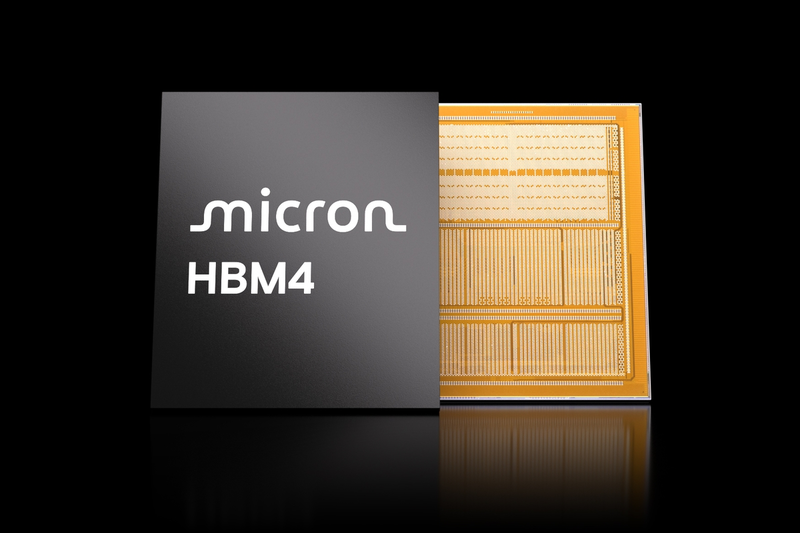
Micron, one of Samsung Electronics’ main competitors, is rapidly closing the gap in HBM technology. The company recently announced that it has achieved per-pin data speeds for HBM4 comparable to those of Samsung and SK Hynix. Industry observers had initially expected Micron’s HBM4 to reach around 8 Gbps per pin — typical for a latecomer in the HBM race — but the company claims to have surpassed expectations with an impressive 11 Gbps per pin.
Micron’s speed gains appear to stem from architectural changes focused on improving signal integrity rather than raw logic performance. One key improvement lies in strengthening the I/O (input/output) interface. During its fiscal Q4 2025 earnings call on September 23 (local time), Micron stated that it had made the HBM’s I/O circuitry “smarter and stronger” by embedding it deeper into the chip’s base die. The approach reduces bit error rates (BER) at equivalent frequencies by optimizing signal quality rather than merely increasing transistor speed.
The company is also believed to have enhanced timing alignment and calibration within the chip. By applying fine-grained training at the channel level — which automatically realigns data and clock signals in response to temperature and voltage fluctuations — Micron reportedly improved link stability and broadened tolerance margins during operation, effectively maintaining throughput under load. While such measures do not increase the absolute speed of logic transistors, they shorten signal propagation delays across connected DRAM arrays and reduce overall electrical stress.
Still, some analysts remain skeptical. “Micron’s base-die issue isn’t something that can be fixed in a month or two,” said one market insider. “It’s likely that the company’s comments were based on select sample units that showed favorable performance metrics.”
Market Share Rankings Could Be Reshuffled
As Samsung Electronics and Micron ramp up their pursuit in the high-bandwidth memory (HBM) race, analysts predict that the market—long dominated by SK Hynix—could soon transition into a “three-way competition” once HBM4 enters mass production. According to Counterpoint Research, SK Hynix held the top spot in the global HBM market in Q2 2024 with a 62 percent share, followed by Micron at 21 percent and Samsung at 17 percent.
Industry insiders expect Samsung to overtake Micron and secure the No. 2 position in NVIDIA’s HBM4 supply chain next year. While SK Hynix is projected to maintain a near-monopoly in the first half, the balance of power could shift in the second half. Some forecasts suggest SK Hynix’s share of NVIDIA’s HBM4 orders could fall from 100 percent in H1 to around 60 percent in H2, with Samsung capturing up to 30 percent and Micron between 10 and 15 percent.
Whether this scenario materializes will depend largely on NVIDIA’s upcoming qualification tests for HBM4 performance. A semiconductor industry source said, “NVIDIA has already finalized much of its HBM4 volume negotiation with SK Hynix for the first half of next year. Since SK Hynix submitted its customer sample first, it’s highly likely to complete qualification certification by the end of this year, effectively guaranteeing exclusivity through the first half.” The source added, “But starting in the second half, as Samsung and Micron join the supply chain, the market structure is expected to change dramatically.”
Similar Post