U.S., U.K., and Australia Invest Billions in AUKUS — Washington to Counter China, Allies to Pursue Own Interests

As one of the youngest members of the team, Tyler Hansbrough is a rising star in financial journalism. His fresh perspective and analytical approach bring a modern edge to business reporting. Whether he’s covering stock market trends or dissecting corporate earnings, his sharp insights resonate with the new generation of investors.
Authored On
Modified
AUKUS Allies to Invest A$368 Billion Over 30 Years
U.S. Leans on Australia—With Fewer Military Constraints—to Counter China
U.K. and Australia Deepen Cooperation, While Japan’s Hopes to Join Fade
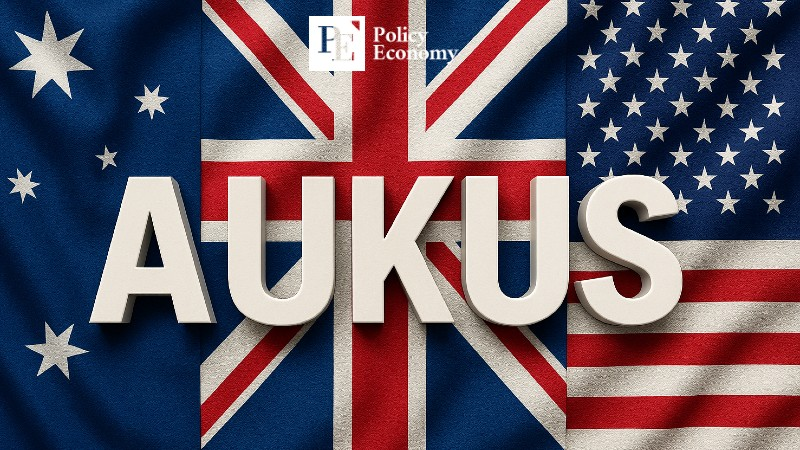
Australia, the United States, and the United Kingdom are set to pour hundreds of billions of Australian dollars into advancing their nuclear-powered submarine alliance, AUKUS. As Washington ramps up military support for Canberra to strengthen its strategic position against China in the Indo-Pacific, both the U.K. and Australia are actively deepening cooperation within the pact to advance their respective national interests.
AUKUS Alliance Kicks Into Gear
On October 20 (local time), The Economic Times of India reported that Australia, the United States, and the United Kingdom plan to invest a total of 368 billion Australian dollars (about 220 billion USD) over the next 30 years to advance the AUKUS nuclear-powered submarine alliance. Officially launched in September 2021, AUKUS consists of two main pillars: “Pillar 1,” under which the U.S. and U.K. will provide conventionally armed nuclear submarines to Australia, and “Pillar 2,” which focuses on joint development of advanced defense technologies in eight fields, including artificial intelligence, quantum computing, cybersecurity, and undersea systems.
Starting in 2027, the alliance will rotate four U.S. Virginia-class and one British Astute-class submarine through HMAS Stirling near Perth, Western Australia, to train Australian crews under U.S. command. By the end of this year, between 50 and 80 U.S. Navy personnel will arrive at the base to prepare for the submarines’ deployment.
Australia will purchase three Virginia-class submarines from the United States by 2032 for its own fleet. The Virginia class—capable of intelligence gathering, anti-submarine warfare, land strikes, and special-operations missions—represents the cutting edge of attack-submarine design. Once those transfers are complete, the next-generation SSN-AUKUS submarines, developed primarily by U.K. defense contractors, will begin delivery from 2038. Australia plans to launch its first domestically built SSN-AUKUS in the early 2040s, filling the capability gap left by the retirement of its aging Collins-class diesel submarines.
Why Are the U.S. and U.K. Joining the Alliance?
Washington’s enthusiasm for AUKUS stems from the fact that Australia is the only Indo-Pacific nation capable of openly countering China without significant political constraints. Beyond AUKUS, the U.S. also participates in the Quad — a security dialogue that includes Japan, India, and Australia — but both Tokyo and New Delhi face structural limitations: Japan is restricted by Article 9 of its pacifist constitution, and India remains preoccupied with territorial tensions along the Himalayas, making immediate maritime engagement against China difficult.
Australia, by contrast, faces few operational restrictions. Once it acquires nuclear-powered submarines, it will be able to conduct reconnaissance missions across the South China Sea and near Taiwan, bolstering the U.S.’s Indo-Pacific deterrence posture. Strategically, this cooperation helps Washington maintain its maritime dominance in the region while counterbalancing China’s growing naval power. The U.S. is also concerned about a sharp decline in submarine capability once its Los Angeles–class fleet retires in the mid-2030s, whereas China continues to expand aggressively, now fielding around 15 nuclear-powered and 56 diesel submarines. Transferring nuclear-submarine technology to Australia, therefore, represents a calculated move to preserve the regional balance of power.
For the United Kingdom, participation in AUKUS builds on the trust established through the “Five Eyes” intelligence-sharing alliance (comprising the U.S., U.K., Canada, Australia, and New Zealand). However, London’s deeper motivation likely lies in expanding its strategic footprint in the Indo-Pacific and advancing cooperation on next-generation defense technologies. The U.K. government has described AUKUS as its most important defense and foreign-policy partnership in six decades and a cornerstone of efforts to promote peace and stability in the region.
Australia Spares No Expense in Aligning With the U.S.
Australia has taken a bipartisan approach to aligning closely with Washington, prioritizing national interests even at economic cost. A notable example came several years ago when Canberra banned Chinese telecom giant Huawei’s 5G equipment despite the risk of trade retaliation from Beijing. The country also withdrew from China’s Belt and Road Initiative and passed the Foreign Relations (State and Territory Arrangements) Act 2020, granting the prime minister authority to nullify any agreements made with foreign governments, including those with China.
Australia has also committed significant funding to bring the AUKUS alliance’s goals to life. In exchange for receiving nuclear-powered submarines, Canberra pledged 3 billion USD to the U.S., of which 500 million USD has already been paid as of February. Last month, Deputy Prime Minister and Defense Minister Richard Marles announced in interviews with ABC and other local outlets that Australia would invest an additional 8 billion USD over the next decade to build shipyards and operational facilities to support the alliance.
As AUKUS cooperation between the U.S., U.K., and Australia deepens, Japan — which has long sought to form an expanded “JAUKUS” framework (Japan + AUKUS) — is finding itself increasingly sidelined. Tokyo has pushed for stronger defense spending and military presence in the region since the Abe administration and has lobbied Washington extensively to strengthen its role. One example came in 2019, when Seoul announced its intent to terminate the GSOMIA (General Security of Military Information Agreement) with Tokyo, prompting heavy pressure from the Trump administration on South Korea. Although Japan’s potential participation in AUKUS was discussed again last year, the idea stalled amid the shifting dynamics of the U.S. presidential election.
As one of the youngest members of the team, Tyler Hansbrough is a rising star in financial journalism. His fresh perspective and analytical approach bring a modern edge to business reporting. Whether he’s covering stock market trends or dissecting corporate earnings, his sharp insights resonate with the new generation of investors.
Similar Post