Taekwang Expands Beyond Petrochemicals with Acquisition of Aekyung Industrial: Global Strategy to Determine Success of K-Beauty Push

Anne-Marie Nicholson is a fearless reporter covering international markets and global economic shifts. With a background in international relations, she provides a nuanced perspective on trade policies, foreign investments, and macroeconomic developments. Quick-witted and always on the move, she delivers hard-hitting stories that connect the dots in an ever-changing global economy.
Authored On
Modified
Taekwang and Aekyung Boards Approve Deal
Aekyung Expands Beyond China to U.S. and Southeast Asia
Taekwang Broadens Portfolio from Petrochemicals to Consumer and Beauty Sectors

Aekyung Group has signed a definitive agreement to sell Aekyung Industrial to Taekwang Industrial, transferring its flagship cosmetics and household goods business to the Taekwang Group. The transaction is viewed as a win-win for both parties. Aekyung Industrial aims to leverage Taekwang’s capital strength and global network to expand its international sales channels and enhance distribution efficiency, while Taekwang seeks to diversify beyond its petrochemical-heavy portfolio by entering the K-beauty and consumer goods markets as a new growth pillar. Industry analysts say the success of the acquisition will hinge on how precisely Taekwang designs its global expansion strategy to offset declining demand from China.
Taekwang–Aekyung Finalize Equity Transfer Deal
According to investment banking sources on October 21, Aekyung Industrial’s parent company AK Holdings and Taekwang Industrial each held board meetings the previous day to approve the acquisition and sale. The decision comes four months after the Taekwang-led consortium was selected as the preferred bidder in June. The consortium—comprising Taekwang Industrial, T2 Private Equity, and Yuanta Investment—announced that it plans to sign the stock purchase agreement (SPA) with AK Holdings by October 22. The final settlement is scheduled for February 19, 2025.
Although the two sides had originally planned to sign the SPA by October 15, the deal was delayed. Taekwang’s board approved the deal on October 14, but Aekyung’s board rejected it the following day pending further review, prompting Taekwang to withdraw its resolution. While there was speculation that the transaction might collapse, both sides maintained strong commitment to the deal, and the market expects it to close smoothly.
The sale involves a 63.13% stake in Aekyung Industrial, valued at approximately $350 million. On a 100% equity basis, the company is valued at around $550 million. The sale price of about $20 per share represents an 86.9% premium over the October 17 closing price of $11, but remains below Aekyung’s proposed valuation of $600 million and market expectations of roughly $450 million.
Aekyung’s Struggles in China and Path to Rebound under Taekwang’s Capital and Distribution Power
Aekyung Group’s decision to sell its founding business, Aekyung Industrial, stems from deteriorating financial health. The pandemic severely hit its airline and retail affiliates, shaking the group as a whole. Jeju Air faced an extended flight suspension, and AK Plaza suffered from weakened consumer spending and heightened competition.
Founded in 1954 as Aekyung Oil & Fat Industries and incorporated in 1985 under its current name, Aekyung Industrial established itself as a household goods and cosmetics company. Its detergent brand “Spark,” shampoo “Kerasys,” and cosmetics lines such as “Luna” and “AGE 20’s” built strong consumer recognition. In particular, the “Essence Cover Pact” from AGE 20’s became a home-shopping sensation in the 2010s, symbolizing the K-beauty boom. Following its 2018 KOSPI listing, the company’s stable household product sales and high-margin cosmetics segment made it one of the group’s strongest performers.
However, circumstances have since shifted. Weak demand in China and intensified competition have eroded the brand’s dominance. In the first half of this year, sales declined 5.9% year-on-year to $240 million, while operating profit and net profit plunged 49.3% and 39.1%, respectively. The cosmetics segment was hit hardest, with sales dropping 25% to $94 million and operating profit tumbling 65% to $6 million. Revenue from China shrank 23% to $48 million, exposing structural vulnerabilities.
Now under Taekwang’s umbrella, Aekyung Industrial is preparing for a turnaround centered on portfolio realignment. About 70% of its cosmetics revenue currently comes from overseas markets, with 80% of that concentrated in China—a key risk factor. To mitigate this, the company is expanding into the U.S., Southeast Asia, and Japan. Its distribution strategy is also evolving: while home-shopping and e-commerce have been the main channels, Daiso has recently emerged as a key retail partner, driving strong sales for brands such as A-Solution, TwoeDit, and 2080. Meanwhile, AGE 20’s and Luna continue to post robust sales at Olive Young.
Aekyung Industrial has set a goal of achieving $750 million in revenue by 2027, focusing on building global megabrands, strengthening digital distribution, and expanding its premium product lines to drive both growth and profitability. As of last year, household goods and cosmetics accounted for 61% and 39% of sales, respectively. The company plans to increase the cosmetics share to 48% in the coming years.
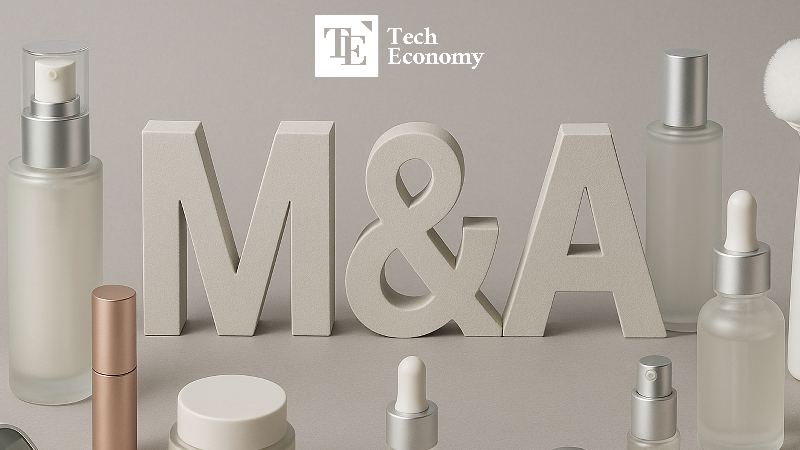
Taekwang’s Strategic Shift from Petrochemicals to K-Beauty and Consumer Goods
Through the acquisition, Taekwang Industrial is positioned to diversify its business and expand into the consumer and beauty sectors. The company, long rooted in textiles and petrochemicals with a predominantly B2B model, has faced slowing growth amid weak petrochemical demand and intensifying Chinese competition.
Taekwang views the acquisition as a milestone in its transformation journey. With its petrochemical-based manufacturing infrastructure, the company expects operational synergy in raw material development and supply chain efficiency for cosmetics production. Leveraging Yuanta Investment’s global network within the consortium, Taekwang plans to strengthen international partnerships and accelerate Aekyung Industrial’s expansion into China, Southeast Asia, and North America. Given Aekyung’s brand recognition among younger consumers, the combination of Taekwang’s financial capacity and distribution capabilities is expected to expedite its global rollout.
According to Taekwang’s new business expansion plan announced in July, the group intends to invest a total of $1.1 billion by next year in acquiring or establishing companies in cosmetics, energy, and real estate development. Of this, $740 million will be spent this year and $370 million next year, with roughly $370 million—about one-third of the total—earmarked for the Aekyung acquisition. The company aims to use this large-scale investment to move beyond petrochemicals and gradually expand into adjacent sectors such as healthcare, biotechnology, pharmaceuticals, and specialty chemicals.
Taekwang’s push into the beauty industry reflects its confidence in the sector’s “sustained growth potential.” With the global cosmetics market growing at an annual rate of 9% and the domestic market at 12%, Taekwang sees the entry into consumer goods as a means to diversify earnings and boost market share based on its solid manufacturing foundation. Although some view this as unrelated diversification, Taekwang—facing three consecutive years of losses—appears determined to pursue new growth avenues. Analysts suggest that the company’s urgency to break free from the long petrochemical cycle has driven this bold pivot.
Still, challenges remain. Given Taekwang’s long history as a B2B-focused manufacturer, transitioning into consumer markets may not be seamless. “The key will be how quickly Taekwang can realign its business structure after the acquisition,” said one investment banking official. “The cosmetics industry has low entry barriers and rapidly shifting trends, so Taekwang will need strong innovation and marketing capabilities to compete with established players.”
Anne-Marie Nicholson is a fearless reporter covering international markets and global economic shifts. With a background in international relations, she provides a nuanced perspective on trade policies, foreign investments, and macroeconomic developments. Quick-witted and always on the move, she delivers hard-hitting stories that connect the dots in an ever-changing global economy.
Similar Post