From Patient Care to Logistics and Manufacturing, Automation Accelerates — Can China Take the Lead?

Aoife Brennan is a contributing writer for The Economy, with a focus on education, youth, and societal change. Based in Limerick, she holds a degree in political communication from Queen’s University Belfast. Aoife’s work draws connections between cultural narratives and public discourse in Europe and Asia.
Authored On
Modified
Global Robot Dog Market Projected to Grow 18% Annually Through 2030
Automation Wave Sweeps the World as Amazon Replaces Workers with Robots
China’s Robotics Ecosystem Booms with Strong Government Support
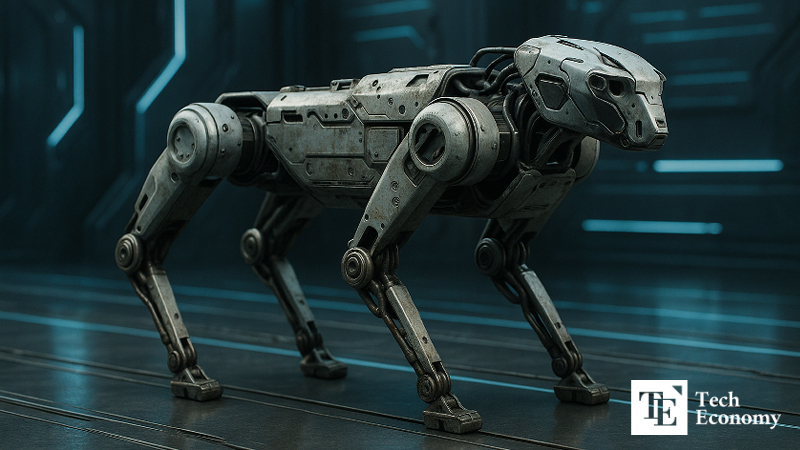
The global robot dog market is expected to grow into a multi-billion-dollar industry within the next five years. As robotics manufacturing and related technologies advance rapidly, service robots are gaining an increasingly prominent presence in the market.
Robot Dogs Finding Uses Across Industries
On October 20, HTF Market Intelligence projected that the global robot dog market will grow at an annual rate of 17.99% from 2023, reaching 456.32 million dollars by 2030. The report attributes this expansion to advancements in AI, robotics, and sensor technology, which are broadening the range of robot dog applications and fueling market growth.
At present, the most common use for robot dogs is in assisting patients with cognitive decline or dementia. In Hangzhou, China, a robot dog named Xiaoxi accompanies elderly residents on walks and engages them in conversation. It responds to voice commands to aid mobility and uses touch sensors to provide emotional comfort. In the United States, Tombot’s Jennie—developed specifically as a therapeutic robot dog for dementia patients—secured 6.1 million dollars in funding last June. Jennie replicates the appearance and sounds of a golden retriever and reacts to touch, voice, and movement to interact naturally with patients.
Robot dogs equipped with 5G and cloud robotics technology are also emerging in industrial settings, where their ability to transmit large volumes of data in real time is proving valuable. Ericsson, the Swedish telecom equipment maker, unveiled a 5G robot dog named Rocky that transmits high-definition video from factory inspection sites with latency under one millisecond, maximizing remote control efficiency. Through such technological convergence, robot dogs are evolving beyond simple patrol and monitoring roles to perform advanced functions such as real-time hazard analysis and remote emergency support.
Service Robots Expanding Their Reach
Beyond robot dogs, a wide range of service robots are rapidly gaining ground in the global market. According to the World Robotics 2025 Service Robots Report released by the International Federation of Robotics (IFR), around 200,000 professional service robots were sold last year — a 9% increase from the previous year.
The report shows that the transport and logistics sector accounted for the largest share, with about 102,900 units sold. Autonomous mobile robots (AMRs) and indoor delivery robots used in warehouses and factories saw particularly strong demand. Sales of service, guidance, and hospitality robots — about 42,000 units — also stood out. These robots are commonly deployed in shopping malls, hotels, and public facilities to provide information, promotions, and customer assistance. In recent years, new variants such as cooking and beverage-preparing robots have emerged as well. Cleaning robots, including those for professional floor maintenance, recorded a 34% jump in sales, driven by growing demand for automated hygiene management.
The automation trend is also accelerating among big tech companies. Last year, Amazon’s leadership stated that the company could double its sales volume by 2033 without hiring additional U.S. workers, thanks to robotic automation. On October 21, The New York Times reported, citing internal documents, that Amazon plans to automate 75% of its workforce. If implemented, the move could eliminate the need for approximately 600,000 new hires by 2033.
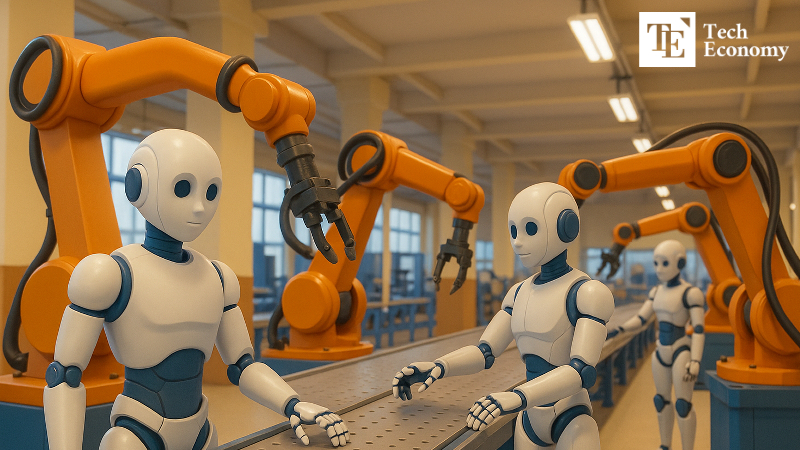
China Accelerates Its Tech Ambitions with Robotics
China, which has been pushing its technological rise, is heavily investing in automation. Since launching the “Made in China 2025” initiative in 2015, the government has prioritized strengthening competitiveness in robotics and has provided massive financial support to the sector. As a result, China has built a robust robotics manufacturing ecosystem that encompasses not only robot production itself but also key components such as actuators.
This strong domestic supply chain has significantly boosted robot deployment within the country. Citing data from the International Federation of Robotics (IFR), The New York Times reported last month that China installed about 300,000 industrial robots last year — more than the total number installed in the rest of the world combined and nearly ten times that of the United States, which ranked third with 34,000 units.
If Chinese robotics firms continue to expand their presence in global industrial markets while consolidating control over component supply chains, leading players like Boston Dynamics and Tesla could face a formidable challenge. Price competitiveness remains China’s most powerful advantage. Unitree, a Chinese robot manufacturer, reportedly sells its latest humanoid robot for around 6,000 dollars per unit — far cheaper than Boston Dynamics’ humanoid Atlas, which is not yet commercially available. Experts estimate that even the most basic model of Boston Dynamics’ four-legged robot, Spot, costs around 74,500 dollars, suggesting that the Atlas could be priced at 150,000 dollars or more.
Aoife Brennan is a contributing writer for The Economy, with a focus on education, youth, and societal change. Based in Limerick, she holds a degree in political communication from Queen’s University Belfast. Aoife’s work draws connections between cultural narratives and public discourse in Europe and Asia.
Similar Post