NVIDIA Expands R&D Presence in Israel, Establishing AI Innovation Hubs in Both North and South

Siobhán Delaney is a Dublin-based writer for The Economy, focusing on culture, education, and international affairs. With a background in media and communication from University College Dublin, she contributes to cross-regional coverage and translation-based commentary. Her work emphasizes clarity and balance, especially in contexts shaped by cultural difference and policy translation.
Authored On
Modified
Southern Beersheba R&D Center Tripled in Size
New Large-Scale Tech Campus Planned in the North
Aggressive Acquisitions of Local Startups Including Run:ai
NVIDIA is undertaking a series of large-scale investments to transform Israel—its core research and development (R&D) base—into a next-generation artificial intelligence (AI) innovation hub. Following its announcement in July of a new mega tech campus in northern Israel, the company has now revealed plans to expand its southern Beersheba R&D center to three times its current size and hire several hundred additional employees. At the same time, NVIDIA is accelerating its efforts to strengthen technological competitiveness through acquisitions of local AI startups and data center solution companies.
NVIDIA: “Will Drive the Growth of the Southern Tech Ecosystem”
According to the Times of Israel on the 27th (local time), NVIDIA officially announced the previous day that it would relocate and greatly expand its R&D center in the southern Israeli city of Beersheba. The decision is a strategic move aimed at enhancing its capabilities in developing next-generation processors and networking chips—key technologies for training AI models. NVIDIA stated that it intends to transform Beersheba into an AI innovation hub that will drive the growth of the southern Negev region’s technological ecosystem.
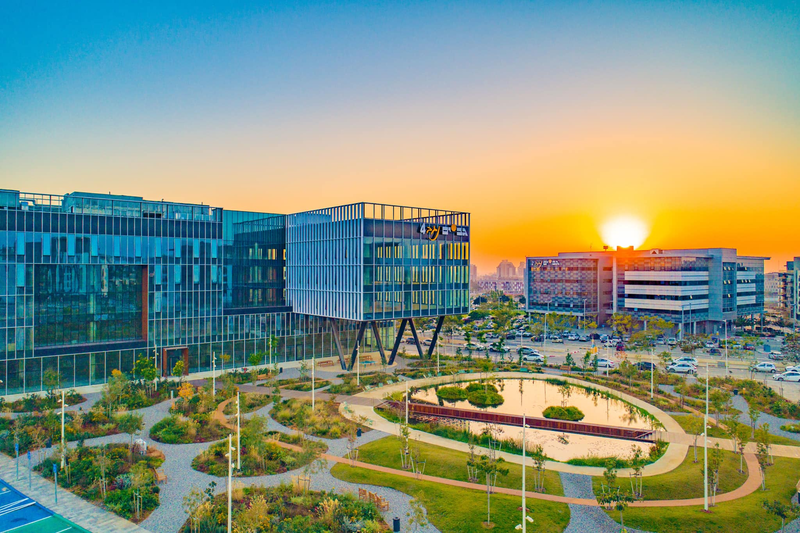
To achieve this, NVIDIA will relocate its current Beersheba R&D center—currently operating on a 1,000-square-meter site—to a newly constructed facility nearby, while recruiting hundreds of additional staff specializing in hardware and software engineering, as well as AI networking technologies. The new center, located within the Gav-Yam Negev High-Tech Park in Beersheba, will cover approximately 3,000 square meters—three times the size of the existing facility. NVIDIA aims to have the new center fully operational by the end of the first half of 2026.
The Gav-Yam High-Tech Park, which will serve as NVIDIA’s new home, has rapidly emerged as a key innovation hub in southern Israel. Situated near Ben-Gurion University, which boasts the country’s largest R&D infrastructure, the area offers access to a rich pool of talent and strong potential for industry-academia collaboration. Owing to these advantages, the park is already home to R&D facilities for global tech giants such as Microsoft, Dell, and Wix, as well as major Israeli defense contractors including Rafael Advanced Defense Systems and Elbit Systems.

Northern Campus Expansion to Create Over 5,000 Jobs
NVIDIA’s investments in Israel extend well beyond the southern region. Earlier this year, in July, the company unveiled plans to build a massive new tech campus in northern Israel, a project expected to generate several thousand jobs. This move is seen as part of NVIDIA’s broader strategy to achieve balanced R&D growth across both northern and southern Israel. Reports indicate that the company is currently searching for a 30-acre plot—capable of accommodating up to 180,000 square meters of facilities—across the Zikhron Ya'akov, Haifa, and Jezreel Valley regions.
Even before these large-scale expansion plans, Israel already represented NVIDIA’s largest R&D base outside of its U.S. headquarters. From Yokneam in the north to central hubs such as Tel Aviv, Jerusalem, and Ra’anana, and further south to Beersheba, NVIDIA operates seven R&D centers across Israel, employing over 5,000 people. The Israeli centers occupy a uniquely important position within NVIDIA’s global network, as many of the company’s cutting-edge high-end processors and networking chips—essential for large-scale AI model training—are developed there.
In addition to R&D expansion, NVIDIA has actively pursued an aggressive mergers and acquisitions (M&A) strategy to integrate leading Israeli tech companies. In December last year, the company acquired AI workload management startup Run:ai for approximately $700 million, strengthening its ability to optimize AI learning and cluster resource efficiency. Earlier, in 2020, NVIDIA made headlines with its $7 billion acquisition of high-speed networking solutions provider Mellanox Technologies—whose products power the world’s top supercomputers—marking the largest M&A deal in Israeli history and solidifying its dominance in data center networking technology.
Israel’s AI Ecosystem Ranks Among the World’s Most Competitive
Israel’s AI ecosystem is renowned for its strong academic-industry collaboration and dense concentration of top-tier talent, ranking among the most competitive globally. Over 1% of Israel’s total workforce is employed in AI-related fields. Many professionals acquire advanced technical expertise during military service before transitioning into university research institutes, academia, startups, and multinational corporate R&D centers—creating a virtuous cycle of innovation. The government’s robust national AI strategy and sustained investments have fostered over 500 global R&D centers and thousands of AI startups, driving cross-sector integration and R&D advancement.
Leveraging this ecosystem, Israeli startups are now beginning to challenge NVIDIA’s dominance in the high-performance graphics processing unit (GPU) market. One such contender is CogniFiber, a company that recently unveiled a new data center processor called “DeepLight.” Based on multicore optical fibers, DeepLight processes data at the speed of light while reducing energy consumption to roughly 1% of that required by conventional chips and achieving up to 1,000 times faster AI inference processing.
Inspired by the efficiency of the human brain, DeepLight is an innovative optical-fiber computing system that harnesses the speed of light, and early proof-of-concept (POC) testing has reportedly demonstrated performance surpassing that of state-of-the-art processors. Dr. Eyal Cohen, CogniFiber’s co-founder and a neuroscientist, explained, “With our first-generation processor now complete and initial products entering the global market, we are focusing on marketing and sales efforts. We believe our new processor will fulfill the promise of scalable photonic computing.”
Siobhán Delaney is a Dublin-based writer for The Economy, focusing on culture, education, and international affairs. With a background in media and communication from University College Dublin, she contributes to cross-regional coverage and translation-based commentary. Her work emphasizes clarity and balance, especially in contexts shaped by cultural difference and policy translation.
Similar Post