Korea–Malaysia FTA Finalized: Seoul Secures Resource Stability, Kuala Lumpur Gains Diplomatic Leverage

Authored On
Modified
Additional market openings for Korea’s core export sectors, including steel and petrochemicals
Foundation laid for deeper cooperation in future-oriented industries such as clean energy and biotechnology
Malaysia seeks “qualitative transformation” in trade through renewed negotiating leverage beyond diversification
The free trade agreement (FTA) negotiations between Korea and Malaysia have been finalized. The deal is expected to give Korea expanded access to the Malaysian market for its key export industries, including automobiles and steel. Malaysia, a resource-rich nation endowed with palm oil, tin, and natural gas, is likewise seen as a promising partner in areas such as supply chains and resource cooperation. For Malaysia—which has been locked in gridlock with the European Union (EU) over palm oil regulations and labor rights issues—the agreement with Korea marks a strategic turning point, easing external pressure by securing alternative market access and recalibrating relations with major trading partners.
Expansion of Cooperation in Defense and Energy Supply Chains
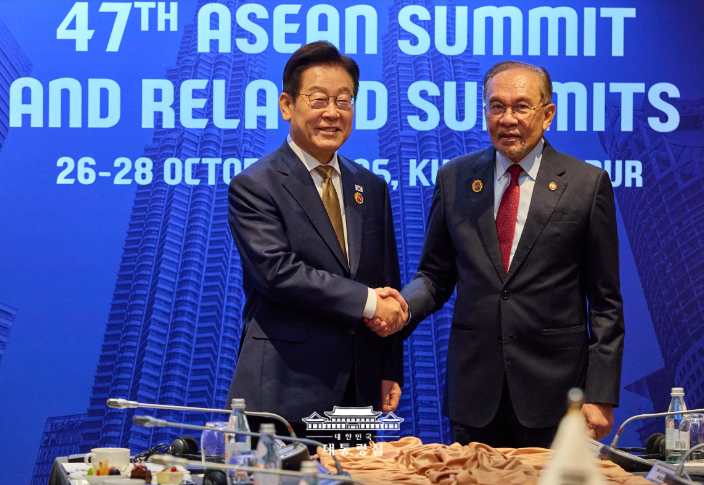
According to the Ministry of Trade, Industry and Energy (MOTIE) on the 28th, President Lee Jae-myung met with Malaysian Prime Minister Anwar Ibrahim in Kuala Lumpur on the sidelines of the ASEAN Summit and agreed to the Korea–Malaysia FTA. With this deal, Malaysia becomes Korea’s 27th FTA partner.
Under the agreement, tariffs on completely knocked down (CKD) electric sedan and SUV assembly kits will be eliminated from the current 10%, while tariffs on fully built electric SUVs—previously at 30%—will be cut by half. Tariffs on gasoline, hybrid, and diesel CKD vehicles will also be lowered across the board. For gasoline CKD automobiles already undergoing tariff elimination, the existing 8–28% range will be reduced by an additional 1–3 percentage points per year. Hybrid and diesel CKD vehicle tariffs—previously set at 8% with no scheduled reductions—will be halved to 4%.
For steel, one of Korea’s key exports, Malaysia has agreed to abolish the 5% tariff on nine high-sensitivity items such as cold-rolled and coated steel sheets. For 12 other items, including hot-rolled and galvanized steel, tariffs will be reduced from 15% to 10%, providing deeper cuts than previous FTAs. The agreement also explicitly guarantees that steel products not produced domestically in Malaysia will be imported from Korea on a duty-free basis. Furthermore, any future changes to Malaysian tariff laws will uphold the principle of most-favored-nation treatment to ensure Korean steel products are not disadvantaged compared to those of other countries.
Tariffs on major Korean chemical exports, such as polyethylene and polypropylene, will also be eliminated. In addition, residual tariffs on bio-based raw materials, including palm fatty acid distillates, will be scrapped—expected to lower costs and enhance supply stability. The tariff elimination period for urea and related industrial chemicals—of which Korea is entirely import-dependent—will be shortened to strengthen supply chain resilience.
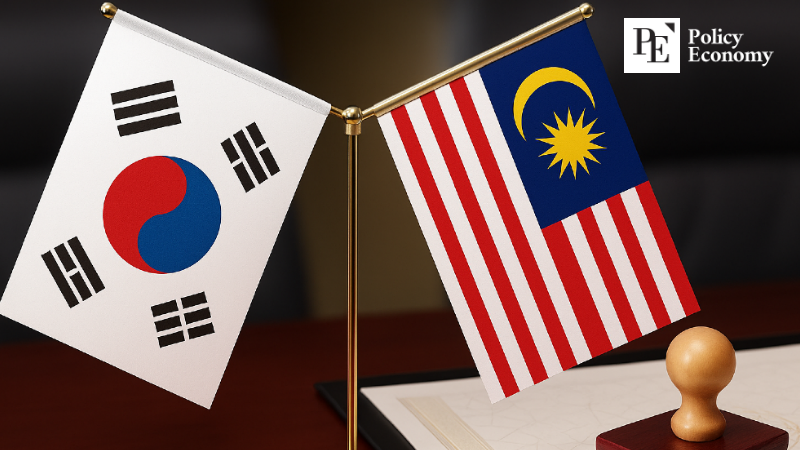
Korea and Malaysia Established Strategic Partnership Last Year
The bilateral FTA builds upon the strategic partnership both nations agreed to last year. In November of that year, then-President Yoon Suk-yeol hosted Prime Minister Anwar at the presidential office in Yongsan and issued a joint declaration on the establishment of a strategic partnership. “Since establishing diplomatic relations in 1960, Korea and Malaysia have developed a deep friendship and cooperation across many fields,” Yoon stated at the time. “In particular, Korea has been a core partner in Malaysia’s ‘Look East Policy,’ and I find today’s decision to elevate our relationship to a strategic partnership highly meaningful.”
Prime Minister Anwar responded, “Through the upgrade to a strategic partnership, I expect our two countries will be able to cooperate comprehensively across diverse areas.” He added, “Korea is a well-known nation in Malaysia. Korean companies built the Penang Bridge, the Petronas Twin Towers, and contributed to the Merdeka 118 Tower.”
In the joint statement, the two sides agreed to accelerate efforts to finalize the Korea–Malaysia FTA by 2025. Negotiations, which had taken place intermittently across three rounds in 2019, had stalled due to Malaysia’s domestic political circumstances and only resumed in March last year. During that summit, Korea also secured Malaysia’s support for its Carbon-Free Energy (CFE) initiative proposed to the international community. Unlike the Renewable Electricity 100% (RE100) campaign, which focuses exclusively on solar and wind power, the CFE concept promotes broader adoption of carbon-free energy sources such as nuclear power, hydrogen, and carbon capture, utilization, and storage (CCUS).
The two countries also affirmed that “defense cooperation represents a symbol of mutual trust rooted in a robust strategic partnership,” and agreed to explore collaboration in military technology and defense industries. In connection with this, the presidential office noted that Malaysia had signed a contract last year to purchase 18 FA-50 light attack aircraft from Korea. The Korean side also requested Malaysia’s consideration for participation by Korean firms in future defense procurement programs, including the upcoming second-phase replacement of Malaysia’s light attack aircraft fleet.
Malaysia Builds Geopolitical Leverage
For Malaysia, the FTA with Korea carries significance far beyond market access—it is viewed as a mechanism for building geopolitical leverage. Kuala Lumpur resumed negotiations with the EU in January this year, aiming to conclude an agreement by 2026. Bilateral trade between the two sides amounts to USD 47 billion annually, with the EU accounting for 7.6% of Malaysia’s total trade—making it the country’s fourth-largest export destination after Singapore, the United States, and China. Penang has emerged as the epicenter of EU–Malaysia trade relations, having attracted USD 22 billion in manufacturing investment from Europe over the past five years, equivalent to 31% of Malaysia’s total exports.
However, key sticking points remain, particularly the EU Deforestation Regulation (EUDR). Introduced in 2022, the EUDR restricts imports of commodities such as palm oil linked to deforestation—measures Malaysia has condemned as discriminatory. Labor rights have also become a sensitive issue. The FTA is expected to include provisions mandating compliance with international labor standards, posing challenges for Malaysia, which has faced allegations of forced labor in its palm oil and manufacturing sectors. Market access concerns persist as well, with European companies reportedly wary of Malaysia’s automobile import licensing system, food safety regulations, and government procurement restrictions.
Against this backdrop, analysts say Malaysia’s FTA with Korea provides a strategic anchor in its broader trade diplomacy with the EU. A trade diplomacy expert commented, “For Malaysia, which has been deadlocked in FTA negotiations with the EU over palm oil and labor rights, opening its market to Korea effectively relieves negotiating pressure by securing an alternative demand base.” The expert added, “This represents not just trade diversification, but a recalibration of Malaysia’s negotiating power and its relations with major trading partners.”
Similar Post