“Tariffs Crippling the Auto Ecosystem” — Hyundai Motor Loses $17 Billion in Q3 Alone, Parts Suppliers Also Hit Hard

Authored On
Modified
Record U.S. sales but plunging profits
High 25% tariffs turning sales into losses
Earnings of top 100 auto parts firms also tumble
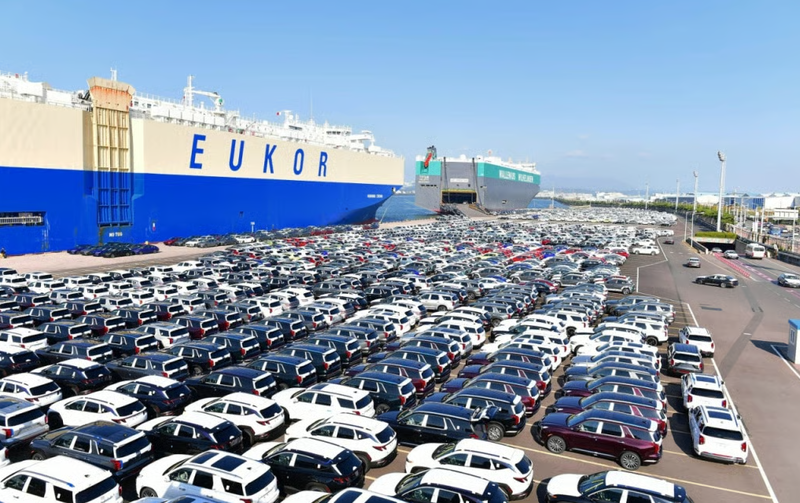
The surge in U.S.-imposed tariffs has battered Hyundai Motor and Kia’s third-quarter earnings. Despite achieving record sales in the U.S. market, their net profits dropped sharply. The more they sold, the more they lost, as revenue growth translated directly into declining profitability. The fallout is rippling across the entire auto supply chain, dragging down the earnings of the top 100 listed parts manufacturers. The high tariffs are now undermining the very foundation of Korea’s automotive industry.
Operating Profit Down 30.6% for Hyundai, 23.5% for Kia
According to consensus data from financial information firm FnGuide on the 29th, Hyundai Motor is expected to post third-quarter revenue of $33.7 billion and an operating profit of $1.9 billion, representing a 5.64% increase in sales but a 28.11% decline in operating profit from a year earlier. Net income is projected to fall 20.83% to $1.5 billion. Kia’s revenue is forecast at $20.7 billion, up 5.11% year-on-year, but its operating profit is expected to drop 22.95% to $1.65 billion, with net income down 14.4% to $1.45 billion.
Combined, Hyundai and Kia are expected to generate $54.4 billion in revenue in the third quarter, up 4.3% year-on-year, but their operating profit is projected to plunge 21.4% to $3.8 billion. This would mark their lowest profit since the third quarter of 2022, when they booked $10 billion in quality-related costs for the Theta II GDI engine recall. Although the combined revenue is estimated to have risen by about $2.3 billion, operating profit is forecast to drop by roughly $10 billion. Analysts estimate that Hyundai and Kia’s tariff-related losses could reach up to $20 billion in the third quarter—around 1.7 times higher than the $12 billion recorded in the previous quarter.
The decline stems from U.S. tariffs. Until recently, Hyundai and Kia paid no import tariffs when selling vehicles to the U.S., allowing them to offer competitive prices while maintaining strong margins. But since April this year, the imposition of a 25% tariff on vehicles exported from Korea has reversed that equation, making each sale less profitable.
Although Seoul and Washington agreed in late July to reduce the tariff on Korean-made vehicles to 15%, follow-up measures have been delayed, meaning Korean exports are still subject to the full 25% rate. This puts them at a clear disadvantage compared to competitors like Japan’s Toyota and Germany’s Volkswagen, whose governments finalized tariff deals with Washington that lowered their rates from 27.5% to 15%.
Tariff Deal Still Elusive, Fourth Quarter to Bear Full 25% Impact
The outlook for the fourth quarter remains bleak. Negotiations over the $350 billion investment package in the U.S. have stalled. Hopes had risen earlier this month that an agreement could be reached ahead of the Asia-Pacific Economic Cooperation (APEC) Summit in Gyeongju. On October 16 (local time), Korean Trade Minister Kim Jung-kwan met with U.S. Commerce Secretary Gina Raimondo in Washington, D.C. for two hours, and the Trump administration reportedly aimed to finalize a deal with Korea before APEC as it focused on ongoing trade talks with China.
U.S. Deputy Secretary of Commerce Scott Besant said earlier, “We expect visible progress within 10 days,” expressing optimism. Kim also stated that “significant progress has been made on most key issues” and that “the likelihood of a breakthrough during APEC has increased.” President Donald Trump further raised expectations, telling reporters aboard Air Force One on October 24 during his Asia tour, “We are very close to a deal. If they’re ready, I’m ready.”
However, within days, differences emerged between the two sides, and the talks appear headed for a prolonged stalemate. During recent ministerial negotiations, the U.S. reportedly demanded $25 billion in annual cash investments over eight years—totaling $200 billion—while Korea countered with a longer-term commitment of $15–20 billion per year over more than a decade. Korea’s National Security Office now believes a near-term deal is unlikely. Oh Hyun-joo, the third deputy director of the National Security Office, told reporters at the Seoul Press Center on the 27th, “Given the current progress, it seems difficult to reach an agreement immediately. The current discussions were not specifically aimed at sealing the deal during this summit.”
According to NICE Credit Rating, if the current 25% tariff remains in place, Hyundai Motor Group’s annual tariff burden will exceed $59 billion—higher than Toyota’s $46 billion, GM’s $52 billion, and Volkswagen’s $34 billion. As a result, the group’s operating margin is expected to drop from 9.7% last year to 6.3% this year. A senior executive in the auto industry said, “Managing with limited local inventories can only go so far. It’s becoming impossible to absorb these multi-billion-dollar tariff costs accumulating each quarter. Since expanding local production cannot happen overnight, both governments must reach a swift compromise to conclude the trade negotiations.”
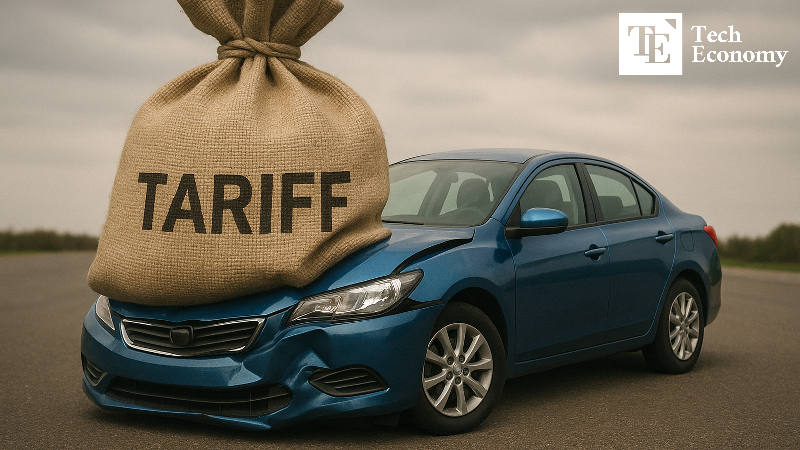
Tariff Deadlock Sends Shockwaves Through Auto Parts Sector
The impact of the high tariffs is extending beyond carmakers to the entire Korean automotive ecosystem. According to a survey by the Korea Auto Industries Cooperative Association (KAICA), the combined operating profit of the top 100 listed auto parts firms excluding Hyundai Mobis reached $7.8 billion in the second quarter, down 10.2% from $8.7 billion a year earlier. The decline was more pronounced among second-tier suppliers (–23.7%) than among first-tier suppliers (–9.2%). With the full tariff effects reflected from the third quarter onward and no pre-tariff export surge to offset the impact, the industry’s profit slump has deepened sharply.
KAICA data shows that Korea’s auto parts exports to the U.S. totaled $8.22 billion last year. Applying the 25% tariff means an additional $2.05 billion in annual costs for the parts sector alone. As a result, many suppliers are now facing the prospect of losses. A supplier in Ansan that manufactures engine ignition components said it exports $450 million worth of products—about 25% of its total sales—to the U.S. The $112 million in tariffs on those exports exceed its operating profit of $105 million last year. The CEO of another parts maker specializing in door trims lamented, “If we cut exports to the U.S. to avoid tariffs, our sales fall and profitability worsens. Since foreign automakers aren’t subject to the cost-indexed price adjustment system that covers rising raw material costs, our margins collapse whenever prices go up.”
Some firms have already opted for court receivership, concluding that it’s impossible to stay profitable under the 25% tariff regime. Alux, an aluminum wheel manufacturer based in Gimje, North Jeolla Province, filed for court receivership in May. A first-tier supplier to Hyundai and Kia, Alux had doubled its revenue from $210 million a decade ago to $450 million last year, but its production costs surged 15.5% ($49 million) in 2024, slashing its operating profit from $38 million to just $2.2 million. Burdened with $170 million in short-term loans at annual interest rates of 5–7%, the company posted a net loss of $39 million last year.
The tire industry, also subject to the 25% tariff, has not been spared. Hankook Tire’s third-quarter operating profit is estimated at $300 million, down 13.7% year-on-year. Kumho Tire, which suffered a sharp production drop after a fire at its Gwangju plant in May, is projected to see its operating profit plunge more than 30% to $70 million. Nexen Tire, which lacks a U.S. plant, faces a 22.8% decline to just $30 million in operating profit due to tariff pressures.
An industry insider said, “In addition to tariffs, the expanded application of the ordinary wage system has also raised labor costs and squeezed profitability. If Hyundai Motor Group’s situation worsens further, the entire Korean auto industry could be in serious trouble.” Kang Nam-hoon, president of the Korea Automobile & Mobility Association, added, “With the tariff negotiations delayed beyond the APEC summit that opens on the 31st in Gyeongju, the industry’s hardship is being prolonged. If the automotive ecosystem collapses, the damage will spread to steel, machinery, and petrochemicals. The government must step in with tax incentives and comprehensive support measures.”
Similar Post