U.S. Nuclear Renaissance Fueled by Japanese Capital: $80 Billion Bet on Reactor Construction

Anne-Marie Nicholson is a fearless reporter covering international markets and global economic shifts. With a background in international relations, she provides a nuanced perspective on trade policies, foreign investments, and macroeconomic developments. Quick-witted and always on the move, she delivers hard-hitting stories that connect the dots in an ever-changing global economy.
Authored On
Modified
Trump Administration, Westinghouse, Brookfield, and Cameco Form Strategic Partnership
At Least $80 Billion to Be Invested Nationwide, Aiming to Reestablish U.S. as Nuclear Powerhouse
U.S. Government to Secure 20% Conditional Profit Participation in Exchange for Funding and Licensing Support
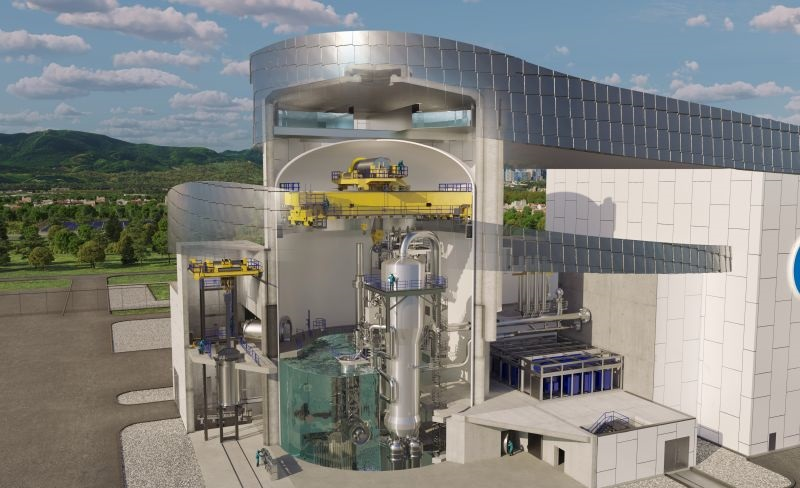
The administration of U.S. President Donald Trump, which is pursuing the revitalization of the domestic nuclear industry, has announced plans to invest $80 billion in the construction of new reactors by U.S. nuclear companies. The initiative, combining American and Japanese capital, is seen as a core pillar of Trump’s “energy sovereignty restoration” agenda.
Partnership with Westinghouse Parent Firms: “Government Investment to Foster Industry”
According to the Financial Times (FT) on the 28th (local time), Brookfield Asset Management, the parent company of Westinghouse, and Canadian uranium producer Cameco have entered into a partnership with the Trump administration to construct power plants, including large-scale AP1000 reactors and small modular reactors (SMRs).
The plan will be jointly financed with Japanese investment. FT reported that President Trump signed a $550 billion U.S.–Japan trade agreement during his first summit with newly elected Japanese Prime Minister Sanae Takaichi, of which up to $100 billion will be allocated to the Westinghouse nuclear project. The partnership was coordinated over several months by U.S. Secretary of Commerce Howard Lutnick and Brookfield’s executive team, while Brookfield CEO Bruce Flatt attended the contract signing ceremony in Japan alongside President Trump.
The U.S. government will assist Westinghouse in securing reactor sites and expediting licensing procedures, and, if necessary, will provide loan guarantees and overseas project support. The agreement also reportedly includes a clause granting the U.S. government a share of Westinghouse’s profits. If the full $80 billion investment is executed, the government will receive 20% of company profits, and if Westinghouse’s valuation exceeds $30 billion by 2029, Washington will have the right to convert its stake into equity and demand a public listing.
New Reactors to Be Licensed Within 18 Months, Quadrupling Nuclear Output by 2050
The initiative marks one of the largest projects in the U.S. nuclear energy sector in decades and aligns with President Trump’s broader strategy to maximize energy production centered on oil, gas, coal, and nuclear power. In May, Trump announced a plan to quadruple the country’s nuclear generation capacity by 2050, signing four executive orders aimed at easing safety-related regulations to accelerate development.
The executive orders cover: (1) reform of the Nuclear Regulatory Commission (NRC), (2) restructuring of nuclear energy research within the Department of Energy, (3) promotion of nuclear plant construction on federal land, and (4) expansion of domestic uranium mining and enrichment. Specifically, they mandate that NRC decisions on new plant licenses be made within 18 months, aligning regulatory procedures with industry needs and public safety. “Before 1978, 133 reactors were built in the U.S., but since then only two commercial reactors have begun operation,” a White House official noted, attributing the stagnation to “excessive regulation.”
Earlier, Trump had also signed an executive order revising regulatory procedures for reactor testing, which includes establishing three new pilot experimental reactors slated for activation by July next year. “This is the nuclear era, and we’re going to go big,” Trump declared.
Texas Project Targeting Groundbreaking Next Year After Rapid Licensing
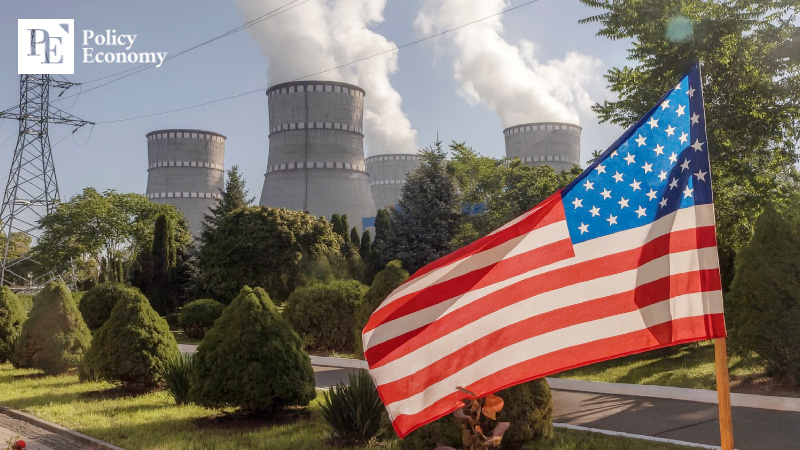
Some of the nuclear projects spearheaded by the Trump administration are already moving at unprecedented speed, with groundbreaking slated for next year. U.S. energy developer Fermi America is constructing an 11-gigawatt (GW) mega power complex near Amarillo, Texas, under “Project Matador,” designed to meet the surging power demand from artificial intelligence (AI) data centers. The site will include four large AP1000 reactors and 2 GW of SMRs.
Fermi plans to break ground on the large-scale reactors in the second half of 2026 — an extraordinary pace given that the NRC’s combined operating license (COL) approval process typically takes more than three years. Founded in January this year, Fermi has begun fundraising through an initial public offering (IPO) and submitted an application to the NRC in June for a 4 GW Westinghouse COL.
Fermi is also closely collaborating with South Korean partners. In July, the company signed a memorandum of understanding (MOU) with Hyundai Engineering & Construction for a six-month front-end engineering design (FEED) process, leading up to engineering, procurement, and construction (EPC) commencement in the third quarter of next year. In August, it entered into additional MOUs with Korea Hydro & Nuclear Power, Doosan Enerbility, and Samsung C&T to cooperate on project execution, potential equity investment, and equipment procurement.
Anne-Marie Nicholson is a fearless reporter covering international markets and global economic shifts. With a background in international relations, she provides a nuanced perspective on trade policies, foreign investments, and macroeconomic developments. Quick-witted and always on the move, she delivers hard-hitting stories that connect the dots in an ever-changing global economy.
Similar Post