Tesla Retreats from ‘Full Autonomy’ amid Safety Risks and Technical Limits, Considers Adding Steering Wheel and Pedals to Cybercab

Siobhán Delaney is a Dublin-based writer for The Economy, focusing on culture, education, and international affairs. With a background in media and communication from University College Dublin, she contributes to cross-regional coverage and translation-based commentary. Her work emphasizes clarity and balance, especially in contexts shaped by cultural difference and policy translation.
Authored On
Modified
Cybercab Redesign and FSD Strategy Revision
Legal and Regulatory Pressure Stalls Commercialization
Optimism over Full Autonomy Faces Reality Check
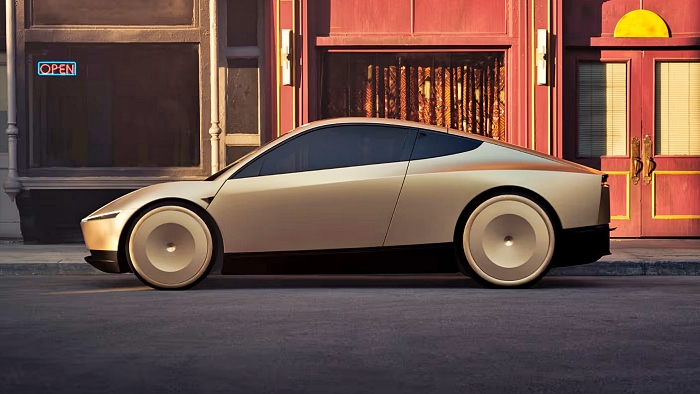
U.S. electric vehicle maker Tesla is reportedly reconsidering its plan to launch the next-generation Cybercab exclusively as a fully autonomous robo-taxi, leaving open the possibility of offering a conventional version equipped with a steering wheel and pedals. The move marks a clear departure from Tesla’s earlier vision of an all-autonomous future. It follows the company’s decision last month to downgrade Full Self-Driving (FSD) from a “fully autonomous system” to a “driver-supervised assistance system,” signaling a broad recalibration of its commercialization strategy.
Tesla Redesigns Cybercab
According to U.S. EV outlet Electrek on the 29th (local time), Tesla Chair Robyn Denholm told Bloomberg on the 28th that “if a steering wheel is needed, we can add it — pedals as well.” Denholm described the Cybercab as what investors often call “Model 2,” a vehicle priced below the Model 3, hinting at a shift away from Tesla’s earlier insistence on full autonomy.
The Cybercab had originally been introduced as a steering-wheel-free, pedal-less autonomous vehicle. Tesla CEO Elon Musk unveiled the prototype last October at a studio near Los Angeles, calling the idea of building a $25,000 conventional EV “pointless” and “contrary to Tesla’s philosophy.” Denholm’s latest remarks, however, suggest the company is softening its stance.
In practice, Tesla has yet to achieve driver-unmonitored autonomy. Musk’s repeated predictions about the timeline for full self-driving have consistently missed the mark. Last month, Tesla rebranded the feature as “FSD (Supervised),” clarifying that human oversight remains mandatory. Updated legal disclaimers explicitly state that “the vehicle is not autonomous and does not guarantee such capability.”
Musk’s new compensation package also contains language clarifying that FSD “does not mean unsupervised autonomy.” Instead, the system is described as “an advanced driver-assistance feature capable of semi-autonomous operations under specific conditions.” In effect, Tesla has reclassified FSD as a high-level assistive technology rather than a fully autonomous system. Meanwhile, U.S. regulators still require both steering wheels and pedals for consumer vehicles, and mandate safety monitors even for robo-taxi testing.
Court Rules Tesla Partly Liable in Robo-Taxi Fatality
Regulatory limits have also influenced Tesla’s potential redesign. The National Highway Traffic Safety Administration (NHTSA) caps production of steering-wheel-free vehicles at 2,500 units per company per year, constraining the market size for fully autonomous robo-taxis.
A larger factor, however, stems from a recent court ruling on a fatal crash involving Tesla’s Autopilot system. In August, a Miami federal jury found Tesla 33% liable for a 2019 Florida accident, ordering the company to pay $243 million in damages, including $200 million in punitive damages.
It marked Tesla’s first courtroom loss in an Autopilot-related fatality. Previously, the company had settled most cases out of court or prevailed at trial. According to the nonprofit tracker TeslaDeaths.com, at least 58 fatalities have occurred while Autopilot was engaged. The verdict is expected to complicate Tesla’s plans to expand its robo-taxi services beyond Austin, Texas, into other states such as California.

Full Autonomy Deemed “Fundamentally Unfeasible”
Analysts describe Tesla’s retreat from full autonomy as inevitable. Major automakers have already conceded that “Level 5” self-driving — vehicles operating in all conditions without human input — remains technically out of reach.
Back in 2015, Ford predicted self-driving cars would be on roads within five years. In 2016, Musk himself declared Tesla would complete a fully autonomous trip from Los Angeles to New York by the end of 2017. Yet such promises have repeatedly been deferred. In a September report, S&P Global Mobility projected that “true Level 5 autonomy will not appear before 2035 — and potentially much later.” Some experts interpret that as “perhaps never.”
Abandoning full autonomy altogether has become increasingly common. In October 2022, Ford shut down its autonomous driving subsidiary Argo AI, laying off over 2,000 employees and scrapping a planned IPO. The automaker redirected roughly $2.7 billion toward developing advanced driver-assistance systems (ADAS) instead. Volkswagen likewise halted Audi’s self-driving program, citing cost, practicality, and technical constraints. Apple, which had invested billions of dollars in its Level 4 and Level 5 car project, officially canceled it in February last year. A string of smaller autonomous driving startups have since folded as well.
Siobhán Delaney is a Dublin-based writer for The Economy, focusing on culture, education, and international affairs. With a background in media and communication from University College Dublin, she contributes to cross-regional coverage and translation-based commentary. Her work emphasizes clarity and balance, especially in contexts shaped by cultural difference and policy translation.
Similar Post