U.S. and China Call a Truce in Their ‘Chicken Game’ — But the Fuse Remains Live Under a One-Year Deal

Matthew Reuter is a senior economic correspondent at The Economy, where he covers global financial markets, emerging technologies, and cross-border trade dynamics. With over a decade of experience reporting from major financial hubs—including London, New York, and Hong Kong—Matthew has developed a reputation for breaking complex economic stories into sharp, accessible narratives. Before joining The Economy, he worked at a leading European financial daily, where his investigative reporting on post-crisis banking reforms earned him recognition from the European Press Association. A graduate of the London School of Economics, Matthew holds dual degrees in economics and international relations. He is particularly interested in how data science and AI are reshaping market analysis and policymaking, often blending quantitative insights into his articles. Outside journalism, Matthew frequently moderates panels at global finance summits and guest lectures on financial journalism at top universities.
Authored On
Modified
Trump and Xi Hold First Talks in 6 Years and 4 Months
China to Ease Rare Earth Export Curbs, U.S. to Halve Fentanyl Tariffs
Most Measures Are One-Year Deferrals, Leaving Risks of Renewed Tensions
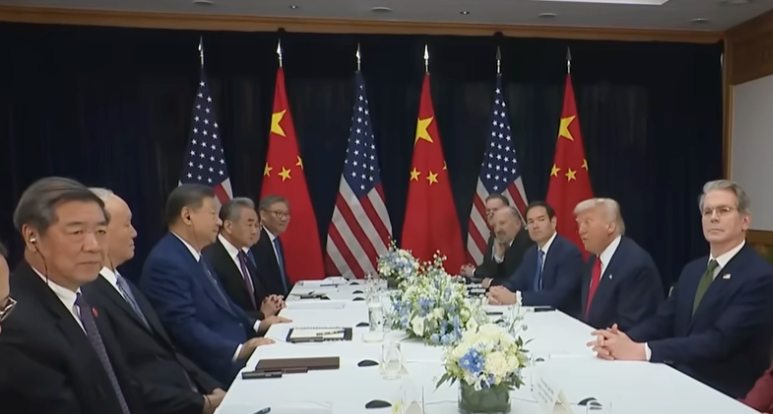
U.S. President Donald Trump and Chinese President Xi Jinping met again in Busan—their first encounter in six years and four months since the 2019 G20 Summit in Osaka, Japan. The two leaders formally declared a truce in the escalating U.S.-China trade war and reached limited agreements on key economic issues. However, the meeting was seen largely as a temporary patch on flashpoints such as rare earths and tariffs, with unresolved disputes over Taiwan, Russia, and security matters leaving the underlying volatility intact.
Agreement Amounts to a Temporary ‘Ceasefire’ on Tariffs, Rare Earths, and Agricultural Trade
According to China Central Television (CCTV), the two leaders met for approximately one hour and forty minutes at the air base’s reception hall before concluding their talks. The summit effectively formalized the outcomes of the fifth round of trade negotiations held earlier in Kuala Lumpur.
Under the agreement, the United States will halve its so-called “fentanyl tariffs” on Chinese products—from 20% to 10%—in exchange for China’s cooperation in curbing the smuggling of the synthetic opioid fentanyl. Earlier this year, the Trump administration imposed a punitive 20% surcharge on top of existing tariffs, citing Chinese-made fentanyl precursors flowing through Mexico and Canada into the U.S. With the reduction, the average U.S. tariff rate on Chinese imports will fall from 57% to 47%, reflecting a combination of base tariffs and the revised fentanyl levy.
The U.S. Department of Commerce also agreed to suspend for one year its new export control measure applying restrictions to subsidiaries that are more than 50% owned by blacklisted Chinese firms. In return, Beijing will resume purchases of U.S. soybeans and other agricultural products and suspend its export curbs on rare earth materials for at least a year. The two sides likewise agreed to defer for one year the imposition of special port fees that were scheduled to take effect on October 14.
The leaders also touched on semiconductor issues central to the AI ecosystem. President Trump noted that Nvidia would negotiate directly with Chinese authorities over its AI chip sales, though he refrained from mentioning whether the company’s latest “Blackwell” processors would be supplied to China. The U.S., in its tech rivalry with Beijing, has restricted exports of advanced AI chips. Nvidia’s lower-performance H20 chips, designed to comply with prior export rules, were also banned from export this April. “That’s between China and Nvidia,” Trump said. “We’re the mediators—the referees.”
No ‘Big Deal’ or Structural Shift in Tariffs
Analysts judged that the meeting did little to ease the structural strain in U.S.-China relations. Ryan Hass of the Brookings Institution observed, “None of the previous five Trump–Xi meetings produced a lasting breakthrough or sustainable understanding, and this one was no exception.”
A Chinese government-affiliated scholar told the Financial Times that a “dynamic equilibrium” would persist until each side could weaken the other’s grip over critical technologies like rare earths and semiconductors, adding, “Whoever breaks that balance first will be the one who develops new technologies faster.” Sarah Berran, a partner at Macro Advisory Partners, said both sides were using the summit “to stabilize relations temporarily, slow the pace of decoupling, and minimize the economic fallout.” She added that while the modest agreements could restore ties to their pre–rare earth crisis levels, “the structural tensions will remain unresolved.”
Despite appearances of de-escalation, experts agreed the summit achieved only a tentative compromise on “easy targets,” leaving the deeper conflicts untouched. Earlier this year, Washington and Beijing agreed to a 90-day tariff truce after cutting reciprocal duties by 115 percentage points during talks in Geneva. Subsequent meetings in London, Stockholm, Madrid, and Kuala Lumpur aimed to manage the fallout from successive rounds of sanctions and export bans.
Yet the latest measures—China’s one-year suspension of rare earth controls, its resumption of U.S. soybean imports, and the U.S. reduction of fentanyl-related tariffs—were largely prearranged at the October Kuala Lumpur talks. Though the two presidents sat face-to-face, the outcome amounted to reaffirming previous understandings rather than striking a transformative “big deal.” Sensitive topics such as Taiwan, the South China Sea, and China’s Pacific military buildup were left off the table, while Ukraine was only mentioned symbolically as an area for “joint response.” As a result, the meeting was widely viewed as lacking substantive progress.
Trump’s Order to Resume Nuclear Testing Seen as a New Negotiating Lever
Even as the two leaders paused their economic confrontation, both are expected to sustain top-down diplomacy through the Asia-Pacific Economic Cooperation (APEC) process. Trump plans to visit China in April next year, with Xi likely to make a reciprocal trip to Palm Beach, Florida, or Washington, D.C. thereafter.
Hours before the Busan summit, Trump signaled his intent to wield a new bargaining chip. On his Truth Social account at 10 a.m., he wrote, “Because of other countries’ nuclear testing programs, I have directed the Department of Defense to begin testing our Nuclear Weapons at a comparable level. This process will begin immediately.” The reference to “other countries” was widely interpreted as aimed at Russia and China.
He added, “The United States has more nuclear weapons than any other nation—thanks to a full overhaul and modernization during my first term. Given their enormous destructive power, I really did not want to do this, but I have no choice. Russia is second, and China—though far behind—could reach parity within five years.”
Trump’s declaration followed recent developments in Moscow and Beijing. Russian President Vladimir Putin announced on October 29 that Russia had successfully tested its Poseidon nuclear-powered underwater drone capable of carrying nuclear warheads. China, for its part, showcased five intercontinental nuclear weapons at last month’s military parade commemorating its wartime victory. China’s nuclear stockpile has reportedly doubled from 300 warheads in 2020 to around 600 today.
The U.S. has not conducted an official nuclear detonation since the 1992 “Divider” test in Nevada and signed the Comprehensive Nuclear-Test-Ban Treaty (CTBT) in 1996. If the plan proceeds, it would mark a reversal after 33 years. The New York Times noted that Trump’s call for “equivalent standards” likely signals not a full-scale nuclear explosion but performance tests of missiles or undersea assets, describing the move as both a pressure tactic against Russia and a strategic lever in the ongoing trade confrontation with China.
Matthew Reuter is a senior economic correspondent at The Economy, where he covers global financial markets, emerging technologies, and cross-border trade dynamics. With over a decade of experience reporting from major financial hubs—including London, New York, and Hong Kong—Matthew has developed a reputation for breaking complex economic stories into sharp, accessible narratives. Before joining The Economy, he worked at a leading European financial daily, where his investigative reporting on post-crisis banking reforms earned him recognition from the European Press Association. A graduate of the London School of Economics, Matthew holds dual degrees in economics and international relations. He is particularly interested in how data science and AI are reshaping market analysis and policymaking, often blending quantitative insights into his articles. Outside journalism, Matthew frequently moderates panels at global finance summits and guest lectures on financial journalism at top universities.
Similar Post