China Signals Cuts to EV Subsidies — Is the Country’s Electric Vehicle Boom Losing Steam?

As one of the youngest members of the team, Tyler Hansbrough is a rising star in financial journalism. His fresh perspective and analytical approach bring a modern edge to business reporting. Whether he’s covering stock market trends or dissecting corporate earnings, his sharp insights resonate with the new generation of investors.
Authored On
Modified
China Removes Electric Vehicles from Strategic Industry List
Analysts Warn of Sharp Competitiveness Decline if Subsidies End
Mass Closures Hint at Deepening Restructuring Crisis in China’s EV Sector
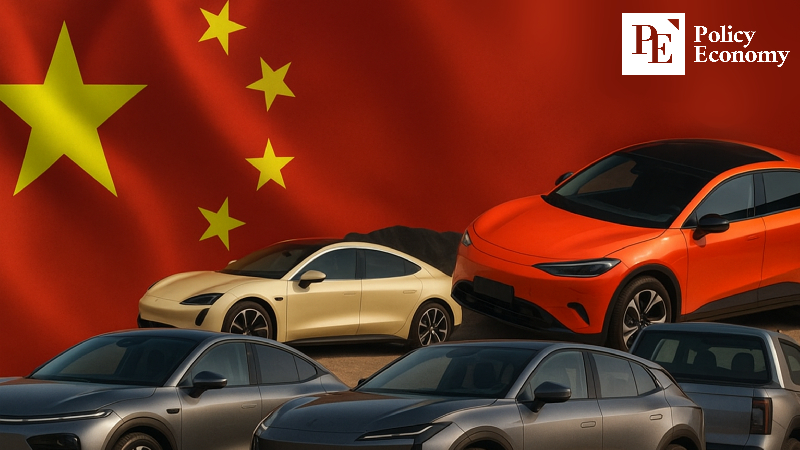
The Chinese government has signaled a potential reduction in support for the electric vehicle industry, having excluded new energy vehicles—including electric, hydrogen, and hybrid cars—from the list of strategic emerging industries in its newly finalized five-year plan. Analysts warn that if subsidies and tax incentives for EVs are not renewed once they expire, China’s electric vehicle sector could lose its growth momentum and face a sharp decline in sales.
China Pulls Back Support for Its Electric Vehicle Industry
According to China’s state-run Xinhua News Agency on the 28th (local time), the Communist Party unveiled the full text of its “Proposals on Formulating the 15th Five-Year Plan for National Economic and Social Development,” adopted during the Fourth Plenary Session of the 20th Central Committee. The 20,000-character document outlines Beijing’s goal to “make significant progress in basic research and original innovation, achieve breakthroughs in key technologies, and strengthen technological self-reliance.” It marks the first time in about a decade that “technological self-reliance” has been explicitly defined as a core national development objective.
The proposal also sets out plans to “maintain economic growth within a reasonable range, steadily enhance total factor productivity, and significantly boost household consumption.” It emphasizes strengthening domestic demand as the main driver of growth — signaling Beijing’s intent to shift its economic structure toward consumption-led expansion. Larry Hu, chief China economist at Macquarie Group, noted, “This doesn’t imply immediate stimulus measures, but it reflects a long-term elevation of consumption’s role in the economy.”
Amid this renewed focus on technological advancement, markets have zeroed in on the government’s decision to exclude new energy vehicles (NEVs) from the list of strategic emerging industries in the new Five-Year Plan. NEVs — which include electric, hydrogen, and hybrid cars — had been designated as a strategic priority for three consecutive plans and served as a key growth driver. Analysts now see the exclusion as a signal that Beijing considers the EV sector mature and intends to scale back financial support, allowing market forces to take over. Dan Wang, China director at Eurasia Group, said, “This is an official acknowledgment that EVs no longer require preferential policy support — subsidies will disappear.”
Sales Slowdown Looms as Subsidies and Tax Incentives Near Expiration
For years, the Chinese government has poured massive funding into the electric vehicle industry. According to research by Scott Kennedy of the Center for Strategic and International Studies (CSIS), China has provided an estimated 230.9 billion dollars in subsidies and grants to the EV sector over the past 15 years. Currently, Beijing continues to offer about 20,000 yuan (roughly 4,000 dollars) in subsidies per EV purchase under its “trade-in program” designed to boost domestic consumption. Tax incentives such as exemptions from purchase and consumption taxes for new energy vehicles (electric, hydrogen, and hybrid cars) also remain in place.
Western nations, however, have pushed back against China’s aggressive industrial support. The European Union, for instance, imposed additional countervailing tariffs on Chinese-made EVs last October, arguing that Beijing’s subsidies allowed unfair price advantages that distorted the European market. The EU subsequently raised its tariff rate on Chinese EVs from 10% to between 17.8% and 45.8%.
Analysts warn that if China phases out these subsidies and incentives, the country’s EV market could lose momentum rapidly. Nick Lai, Asia-Pacific automotive analyst at J.P. Morgan, told the South China Morning Post that “because subsidies pulled forward significant demand, overall car sales could fall by 3–5% next year,” adding that “EV sales growth specifically may slow from 27% this year to around 15% next year.”
The concern stems from the fact that key support measures are set to expire soon. The trade-in program will end this year, while current tax breaks will be gradually withdrawn—imposing a 5% purchase tax on new energy vehicles starting in 2025 and 10% from 2028. With NEVs now excluded from China’s list of strategic emerging industries, the likelihood of these programs being extended appears increasingly slim.
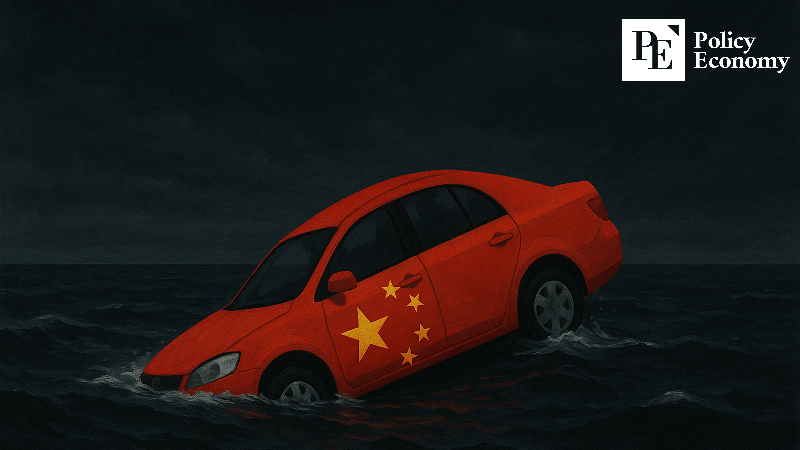
China’s EV Industry Locked in a Price War
The Chinese government’s withdrawal of support could deal a heavy blow to an electric vehicle industry already mired in stagnation. According to data from consulting firm AlixPartners, the number of Chinese EV manufacturers surged from 34 in 2018 to 80 in 2023 but fell to 77 last year — the first decline on record. Sixteen automakers shut down that same year, unable to survive the overheated competition in a domestic market inflated by government subsidies.
Now, Chinese EV makers are engaged in a brutal price war to stay afloat. J.P. Morgan reports that the average discount rate among Chinese carmakers doubled from 8.3% last year to 16.8% as of April this year. Even major players are caught up in the fight: when BYD announced in May that it would slash prices on 22 models by up to 34%, roughly ten competitors — including Chery and SAIC Motor — retaliated with discounts of up to 47%.
The fallout is spreading beyond automakers to the broader automotive ecosystem. Profitability among car dealerships has plunged as the EV price war intensifies. In the first half of this year, more than half (52.6%) of Chinese dealerships reportedly sold vehicles at a loss. As the red ink deepened, an unprecedented wave of bankruptcies followed — with over 70 dealerships shutting down overnight just last month.
As one of the youngest members of the team, Tyler Hansbrough is a rising star in financial journalism. His fresh perspective and analytical approach bring a modern edge to business reporting. Whether he’s covering stock market trends or dissecting corporate earnings, his sharp insights resonate with the new generation of investors.
Similar Post