Starbucks, Squeezed by China’s Economic Slump and Low-Cost Rivals, Sells Control of Its China Business

Anne-Marie Nicholson is a fearless reporter covering international markets and global economic shifts. With a background in international relations, she provides a nuanced perspective on trade policies, foreign investments, and macroeconomic developments. Quick-witted and always on the move, she delivers hard-hitting stories that connect the dots in an ever-changing global economy.
Authored On
Modified
Chinese Sales Peaked in 2021 Before Declining
Losing Ground to Domestic Brands Like Luckin Coffee
Even the Coffee Giant Yields to the “Low-Price” Onslaught

Starbucks is selling a majority stake in its China operations, once touted as the brand’s most promising market beyond the United States. The $4 billion deal hands managerial control to Chinese private equity firm Boyu Capital. Since entering China in 1999 as a symbol of “premium coffee culture,” Starbucks has enjoyed two decades of dominance. But that momentum has now reversed. As China’s prolonged economic downturn tightens household budgets, local low-cost coffee chains have surged in popularity. Compounding the challenge, mobile ordering and delivery—fields dominated by domestic competitors—have overtaken the in-store “experience” Starbucks once relied upon.
Selling 60% of China Stake
On November 3 (local time), Starbucks’ U.S. headquarters announced a new joint venture with Boyu Capital to operate its mainland China business. Under the agreement, Boyu will hold up to a 60% stake, while Starbucks retains 40%. Starbucks will license its intellectual property—including branding, recipes, and app infrastructure—to the joint venture in exchange for royalties. The transaction is expected to close by the second quarter of fiscal 2026.
The sale marks a strategic retreat for Starbucks. The company opened its first store in China in 1999, betting on the market’s vast population and growth potential. It rapidly expanded from Beijing and Shanghai into smaller cities, adding hundreds of stores annually. Today, with roughly 7,800 locations, China remains Starbucks’ second-largest global market.
However, the brand’s standing in China has deteriorated sharply. After peaking at $3.7 billion in revenue in 2021, Starbucks’ China sales fell to $3 billion last year despite continued store expansion. In the first quarter of this year, revenue reached $743.6 million—up just 1% year-on-year—while same-store sales fell 6%.
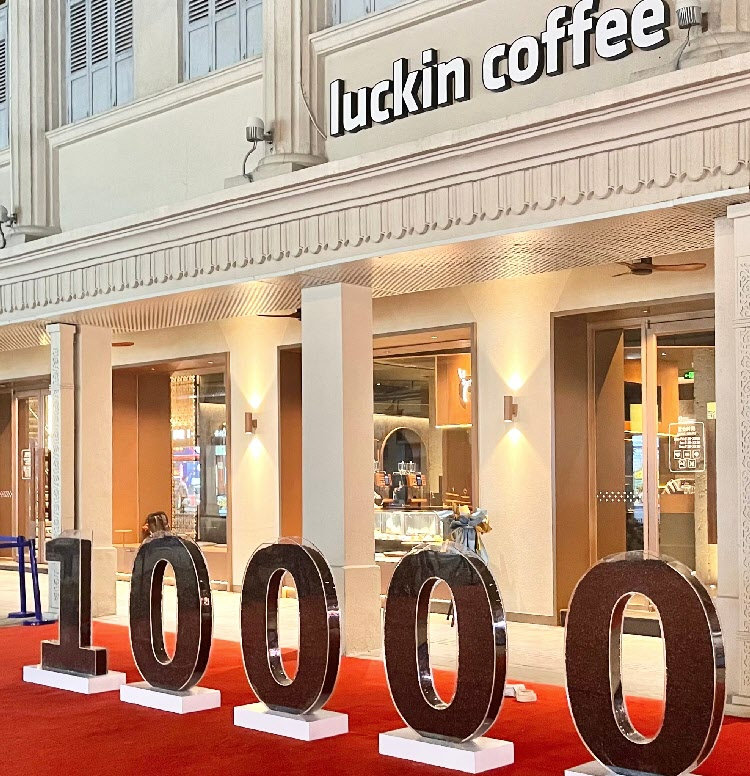
Luckin Coffee Targets Starbucks with Aggressive Low-Cost Strategy
The greatest threat to Starbucks’ dominance has come from homegrown challengers, especially Luckin Coffee. From the outset, Luckin sought to undercut Starbucks with aggressive pricing and rapid expansion. It now surpasses Starbucks in both store count—over 20,000 outlets—and revenue. As a result, Starbucks’ market share in China has plunged from 34% in 2019 to 14% last year—halved in just six years since Luckin’s founding.
Luckin’s rise wasn’t without turmoil. After its 2020 accounting scandal, the company was delisted from Nasdaq and fined $180 million by the U.S. Securities and Exchange Commission. Yet it rebounded through bankruptcy restructuring and bold marketing—coupon promotions, specialty menu launches, and a delivery-centric model. In the first quarter of 2024, Luckin’s revenue surged 41.2% year-on-year to approximately $12.5 billion, while operating profit reached about $1.25 billion with an 8.3% margin. Same-store sales rose 8.1%, and monthly active customers jumped 24% to 74.27 million, with total customers exceeding 355 million. Growth continued into the second quarter, when Luckin generated $17.5 billion in sales—far outpacing Starbucks’ $8 billion.
Luckin’s main advantage lies in affordability. With real estate stagnation and a slowing economy, Chinese consumers are increasingly price-conscious. The trend is evident across the retail sector: while luxury restaurants and jewelers have struggled, budget coffee chains and outlet stores have flourished. According to Reuters, a Luckin latte sells for about $1.30—roughly one-third the price of Starbucks.
Product diversification has also fueled Luckin’s success. Its signature “Raw Coconut Latte,” now in its fourth year, has sold over 1.3 billion cups. In March, the company set a new single-day record by selling 1.67 million cups of its new “Fresh Jasmine Tea.” In 2023, Luckin’s collaboration with Moutai to create a “Moutai Latte” became a viral sensation. Starbucks’ response—a $12 “Dongpo Pork Latte” released for the Lunar New Year—was widely panned for its high price and polarizing flavor.
Luckin also excels in convenience. Customers can order drinks from flat whites to raspberry cold brews instantly via its mobile app. By eliminating in-store ordering and focusing entirely on mobile pickup, Luckin popularized the takeout coffee culture in China. Starbucks, though now processing over one-third of its Chinese orders through mobile channels, still struggles with slow service as baristas prepare customized beverages—leading to long waits and customer frustration during rush hours.
Deflation Pressures Force Starbucks to Cut Prices
Facing mounting pressure, Starbucks took the unprecedented step of lowering beverage prices in China this summer—the first price reduction since its market entry. The company framed the move as an effort to boost afternoon sales through its “coffee by morning, non-coffee by afternoon” strategy, targeting milk tea and other beverages. Yet analysts say the decision undermined Starbucks’ premium brand identity built around its “third place” experience.
In July, Starbucks began offering free study rooms in select stores—an approach that sharply contrasts with its U.S. policy of restricting restroom access to paying customers. These study spaces require no purchase or reservation and have drawn heavy foot traffic, but at the cost of profitability. By September, same-store sales in China were up just 2% for the quarter, even as customer traffic surged 9%. More visitors came, but average spending per customer fell 7% as buyers opted for cheaper drinks.
Experts widely agree that Starbucks’ only viable path to survival in China is further price cuts. Chinese consumers’ purchasing power is unlikely to recover soon. Although China’s GDP grew 5.4% year-on-year in the first quarter—slightly above expectations—global financial institutions now forecast full-year growth in the 4% range, a far cry from the 5–6% rates of earlier years. Persistently high youth unemployment, lingering since the pandemic, continues to weigh on spending. According to the National Bureau of Statistics, the jobless rate among urban youth aged 16–24 (excluding students) stood at 15.8% in September, down slightly from 16.5% in August but still alarmingly high. Mounting numbers of jobless graduates are deepening the slump in consumer demand.
Anne-Marie Nicholson is a fearless reporter covering international markets and global economic shifts. With a background in international relations, she provides a nuanced perspective on trade policies, foreign investments, and macroeconomic developments. Quick-witted and always on the move, she delivers hard-hitting stories that connect the dots in an ever-changing global economy.
Similar Post
















