From Drones to Robot Dogs: The End of Heavy Weapons Warfare

Aoife Brennan is a contributing writer for The Economy, with a focus on education, youth, and societal change. Based in Limerick, she holds a degree in political communication from Queen’s University Belfast. Aoife’s work draws connections between cultural narratives and public discourse in Europe and Asia.
Authored On
Modified
China Deploys Four-Legged “Wolf” Robots in Taiwan Strait Landing Drills
If Defensive Weaknesses Are Fixed, Drones and Robots Could Drive an Unmanned Battlefield
Military Drones Deliver Overwhelming Efficiency — From Small-Unit Support to Infrastructure Strikes
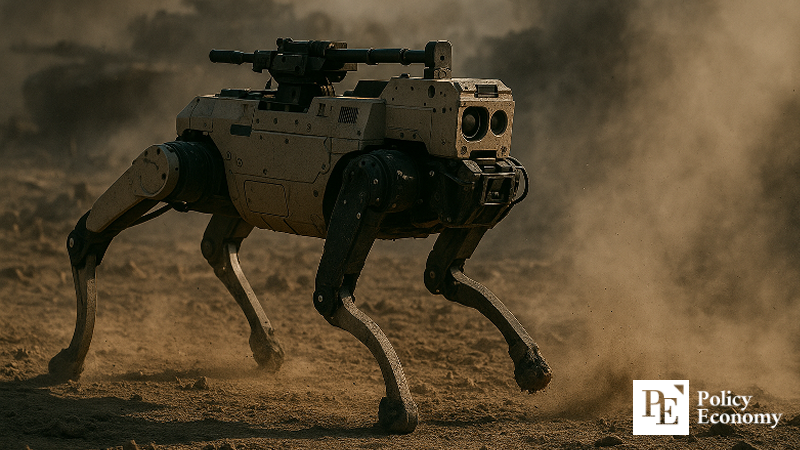
China’s People’s Liberation Army (PLA) has deployed unmanned robots in exercises in the Taiwan Strait. Four-legged “wolf robots” were assigned tasks such as reconnaissance and transport to streamline combat scenarios. The drills exposed technical limitations of the wolf robots, but experts expect those gaps to be closed soon. Analysts say ground-walking robots are likely to follow the path of already commercialized drones and redefine the standards of modern warfare.
Frontline 'Wolf Robots' Lead the Charge
On the 4th, China’s Central Television (CCTV) reported that the Huangcaoling Hero Company of the PLA’s Eastern Theater Command’s 72nd Group Army — a unit considered a core force for Taiwan Strait operations — unveiled four-legged “wolf robots” for the first time during an amphibious landing drill. Developed by state defense contractor China Ordnance Equipment Group, the robots are fitted with five thermal cameras, LiDAR, and multiple sensors to scan terrain in 360 degrees and carry out reconnaissance and target-engagement tasks in areas difficult for humans to access.
Using China-made autonomous-control chips, the robots can climb slopes of up to 40 degrees, overcome obstacles up to 30 cm high, and carry up to 20 kg. Their operational range is about 10 km and runtime around 2.5 hours.
In the exercise, assault-type wolf robots moved roughly 10 m ahead of soldiers to clear obstacles and identify hazards, breaching defenses such as barbed wire and trenches in three to five minutes. Transport-type robots followed, carrying 20 kg of ammunition and first-aid kits. Taiwan’s United Daily News reported that a single soldier used a 3D battlefield model to simultaneously control nine wolf robots and six drones, expanding the combat radius to four times that of a traditional squad.
However, footage released from the drill showed some wolf robots exposed on open beaches, revealing limited camouflage and concealment. Lacking protective armor against light weapons, several were easily destroyed. Some military analysts also noted that key components are externally exposed, reducing the robots’ survivability on the battlefield.
The Influence of Drones on the Battlefield
Some analysts predict that once “wolf robots” overcome limitations in durability and mobility, they could follow the same path as drones — now a common presence in modern warfare. After World War II in 1945 and through the Cold War era, drones were used primarily for reconnaissance and intelligence gathering. However, with advances in communications, battery technology, and payload capacity in the 21st century, drones have evolved into offensive weapons capable of carrying small munitions and conducting precision strikes in place of ground troops.
These upgraded drones were first widely deployed in the 2010s and 2020s across conflict zones in the Middle East and Africa. Wars in regions such as Afghanistan and the Middle East were characterized by guerrilla tactics, terrorism, and covert operations, where combat drones were used to locate and eliminate hidden targets. On July 31, 2022, the United States used a drone strike to assassinate Ayman al-Zawahiri, the leader of the extremist group al-Qaeda, who had succeeded Osama bin Laden and was one of the masterminds behind the 9/11 attacks.
The technology evolved further during the Russia–Ukraine war, the largest conventional conflict in Europe in the 21st century. Drones are now used not only for targeted strikes but as unmanned bombing platforms. Ukraine has expanded long-range drone attacks on strategic facilities inside Russia, including oil refineries, fuel depots, and military logistics hubs. More recently, Ukrainian forces have combined aerial and ground drones to encircle and bomb Russian trench positions, demonstrating how drones are now central to both anti-personnel operations and infrastructure destruction across the battlefield.
Cheap and Highly Versatile
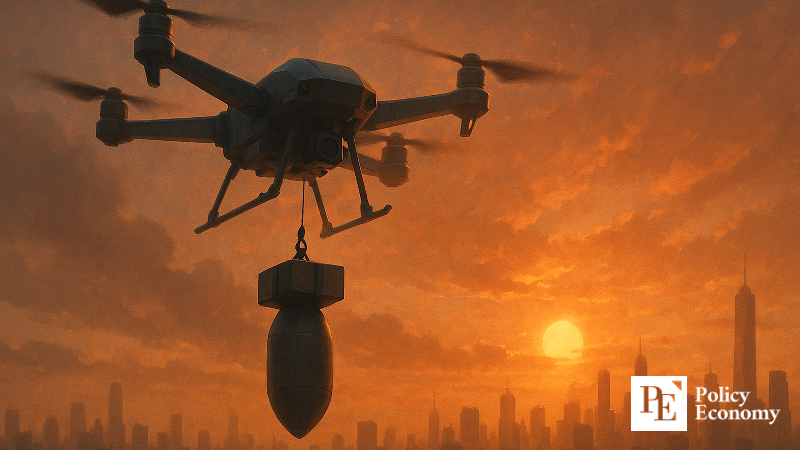
Drones are widely used on the battlefield because they are cheap and can be mass-produced quickly. Military drones come in many types and sizes. The most commonly used are small, low-cost first-person-view (FPV) drones. FPV drones stream real-time video for the operator and were originally used for racing and filming. Early in the Russia–Ukraine war, Ukraine quickly converted hobby FPV drones into weapons. Each modified drone costs about $400 to make. By contrast, a single Javelin anti-tank missile launch costs about $80,000, making FPV drones vastly cheaper.
If low-cost, small drones that can both scout and strike are produced in large numbers, they could fundamentally change small-unit infantry combat. Before drones became common, squads and platoons had to call for support from higher echelons when targets lay beyond their reach. Higher units would use reconnaissance aircraft, counter-battery radar, or scout teams to find and strike targets in a stepwise kill chain. But if squads and platoons deploy FPV drones, they can conduct wide-area reconnaissance and detection within a 20 km radius. They can immediately attack discovered targets with kamikaze strikes.
When precise anti-drone systems that identify and track enemy drones are paired with infantry at the squad and platoon level, forces could adopt a tactic where FPV drones perform reconnaissance and strikes first, and infantry enter the battlefield using the drone-gathered intelligence. In effect, battlefield outcomes now hinge less on the size and cost of weapons and more on the efficient use of advanced small systems like drones.
Aoife Brennan is a contributing writer for The Economy, with a focus on education, youth, and societal change. Based in Limerick, she holds a degree in political communication from Queen’s University Belfast. Aoife’s work draws connections between cultural narratives and public discourse in Europe and Asia.
Similar Post