The Mirage of the Humanoid Robot Market: Flashy Marketing Without Real Technological Substance

Anne-Marie Nicholson is a fearless reporter covering international markets and global economic shifts. With a background in international relations, she provides a nuanced perspective on trade policies, foreign investments, and macroeconomic developments. Quick-witted and always on the move, she delivers hard-hitting stories that connect the dots in an ever-changing global economy.
Authored On
Modified
Motion Control and Sensor Development Still in Early Stages
Even $80,000 Robots Require Pre-Inputted Object Locations
Incidents of Falling, Toppling, and Even Attacking Humans Reported
While humanoid robots are often hailed as the next great tool for replacing human labor, mounting evidence suggests that much of the optimism is misplaced. Experts argue that investors are wasting billions of dollars lured by glossy marketing campaigns, while the underlying technology remains immature. Before humanoid robots can scale, fundamental issues of reliability and safety must be resolved—yet the current technical capability is still in its infancy.
$80,000 Humanoid Robot Collapses Mid-Cooking Demonstration
According to TechCrunch on November 5 (local time), warnings are growing across the IT sector that the humanoid robot industry is an inflated bubble. The limitations were recently evident in experiments at the Massachusetts Institute of Technology (MIT). The Living Lab within MIT’s Computer Science and Artificial Intelligence Laboratory (CSAIL), which replicates a real kitchen environment, conducted a demonstration with Rainbow Robotics’ humanoid robot, priced at $80,000. Mounted on a wheeled base with dual arms, the robot prepared lemonade by pouring powder into a container of water and stirring it. The demo succeeded, but the robot’s reliance on pre-inputted object locations revealed a major weakness. Despite taking nearly a year to develop, the robot still cannot independently identify or locate objects.
Chinese robotics company Unitree faced similar challenges. Its humanoid robot managed to lift foam blocks to build a pyramid but frequently toppled the base or dropped the top layer, showing instability. In another test, a Unitree robot hurled tennis balls so fast that one ricocheted off a wall and disappeared, and on the second attempt, it lost balance and fell face-first onto the carpet.
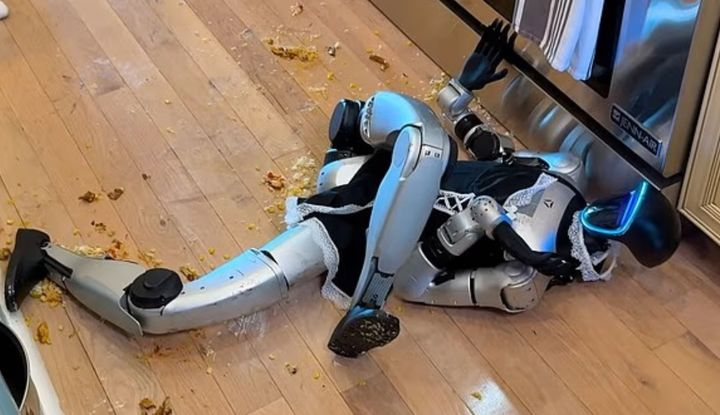
These flaws were further exposed by American YouTuber Cody Detwiler (channel name WhistlinDiesel), who tested Unitree’s $80,000 G1 humanoid robot by taping a frying pan to its hand and instructing it to cook stir-fry. The G1 failed to grip the pan properly, scattered food across the floor, and then slipped on the spilled food, falling over. The result: a kitchen covered in debris as both robot and human ended up slipping together.
The G1 employs 3D LiDAR sensors and depth cameras to perceive its surroundings, but without pre-programmed instructions, it can do little beyond walking or waving. When placed in an unprepared environment like a kitchen, it is highly prone to confusion and errors. Viewers reacted with amusement, calling the video “a comedy classic” and “the most realistic experiment ever,” while others joked, “We’ll be punished by robots in 20 years,” and “AI now has a reason to eliminate humanity within seven years.”
“A Waste of Money”: Expert Criticism Mounts
Experts warn that humanoid robot ventures are likely to fail for fundamental reasons. Rodney Brooks, an MIT-trained roboticist, recently wrote in an essay that “billions of dollars are being poured into humanoid robot startups, but it’s a waste of money.” He criticized the belief that showing robots human motion videos could teach them dexterity as “pure fantasy.” Human fingers contain about 17,000 specialized tactile receptors—something no robot can replicate. “We lack any real tradition of tactile data,” he wrote, “which makes it nearly impossible to mimic the human hand’s complexity.” Brooks also noted that machine learning advanced in voice and image recognition thanks to decades of data accumulation—something the robotics field still lacks.
Susanne Bieller, Secretary General of the International Federation of Robotics (IFR), likewise urged caution, warning that expectations have outpaced reality. “We must distinguish between hype and what’s actually achievable,” she said. Referring to an IFR report published in July, she explained that its purpose was to “correct the distortion between media attention and technological reality.” Bieller further emphasized that humanoid robots have not yet reached commercialization; most are still limited to research and development or custom prototypes for demonstrations.
ETH Zurich Professor Raffaello D’Andrea questioned the practical utility of humanoid robots in real-world settings. “There’s a big difference between showing a video of a moving robot and deploying it profitably in the field,” he said. “The key question is whether humanoids can be economical and scalable through mass production.” Boston robotics entrepreneur Sidney McLaughlin added, “Just think about cooking an egg in the morning—there are infinite variables. Robots performing repetitive or dangerous high-value tasks are promising, but replacing humans entirely is still far away.”
Technical and Safety Challenges Pile Up
Despite rapid market growth, analysts argue that the humanoid robot industry remains largely “virtual.” According to Fortune Business Insights, the global humanoid robot market is expected to grow from $24.3 billion in 2023 to $660 billion by 2032, at an annual rate of 45.5%. Goldman Sachs forecasts a $38 billion market by 2035, while Morgan Stanley projects $60 trillion by 2034.
Yet major technological barriers persist. Operation frameworks and task structures remain primitive, heavily reliant on human supervision. At the component level, several bottlenecks hinder progress, including limited battery capacity leading to short runtimes and high downtime, low production of precision screws that slows scalability, and the lack of advanced tactile sensors for fine-motor hands.
Agility also remains a problem. Micro-movement control and tactile precision are still rudimentary, and image recognition and sensor-based spatial awareness technologies are highly susceptible to environmental noise. Reflective surfaces, mirrors, or heat sources can drastically reduce recognition accuracy—issues that cannot be solved by algorithmic correction alone but require deep hardware–software integration.
Safety is an even greater concern. Humanoid robots must adhere to far stricter safety standards than industrial robots. In environments like car factories where humans and robots share space, advanced anomaly detection and failure-prevention mechanisms are essential—but such capabilities remain unrealized.
In May, a Chinese research lab reported a humanoid robot suddenly lashing out at nearby researchers. Video footage shows two engineers operating the suspended robot when it unexpectedly swung its arms, attacking them and knocking over nearby monitors. The erratic motion only stopped when one researcher pulled the crane backward. Similar risks persist with household robots, which may fall, malfunction, or mishandle dangerous objects such as boiling liquids or kitchen knives.
Establishing clear liability frameworks is also critical. As with autonomous vehicles, commercialization of humanoid robots requires defined responsibility among manufacturers, software providers, and users. Additionally, extensive simulation and data collection are needed to predict and control robot behavior under abnormal conditions. While ISO 10218 sets safety standards for human–robot collaboration, specialized standards for humanoids are still lacking.
Tesla’s Optimus, Figure, and Amazon’s Astro exemplify the industry’s speculative bubble. Figure, founded by former Tesla engineers, raised $1 billion but ultimately abandoned development after hitting technical walls. Amazon likewise scrapped its home-robot project five years after launching it in 2013 due to similar challenges. Its subsequent Astro robot failed to impress the market. Tesla, which introduced its Optimus humanoid in 2021 as a future growth engine, has also struggled to deliver. CEO Elon Musk originally promised production of 5,000 units this year, but only a few hundred have reportedly been built. Even in Tesla’s recent Master Plan 4, the company offered no concrete timeline for factory deployment of Optimus.
Anne-Marie Nicholson is a fearless reporter covering international markets and global economic shifts. With a background in international relations, she provides a nuanced perspective on trade policies, foreign investments, and macroeconomic developments. Quick-witted and always on the move, she delivers hard-hitting stories that connect the dots in an ever-changing global economy.
Similar Post