“AI Bubble Could Wipe Out 8% of U.S. Household Wealth” — Is the AI Boom Just Another Theme-Stock Frenzy?

As one of the youngest members of the team, Tyler Hansbrough is a rising star in financial journalism. His fresh perspective and analytical approach bring a modern edge to business reporting. Whether he’s covering stock market trends or dissecting corporate earnings, his sharp insights resonate with the new generation of investors.
Authored On
Modified
The Economist Warns: “If the AI Bubble Bursts Like the Dot-Com Crash, the Damage Could Be Enormous”
As Wall Street Sounds the Alarm, Some Compare the Trend to a “Thematic Stock Craze”
Hardware Firms See Explosive Growth, While Consumer-Facing Services Struggle to Profit
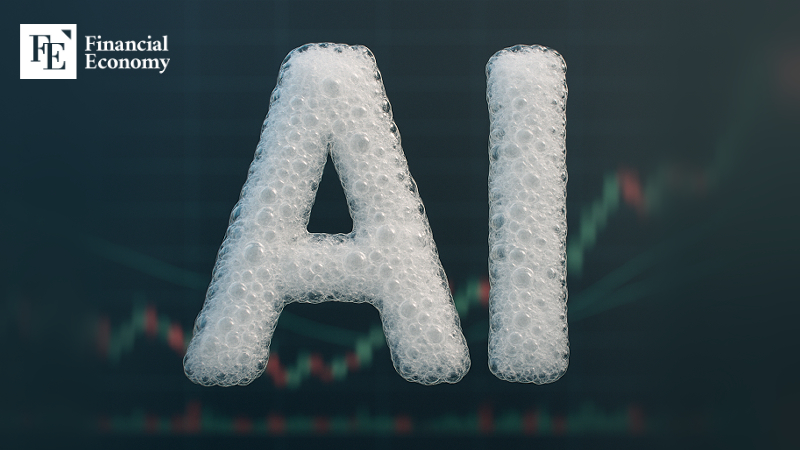
An analysis warns that if the U.S. stock market — fueled by the artificial intelligence (AI) boom — collapses to the extent of the dot-com bubble, up to 8% of total U.S. household wealth could be wiped out. Despite massive investment in AI, most services have yet to demonstrate meaningful economic returns, intensifying fears that an AI bubble may soon burst.
AI Frenzy Pushes U.S. Stocks to Overheated Levels
According to a report published by The Economist on the 5th, the U.S. stock market has surged about 71% since OpenAI’s launch of ChatGPT in 2022. In the second quarter of this year, the S&P 500’s market capitalization exceeded 175% of U.S. GDP. Nvidia last month became the world’s first company to reach a $5 trillion valuation, while OpenAI is reportedly preparing for an IPO valued at $1 trillion.
The Economist noted that the current rally resembles the dot-com bubble of the early 2000s. Back then, the S&P 500’s market cap rose to 124% of GDP, and the top five tech firms were valued at a combined $2 trillion. When the bubble burst, tech stocks plunged an average of 76%, and the S&P 500’s market-cap-to-GDP ratio dropped by 53 percentage points — taking 20 years to return to its previous peak.
Currently, U.S. households hold 20% of their assets in stocks, totaling about $42 trillion, while foreign investors own another $18 trillion in U.S. equities. If the AI bubble were to burst, the resulting losses could be catastrophic. The Economist estimated that a decline similar to the 76–80% collapse seen during the dot-com crash could erase $16 trillion in household wealth — roughly 8% of total U.S. household assets — and inflict $7 trillion in losses on foreign investors. These estimates exclude an additional $20 trillion held indirectly through pensions and insurance funds.
The economic fallout would also be severe, as the U.S. economy is driven by consumer spending, which accounts for about 70% of GDP. Economists warn that if an AI bubble collapse materializes, annual U.S. consumption could shrink by around $890 billion, or 2.9% of GDP, delivering a serious blow to growth.
Wall Street Grows Wary of an AI Bubble Burst
Warnings about an “AI bubble” are mounting across Wall Street. According to the U.S. Securities and Exchange Commission’s (SEC) 13F filings released on the 4th, Scion Asset Management — led by Michael Burry, the famed “Big Short” investor who predicted the 2008 market crash — purchased $912 million in Palantir put options and $187 million in Nvidia put options during the third quarter. A put option gives the right to sell shares at a predetermined price, effectively a bet on a future market decline. Burry adopted a similar bearish strategy before the 2008 financial crisis.
At the same time, major Wall Street executives are voicing concern. David Solomon, CEO of Goldman Sachs, warned at a financial summit in Hong Kong that while market cycles tend to rise over time, “unexpected factors can shift investor sentiment and trigger corrections.” He added that “valuations in tech stocks are already saturated,” citing overheating around AI-related firms. Morgan Stanley CEO Ted Pick echoed the view, saying a 10–15% correction would actually be “healthy” for the market.
Such pessimism persists because, despite massive spending on AI, few companies have delivered meaningful profits. Major tech firms are expected to invest a combined $750 billion in AI data centers by 2025, with global AI investment projected to hit $3 trillion by 2029. Yet at present, Nvidia — fueled by soaring demand for AI GPUs — remains virtually the only AI company generating substantial returns.
Adding to concerns, AI stocks are surging even as the broader U.S. economy shows signs of cooling. The labor market is weakening sharply: according to consulting firm Challenger, Gray & Christmas, U.S. companies announced over 153,000 layoffs in October, tripling from the previous month and up 175% year-on-year. Meanwhile, worries about financial stability are growing, as regional banks report rising bad loans and risks emerge in the $3 trillion private credit market.
Some analysts now liken the current AI stock frenzy to a “thematic stock” boom — where shares rise and fall collectively around a single trend or narrative, often without fundamental performance to back them. While stock prices typically reflect expectations of earnings growth, when valuations move wildly on sentiment alone, the pattern resembles a speculative bubble. That’s why investors are increasingly warning that AI mania could mirror past theme-stock surges — and end just as abruptly.

AI Profits Concentrated in Hardware Firms
The AI industry argues that market fears of an “AI bubble” are overstated. At The Wall Street Journal’s Tech Live conference in California on the 5th, OpenAI CFO Sarah Friar said, “The discussion is too focused on the possibility of an AI bubble,” adding that “given AI’s real impact on individuals and industries, more exuberance is actually warranted.” Nvidia CEO Jensen Huang also dismissed comparisons to the dot-com era, saying in a recent interview that “AI infrastructure hyperscalers already operate businesses worth more than $2.5 trillion,” emphasizing that “we’ve only just begun investing hundreds of billions into a multi-trillion-dollar transformation.”
Some analysts also argue that the current AI boom differs fundamentally from the dot-com bubble. The latest AI cycle, they say, is driven by a concentrated rally among large, profitable tech companies, rather than unproven startups. Federal Reserve Chair Jerome Powell echoed this optimism, saying at a recent press conference, “The dot-com era was about ideas, but today’s companies have profits and substance.” In contrast to the speculative firms of the 2000s, today’s AI leaders are seen as “real businesses” with revenue and established models.
Still, many in the market caution that AI must prove its practical economic value to dispel bubble concerns. One market analyst noted, “Hardware and infrastructure companies like Nvidia are clearly showing strong growth, but the AI services that consumers actually use have yet to generate sufficient profit.” The analyst added, “Despite limited real-world economic impact, markets are reacting as if AI has already transformed the world — a clear sign of overheating.”
As one of the youngest members of the team, Tyler Hansbrough is a rising star in financial journalism. His fresh perspective and analytical approach bring a modern edge to business reporting. Whether he’s covering stock market trends or dissecting corporate earnings, his sharp insights resonate with the new generation of investors.
Similar Post