EU Moves to Codify Huawei Ban Amid ‘Security Threat’ Concerns, Signaling Global Telecom Market Shift

Siobhán Delaney is a Dublin-based writer for The Economy, focusing on culture, education, and international affairs. With a background in media and communication from University College Dublin, she contributes to cross-regional coverage and translation-based commentary. Her work emphasizes clarity and balance, especially in contexts shaped by cultural difference and policy translation.
Authored On
Modified
EU Commission Pressures Member States to Phase Out Chinese Equipment
Legal Enforcement Could Trigger Sanctions for Noncompliance
With UK, Sweden Already Banning Huawei, Italy and Greece Expected to Follow
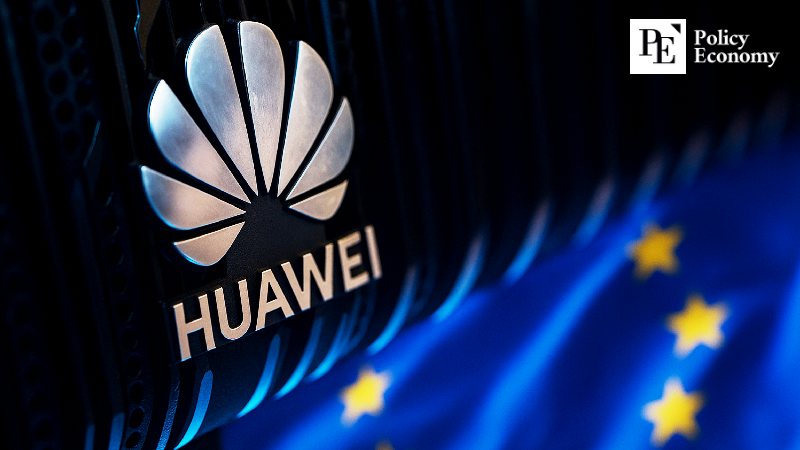
The European Commission is moving to legally mandate the removal of Chinese telecom equipment, including Huawei, from communication networks across all EU member states. The initiative aims to transform the bloc’s five-year-old “recommendation” to restrict high-risk suppliers into binding regulation. While China remains the EU’s second-largest trading partner, mounting concern within Europe over the security risks of entrusting critical infrastructure to companies with close ties to the Chinese government is driving this legislative shift.
From Recommendation to Legal Obligation
According to Bloomberg on November 11 (local time), Henna Virkkunen, Executive Vice President for Technology Sovereignty, Security, and Democracy at the European Commission, confirmed that the EU is considering legally enforcing a ban on high-risk suppliers’ equipment in member states’ mobile networks. The plan effectively targets Chinese firms, restricting the use of their equipment in next-generation broadband and 5G core infrastructure projects that are being rolled out to expand high-speed internet access across Europe.
In 2020, the European Commission had already classified Huawei and other Chinese firms as high-risk suppliers and urged member states to reduce their reliance on them under its 5G security framework. However, that measure was advisory in nature, with no binding effect. Currently, each member state retains nominal authority over telecom infrastructure decisions. Under the new framework, however, member states would be legally obliged to comply with the Commission’s security guidelines. Failure to do so could trigger the EU’s “infringement procedure,” leading to financial sanctions for noncompliance.
The Commission is also considering limiting development aid under the Global Gateway initiative for countries that continue to use Chinese telecom equipment. The Global Gateway, established as the EU’s strategic counter to China’s Belt and Road Initiative, aims to fund infrastructure development in emerging economies. Applying Chinese-equipment exclusion clauses to such projects would mark a significant escalation of the EU’s effort to contain Beijing’s technological influence.
Rising Security Concerns over China
The push for stricter controls reflects the EU’s growing conviction that critical national infrastructure could face security risks if controlled by companies linked to the Chinese government. As trade and diplomatic relations with Beijing deteriorate, concerns have deepened over the potential for Chinese firms’ influence to compromise European data and security networks. The Commission has been urging member states to act swiftly, citing the central importance of 5G network security to Europe’s economic and industrial competitiveness.
Another factor behind the legislative push is the EU’s frustration that years of political pressure have done little to dent Huawei’s market dominance. Research firm Omdia reports that Huawei retained its position as the world’s top telecom equipment supplier last year, commanding a 31% global market share. Combined with ZTE, Chinese companies control roughly 42% of the market.
In Europe, Chinese vendors still hold a substantial presence due to their lower prices and competitive performance compared with Western alternatives. In Germany—the bloc’s largest economy—Chinese suppliers accounted for 59% of 5G equipment as of 2023. Huawei’s extensive lobbying in Brussels has also contributed to its continued foothold. According to the EU Transparency Register, Huawei ranks among the top corporate spenders on EU lobbying. In April, allegations surfaced that several European Parliament members had accepted bribes from Huawei, prompting the Commission to impose access restrictions on the company’s representatives.
Expanding Global Push to Curb Chinese Telecom Influence
The Commission noted that while most member states have introduced legislation to exclude Huawei, only 10 of the 27 have fully complied. Even among those, the pace of equipment removal has been slow due to fears that eliminating Chinese suppliers could delay 5G deployment. According to Euronews, countries including Italy, Poland, Portugal, Austria, Spain, and Greece continue to purchase Chinese 5G equipment, while the UK, Denmark, Sweden, Estonia, Latvia, Lithuania, and Romania have already banned Huawei from their networks. Germany plans a two-phase removal of Chinese equipment by 2026 and 2029.
Industry observers expect the EU’s formal codification of the Huawei ban to accelerate broader international efforts to curtail China’s role in global telecom infrastructure. With the United States potentially imposing retaliatory tariffs depending on the situation, many countries are likely to align more closely with Washington’s strategic posture.
At the center of this shift lies Open RAN (Open Radio Access Network) technology, which standardizes interfaces between telecom equipment, enabling interoperability among devices from different manufacturers. By breaking vendor lock-in, Open RAN is emerging as a key strategy to reduce reliance on Huawei across Europe.
Traditional RAN architectures rely on proprietary interfaces that tie telecom operators to one or two vendors—a structure that has long benefited Huawei’s dominance. International coordination to mitigate such risks is also intensifying. The Global Coalition on Telecommunications (GCOT)—a multilateral alliance led by the UK and joined by the U.S., Japan, Australia, and Canada—was launched in October last year to collaborate on 6G infrastructure development and collectively reduce dependence on Chinese technology.
Siobhán Delaney is a Dublin-based writer for The Economy, focusing on culture, education, and international affairs. With a background in media and communication from University College Dublin, she contributes to cross-regional coverage and translation-based commentary. Her work emphasizes clarity and balance, especially in contexts shaped by cultural difference and policy translation.
Similar Post