Reshaping U.S. Semiconductor Dominance Centered on Arizona, From Design to Manufacturing

Siobhán Delaney is a Dublin-based writer for The Economy, focusing on culture, education, and international affairs. With a background in media and communication from University College Dublin, she contributes to cross-regional coverage and translation-based commentary. Her work emphasizes clarity and balance, especially in contexts shaped by cultural difference and policy translation.
Authored On
Modified
Revival of the U.S. Semiconductor Supply Chain
Arizona as the Epicenter of the U.S. Chip Industry
Convergence of TSMC, Intel and Other Global Heavyweights

The global semiconductor supply chain is shifting decisively toward the United States. Until recently, state-of-the-art semiconductors followed a structure in which GPUs designed in the U.S. were manufactured in Taiwan and then assembled with memory chips produced in Korea. But as Washington accelerates a full-scale “re-industrialization of semiconductors” by attracting global chipmakers, the entire ecosystem—from design to manufacturing to back-end processing—is increasingly being reshored to U.S. soil. At the forefront is Arizona, often described as the “Silicon Desert.” Leveraging abundant talent and a business-friendly environment characterized by low taxation, the state is cultivating a technology ecosystem akin to Silicon Valley.
Business-Friendly Climate Turning the Desert into a Semiconductor Hub
According to SEMI (the Semiconductor Equipment and Materials International) on the 12th (local time), U.S. semiconductor investment is projected to surge from USD 21 billion in 2025 to USD 33 billion in 2027 and USD 43 billion in 2028. Between 2027 and 2030, total U.S. semiconductor investment will reach USD 158 billion. Clark Tseng, a director at SEMI, noted, “Based on confirmed manufacturing investment commitments, the United States is well-positioned to outpace other nations in growth.” In effect, from 2027 onward, U.S. semiconductor investment is expected to exceed that of China, Taiwan, and Korea.
Arizona is the primary driver behind this unprecedented wave of capital formation. Over recent years, the state has emerged as a strategic center in America’s semiconductor advancement agenda. Its physical characteristics as a desert and low-density infrastructure make it well-suited for semiconductor fab construction. Arizona offers clear locational advantages. With minimal rainfall, the region has low exposure to natural disasters. Annual precipitation is just 345 millimeters—roughly one-quarter of the 1,270–1,524 millimeters recorded across the broader U.S. South where the state is situated. These climatic factors make Arizona one of the least hurricane- and tornado-prone areas in the country.
The state also boasts more than 300 days of sunshine a year, enabling highly efficient solar-power generation thanks to strong sunlight and long daylight hours. Arizona currently generates 5.2 million kilowatts (kW)—around 5% of total electricity—from solar energy. This advantage extends beyond cost savings. As more technology companies emphasize ESG commitments, Arizona’s solar-energy infrastructure plays a substantial role in helping firms meet decarbonization goals.
A 6-Nanometer-Class University ‘Nanofab’
Competitive land prices, deregulation efforts, and pro-business tax policies have further fueled global chipmakers’ investment momentum. For two decades, Arizona governors—regardless of political affiliation—have maintained corporate tax rates among the lowest in the country and have consistently expanded enterprise incentives. The state also enacted right-to-work laws that allow employees to work regardless of union membership, preventing the development of strong organized labor.
Human-capital strategies have also been critical. Arizona’s state government is actively shaping institutional conditions and workforce-development pipelines to attract industry. Arizona State University (ASU) is a prime example. Through aggressive industry–academia programs, including corporate-tailored curricula, ASU has boosted employment outcomes for its “education consumers,” namely students. This is why it has been ranked No. 1 in “Most Innovative Schools” by U.S. News for seven consecutive years.
The state’s semiconductor ecosystem support is equally notable. ASU’s “Nanofab,” which mirrors a commercial foundry, is outfitted with cutting-edge equipment such as E-beam tools capable of producing 6-nanometer semiconductors. The facility is used for research and training, and is also available for corporate use. “Startups validate their designed chips here before placing orders with major foundries or securing investment,” an ASU representative said. “Even large foundries occasionally rent the facility when their lines are at full capacity and they need urgent testing.” This industry–academia model generates USD 600 million in annual revenue for ASU—a virtuous cycle in which university growth is funded not by higher tuition but by corporate partnerships, enabling reinvestment in education and deeper collaboration.
TSMC’s Massive Bet on Arizona
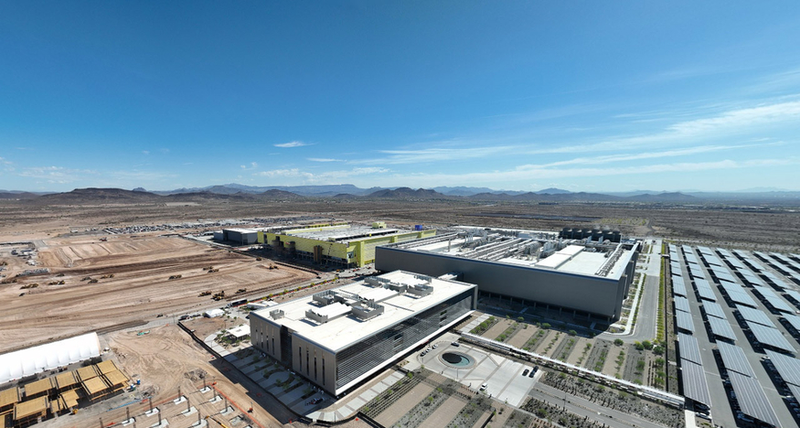
According to the Arizona state government, more than 60 semiconductor-related investments have been executed in the state since 2020, exceeding USD 200 billion in total value. Among them, Taiwan’s TSMC alone accounts for USD 65 billion. TSMC began its Arizona footprint with its first fab—an initial USD 12 billion investment—and has since announced plans for a third facility, raising its total commitment above USD 65 billion.
In March, the company announced—with President Donald Trump at the White House—a new USD 100 billion investment plan for the U.S. semiconductor sector, while reaffirming its commitments for all three Arizona fabs. The first facility began production this year, manufacturing NVIDIA’s latest Blackwell AI processor chips. Previously produced exclusively at TSMC Taiwan, these cutting-edge chips are now also being manufactured in the United States. The second and third fabs are scheduled to begin operations in 2028 and 2030, respectively. Notably, the second fab will incorporate next-generation nanosheet transistor technology alongside previously announced 3-nanometer processes, while the third fab will deploy 2-nanometer-class advanced manufacturing.
TSMC’s Arizona expansion was made possible through robust support from the U.S. federal government and Arizona state authorities. In 2020, during Trump’s first term, the administration secured TSMC’s commitment to build a USD 12 billion fab in Arizona. The Biden administration subsequently passed the CHIPS and Science Act in August 2022, allocating USD 52.7 billion in subsidies and providing tax incentives. As part of this, TSMC plans to apply for an investment tax credit covering up to 25% of qualified capital expenditures. Both the Arizona state government and the City of Phoenix facilitated the investment through infrastructure improvements—including roads and wastewater systems—alongside tax benefits, enabling smoother expansion of TSMC’s operations in the region.
Intel’s Comeback Frontline: Arizona ‘Fab 52’
Intel, which established semiconductor operations in Arizona long before its rivals, continues to expand its campus. The company first entered the state in 1979 and began operating in Chandler in 1980. The current Ocotillo site was developed on farmland purchased in the early 1990s. Fab 12 opened in the 1990s, followed by Fab 22 in 1996 and Fab 32 in the early 2000s. Fab 42 began construction in 2011 but was paused, then restarted with a USD 7 billion investment in 2017 and has been operational since October 2020.
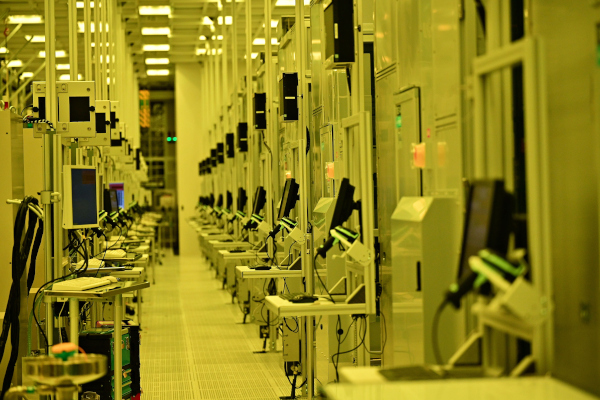
The facility producing the “Intel 18A” process is Fab 52, construction of which began in late 2021. Intel noted that building Fab 52 required excavation of more than 1 million cubic meters of soil and rock, along with 600,000 cubic meters of concrete, 75,000 tons of rebar, and 35,000 tons of structural steel. More than 9,000 kilometers of piping and cabling were installed. Intel now plans to expand beyond Fab 52 to Fab 62 in Ocotillo, committing an additional USD 32 billion in investment.
According to Arizona state data, Intel has invested more than USD 50 billion in the state since 1979 and is one of its largest private employers. As of January 2025, Intel provides approximately 9,600 jobs in Arizona and generated an estimated USD 10.7 billion in annual economic impact in 2023. The company also maintains extensive talent-development programs and partnerships with regional universities.
Siobhán Delaney is a Dublin-based writer for The Economy, focusing on culture, education, and international affairs. With a background in media and communication from University College Dublin, she contributes to cross-regional coverage and translation-based commentary. Her work emphasizes clarity and balance, especially in contexts shaped by cultural difference and policy translation.
Similar Post