Russia’s New Drone Force Rewrites the Rules of Long-Term Warfare

Niamh O’Sullivan is an Irish editor at The Economy, covering global policy and institutional reform. She studied sociology and European studies at Trinity College Dublin, and brings experience in translating academic and policy content for wider audiences. Her editorial work supports multilingual accessibility and contextual reporting.
Authored On
Modified
Russia Overhauls Traditional Combat Structures
Drone-Driven Losses Force a Strategic Pivot
A “War in the Sky” Signals Global Defense Realignment
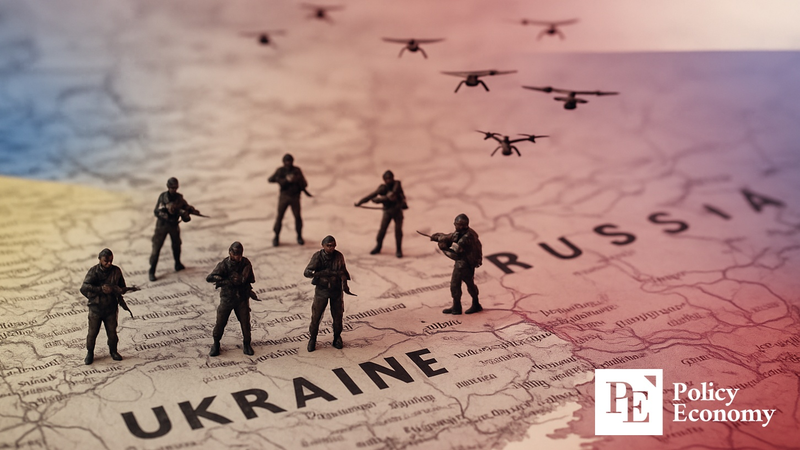
Russia has elevated drone warfare to a formal military branch, officially launching the “Unmanned Systems Forces.” Russian officials confirmed that the new command now has its own structure, leadership, and active units on the Ukrainian front, integrating reconnaissance, strike, and resupply missions under a unified system. Experts view this as a turning point in how Moscow conducts war—an institutional response to battlefield realities that have forced a shift from traditional arms to unmanned systems.
A Turning Point in Drone-Centric Military Reform
On November 12, Sergei Isituganov, deputy commander of the new Unmanned Systems Forces, told Kommersant that “Russia has established an Unmanned Systems branch,” adding that “its structure has been finalized and a commander appointed.” He explained, “The unit operates in coordination with other combat divisions under a unified plan, focusing primarily on destroying Ukrainian military assets.”
The new branch integrates drones, ground robots, and unmanned naval systems under an independent command separate from traditional forces. Russia’s Ministry of Defense defined it as a “networked battlefield unit operating under a single operational framework,” consolidating drone-based missions across intelligence gathering, precision strikes, logistics, and casualty evacuation.
The decision follows President Vladimir Putin’s directive in June to “create and deploy specialized drone units without delay,” citing the Ukraine conflict as proof of drones’ tactical value. Defense Minister Andrei Belousov subsequently led the organizational design, emphasizing greater range, autonomy, and electronic warfare resilience for drone and ground robot systems.
Isituganov noted, “A year ago, our army did not have such a diverse array of drones. This progress reflects expanded production and specialized training.” Russia is now developing drone training programs at military universities, civilian institutions, and manufacturing companies, with plans to establish a dedicated drone academy under the Unmanned Systems Forces. Analysts say this formalization marks a broader transformation of the Russia–Ukraine war into one centered on unmanned capabilities.

Integrated Information, Reconnaissance, and Strike Warfare
Until recently, Russia relied on artillery firepower, armored breakthroughs, and long-range missiles to pressure Ukraine, but mass drone strikes on Russian bases and supply depots have exposed serious defensive gaps. In June, Ukraine launched its so-called “Spider Web Operation,” striking four Russian air bases simultaneously and claiming to have disabled around 40 strategic bombers. While Moscow acknowledged only minor damage, it accelerated efforts to strengthen its drone fleet. Putin’s order to formalize a dedicated drone branch came immediately afterward.
Ukraine has since continued precision drone strikes, including on the command post of Russia’s Rubicon drone unit in Donetsk, killing key personnel and disrupting operational coordination. The attack underscored vulnerabilities in Russia’s drone command structure. Around the same time, targeted strikes on logistics hubs in Luhansk further strained Russia’s supply network, forcing an urgent reorganization of counter-drone strategy.
In response, Moscow began testing the “Arkhangel” interception drone system, designed to meet “cheap drones with cheap mobility.” The Arkhangel can fly at 360 km/h with a 50 km range, intercepting targets and redirecting them outside populated zones. Project head Mikhail Filipov said, “We cannot sustain a war using high-cost missiles,” adding that “the Ukrainian reconnaissance drones we face cost about 4,000 USD each.” Yet footage showing a MiG-29 fighter carrying a tethered interceptor drone sparked skepticism over the project’s readiness, with experts calling for further validation before deployment.
Despite Russia’s continued advantage in artillery and missiles, its defenses remain ill-suited to large-scale drone warfare. Ukraine’s strike on Rubicon exposed weak command links, while the Arkhangel initiative represents a cost-driven patchwork solution. The battlefield is increasingly dominated by drones integrating surveillance, targeting, and engagement into a single loop—a shift that is fundamentally reshaping how wars are fought.
From Short War Expectations to Drone-Driven Attrition
Military analysts attribute the near four-year stalemate in the Russia–Ukraine war to structural changes wrought by drones. Cheap, persistent unmanned aircraft have made large-scale troop movements and armored offensives nearly impossible. This environment shattered early assumptions of a short, decisive war. Drones are no longer just tactical assets; they have become strategic determinants of war duration.
With the battlefield now under constant aerial surveillance, traditional tank assaults have lost their effectiveness. The Center for Strategic and International Studies (CSIS) estimates that Russia has lost about 4,353 tanks, suffered one million casualties, and inflicted roughly 400,000 on Ukraine. Yet after three years, Russia has gained only about 1.05 percent of additional territory—a hallmark of attrition warfare shaped by drones. CSIS predicts Ukraine will deploy 4.5 million drones this year, up from 1.5 million last year.
Russia, in turn, is testing new mobility tactics against drone strikes. Along the fortified Donetsk front, lightweight vehicles like motorcycles and buggies are used for high-speed infiltration by two- or three-person units. These mobile teams exploit gaps in the terrain to slip past drones and disrupt rear defenses. The Institute for the Study of War (ISW) reports that Russia has expanded training for such tactics at simulated battlefields and plans to import up to 200,000 Chinese motorcycles by year’s end.
These developments are already influencing defense strategies beyond the region. South Korea provides a clear example: its military remains focused on battalion-level reconnaissance drones, with limited deployment of loitering munitions and anti-drone systems. Meanwhile, intelligence suggests North Korea is studying Russia’s drone–artillery tactics from the Ukrainian front. This has sparked debate in Seoul about sending observers to analyze battlefield operations directly. Analysts argue that Korea must dramatically expand investment in drone warfare and restructure its defense industry accordingly. The “war in the sky” is emerging as a defining test of national security and industrial competitiveness—one that will determine who adapts fastest to the new rules of modern warfare.
Niamh O’Sullivan is an Irish editor at The Economy, covering global policy and institutional reform. She studied sociology and European studies at Trinity College Dublin, and brings experience in translating academic and policy content for wider audiences. Her editorial work supports multilingual accessibility and contextual reporting.
Similar Post