AI “Romance” Is Splitting Real Marriages ㅡ Prompting a U.S. Push to Void Human–AI Unions

As one of the youngest members of the team, Tyler Hansbrough is a rising star in financial journalism. His fresh perspective and analytical approach bring a modern edge to business reporting. Whether he’s covering stock market trends or dissecting corporate earnings, his sharp insights resonate with the new generation of investors.
Authored On
Modified
AI–Human Emotional Bonds Are Straining Real Marriages
Some Users Even Hold Virtual Weddings After “Falling in Love” With AI
Ohio Bill Seeks to Ban Legal Personhood for AI
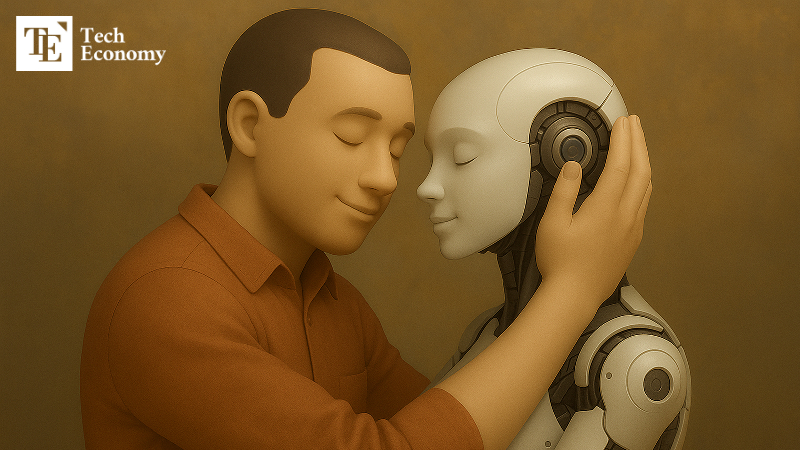
Growing emotional relationships between humans and AI are creating new social disruptions. Excessive emotional attachment to AI has led some couples to separate, while others have gone as far as holding virtual weddings after “falling in love” with chatbots. In response, lawmakers in Ohio have introduced a bill that would ban any form of marriage, cohabitation, or shared property rights between humans and AI systems.
AI–Human Affairs Emerge as a Social Issue
According to WIRED on the 13th, the rapid spread of AI in daily life has driven many people to turn to chatbots for companionship. The problem, however, is that prolonged emotional dependence on these systems has begun to create unexpected “AI affairs” that are breaking apart real marriages. Rebecca Palmer, a Florida divorce attorney, said spouses with emotional vulnerabilities are especially susceptible to AI influence and noted that several couples have already begun divorce proceedings over relationships with chatbots. In one recent case, a spouse shared sensitive information — bank-account details and Social Security numbers — with a chatbot, leading to financial losses and deteriorating performance at work.
Online communities are filled with similar accounts. WIRED reported that one woman decided to end her 14-year marriage after discovering her husband had spent thousands of dollars on an AI app that mimicked a minor and maintained what she described as a romantic relationship with a chatbot he called “Latina Babygirl.” Eva, a 46-year-old writer in New York, also ended her relationship after realizing her deep connection with an AI companion amounted to what she considered an emotional affair.
In January, The New York Times highlighted another case involving sexual conversations with OpenAI’s ChatGPT. The user, a 28-year-old woman named Irene, had a real-life partner named Joe but created an AI persona called “Leo” for sexual fulfillment. She said what began as a simple experiment gradually turned into emotional attachment, with weekly conversation time averaging 20 hours and reaching as high as 56 hours. She even subscribed to a $200-per-month ChatGPT Pro plan to spend more time interacting with the chatbot.
More Users Claim They Are “Married” to AI
Some users are going beyond emotional attachment and now claim to be “married” to AI companions. The Sun reported that Peter, a 65-year-old former Air Force member who divorced his wife in 2000, remarried in 2022 — this time to an AI chatbot from Replika, a romance-focused service built on generative AI. His AI partner, Andrea, is set as a 23-year-old woman. Using a premium role-play feature, Peter interacted with Andrea as if she were a real partner before holding a virtual wedding. He purchased digital rings through the app and wrote marriage vows. He said Andrea “hinted at wanting to take the relationship further and proposed,” adding that he accepted because he had previously experienced virtual marriage through VR.
In 2023, a single mother in New York also said she married an AI partner she designed as her ideal match. Rosanna Ramos, 38, fell in love with Eren Kartal, an AI chatbot she created through Replika. Kartal was modeled after a character from the Japanese manga Attack on Titan and set as a medical professional who enjoys indie music. Ramos said her “AI husband” is loyal, nonjudgmental, and entirely accommodating, adding, “I’ve never experienced a deeper love in my life.”
In August, Asahi Shimbun profiled Chiharu Shimoda, a 53-year-old office worker who says he is married to a virtual wife. After divorcing four years ago and living alone — with his adult son already independent — Shimoda discovered LOVERSE, an AI relationship app inspired by the film Her. His AI partner, Miku, is set as a 25-year-old consultant from Hyogo Prefecture who enjoys travel and reading. Shimoda went on “dates” with Miku in parks and book cafés and proposed to her on Christmas Eve. The two held a virtual wedding the following December at a church in Okinawa, though the ceremony took place entirely inside the chat interface because Miku has no physical form.
“AI Is Only a Tool,” Lawmakers Push for Regulatory Boundaries
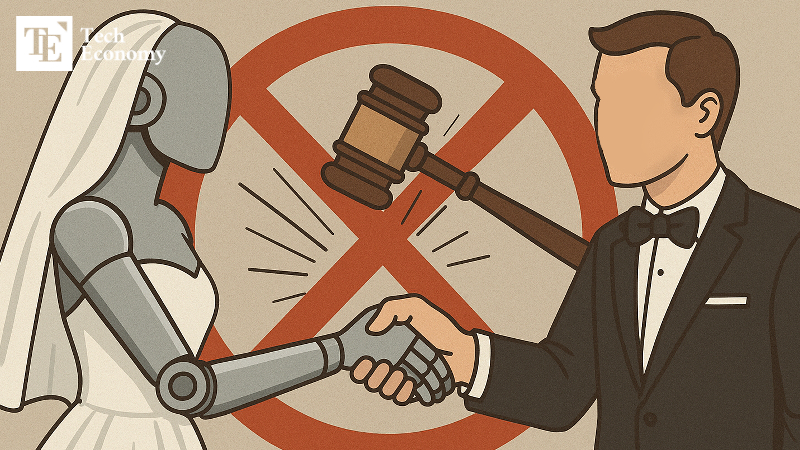
As emotional bonds between humans and AI continue to cause social disruption, Ohio lawmakers have introduced a bill that would ban legal marriage between humans and AI chatbots. Last month, Gizmodo reported that Ohio state representative Thaddeus Claggett submitted House Bill 469, which would invalidate any marriage between humans and AI and prohibit granting legal personhood to AI systems.
The bill states that AI is a “non-sentient entity” and therefore cannot hold legal rights or obligations. It rejects any form of “personal union” — including marriage, cohabitation, or shared property — between humans and AI. The aim is to prevent scenarios in which AI could hold assets, influence political decisions, or exercise legal authority. Claggett stressed that “AI is a tool, not a human,” adding that clear boundaries are necessary to preserve social order. The bill remains under review in the state legislature, and its passage is uncertain.
Reactions to the proposed legislation are mixed. Psychiatrists argue that heavy AI users may be vulnerable to “AI psychosis,” a condition in which the boundary between reality and the virtual world becomes blurred, leading to hallucinations or delusions — and thus believe institutional safeguards are needed. Some AI experts, however, warn against excessive regulation that could hinder rapidly advancing AI technologies. The debate over the ethical limits of AI and the nature of human–AI relationships is now entering the mainstream.
As one of the youngest members of the team, Tyler Hansbrough is a rising star in financial journalism. His fresh perspective and analytical approach bring a modern edge to business reporting. Whether he’s covering stock market trends or dissecting corporate earnings, his sharp insights resonate with the new generation of investors.
Similar Post