Impending U.S. Strike on Venezuela Raises Fears of Another Strongman After Maduro

Matthew Reuter is a senior economic correspondent at The Economy, where he covers global financial markets, emerging technologies, and cross-border trade dynamics. With over a decade of experience reporting from major financial hubs—including London, New York, and Hong Kong—Matthew has developed a reputation for breaking complex economic stories into sharp, accessible narratives. Before joining The Economy, he worked at a leading European financial daily, where his investigative reporting on post-crisis banking reforms earned him recognition from the European Press Association. A graduate of the London School of Economics, Matthew holds dual degrees in economics and international relations. He is particularly interested in how data science and AI are reshaping market analysis and policymaking, often blending quantitative insights into his articles. Outside journalism, Matthew frequently moderates panels at global finance summits and guest lectures on financial journalism at top universities.
Authored On
Modified
Rubio’s Signal: “Foreign Terrorist Organization” Designation Coming on the 24th
Carrier Strike Group Deployment Seen as Pretext for Action Against Maduro
Experts Warn of Guerrilla Warfare, Military Takeover, and Long-Term U.S. Commitment
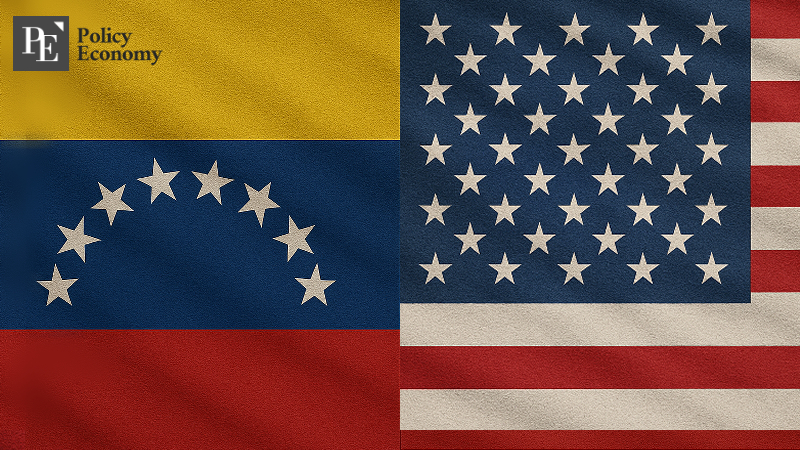
The Trump administration has indicated that it may designate the Venezuelan criminal network Cartel de los Soles (Cartel of the Suns) as a Foreign Terrorist Organization (FTO), after identifying President Nicolás Maduro as its de facto leader. The move is widely viewed as a signal that a U.S. military operation aimed at toppling the Maduro regime may be imminent. Analysts argue that the administration is preparing to frame any potential action not as a state-to-state conflict—which would require congressional authorization—but as a counterterrorism operation targeting a transnational criminal enterprise. Yet specialists warn that even if the United States succeeds in ousting Maduro, the resulting power vacuum could trigger deeper instability, enabling a military takeover or the rise of a hardline successor and potentially strengthening anti-U.S. alliances in the region.
U.S. Carrier Posture and FTO Designation Move
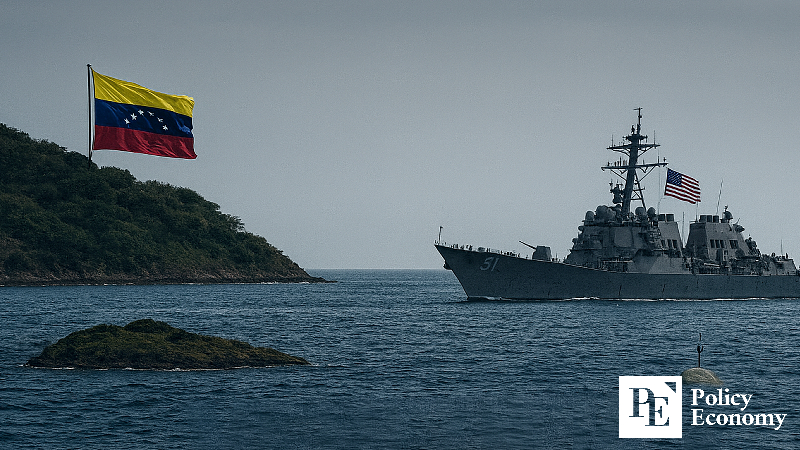
On the 16th, Secretary of State Marco Rubio announced that the State Department intends to designate Cartel de los Soles as an FTO on November 24. That same day, the Defense Department deployed an additional carrier strike group—led by the nuclear-powered USS Gerald R. Ford—to the Caribbean north of Venezuela. The Ford strike group is expected to join the Southern Spear joint task force already operating in the area.
In his statement, Secretary Rubio said, “Cartel de los Soles—rooted in Venezuela—is commanded by senior Maduro regime officials who have corrupted the military, intelligence services, legislature, and judiciary,” adding that “Maduro and his inner circle do not represent Venezuela’s legitimate government.” He further asserted that the organization, together with other designated FTOs such as Tren de Aragua and the Sinaloa Cartel, is responsible for hemispheric violence and narcotics trafficking into the United States and Europe. “The United States will employ all available tools to disrupt the financial and logistical networks of narcoterrorists,” he stressed.
The administration’s latest action is widely interpreted as an effort to link a criminal cartel directly to the Maduro regime, thereby establishing a legal and political rationale for the use of force. While the Trump administration had previously refrained from designating the group as an FTO, it imposed multiple sanctions, including a Treasury Department action last July labeling Cartel de los Soles as a Specially Designated Global Terrorist (SDGT) entity. Although both designations target terrorist activity, FTO status carries more severe consequences.
“Not a War, but a Counter-Narcotics Mission”: Securing Political Cover for Intervention
Trump has consistently argued, dating back to his first term, that Maduro and Cartel de los Soles operate as a unified criminal syndicate. In March 2020, his administration indicted Maduro on narcoterrorism and money-laundering charges, offering a USD 15 million reward for his capture. Former President Joe Biden later raised the reward to USD 25 million, and after beginning his second term, Trump again increased it to USD 50 million.
If Trump frames an intervention as a counter-narcotics mission, the threshold for deploying force in Venezuela becomes significantly lower. Under the U.S. Constitution, Congress holds the power to declare war, but the administration has argued that operations against drug-trafficking groups do not constitute acts of war. Last month, Trump stated, “Ground operations in Venezuela are coming soon,” adding that while he would notify Congress, a formal declaration of war would not be necessary. Since August, U.S. naval forces have been operating off Venezuela’s coast, targeting Venezuelan vessels while characterizing the actions as narcotics interdiction rather than acts of war.
This has fueled speculation that Washington is preparing to justify military action under the banner of counterterrorism. The New York Times reported that the administration is developing multiple military contingencies and could designate Maduro as a central figure in Cartel de los Soles to frame any strike as an operation against terrorist operatives. The Wall Street Journal also reported that the Justice Department has drafted a memo treating drug cartels as targets for “collective self-defense” and classifying fentanyl as a “potential chemical weapon,” laying the legal groundwork for naval interdictions and potential force.
Toppling Maduro May Not Resolve the Crisis
Military experts caution that even if a U.S. operation succeeds in removing Maduro, Venezuela could still spiral into deeper turmoil. Juan González, former senior director for Western Hemisphere affairs at the National Security Council and now a resident scholar at Georgetown University’s Americas Institute, noted that Maduro once remarked, “Go ahead and remove me—do you really think things will get better?” González added, “Within the framework of Chavismo, Maduro is actually seen as a moderate; the real contenders for power may not come from the opposition, but from military-backed hardliners.”
The possibility of a military coup is also being raised. John Bolton, who served as Trump’s national security adviser during his first term, said, “If the armed forces remain cohesive—as they appear to be—Maduro’s removal will not fracture the military. They will follow orders, exert control, and suppress anyone who takes to the streets.” Experts warn that Maduro’s fall could unleash competition among rival factions, including elements within the regime, Colombian insurgent groups, and criminal organizations—potentially pushing the country toward civil conflict. An anonymous Western diplomat with years of experience in Caracas said, “For better or worse, Maduro is the guarantor of the current equilibrium. Without him, no actor can hold the center. That’s why multiple factions are rallying around him.”
Some suggest that opposition figures could fill the power vacuum, but analysts say this is unrealistic without sustained U.S. security assistance. “It is impossible for the opposition to govern Venezuela immediately after Maduro,” González said. “Without U.S. security guarantees, neither their safety nor their governing capacity can be assured. People see Maduro’s removal as an endpoint, but in reality it would mark the beginning of a long, arduous process.”
Other experts argue that even if the United States avoids deploying ground forces, any military intervention would still require prolonged U.S. commitment. A regional diplomat said, “No action will offer a short-term solution. Military force must be paired with a political strategy, and Washington must be prepared to support that strategy for at least five to ten years.” Such a prolonged engagement would clash with Trump’s stated commitment to reducing overseas interventions.
The political risks are also considerable. According to a recent YouGov poll, only 28% of Republican voters support an invasion of Venezuela, while 38% oppose it. A Republican strategist noted, “Voters did not elect Trump to drag the country into another protracted conflict in Latin America. It will be very difficult for him to commit to long-term support for anti-government forces in Venezuela.”
Matthew Reuter is a senior economic correspondent at The Economy, where he covers global financial markets, emerging technologies, and cross-border trade dynamics. With over a decade of experience reporting from major financial hubs—including London, New York, and Hong Kong—Matthew has developed a reputation for breaking complex economic stories into sharp, accessible narratives. Before joining The Economy, he worked at a leading European financial daily, where his investigative reporting on post-crisis banking reforms earned him recognition from the European Press Association. A graduate of the London School of Economics, Matthew holds dual degrees in economics and international relations. He is particularly interested in how data science and AI are reshaping market analysis and policymaking, often blending quantitative insights into his articles. Outside journalism, Matthew frequently moderates panels at global finance summits and guest lectures on financial journalism at top universities.
Similar Post