Foreign Investors Flock to Chinese Tech Stocks Amid Property Slump and Weak Consumption

Siobhán Delaney is a Dublin-based writer for The Economy, focusing on culture, education, and international affairs. With a background in media and communication from University College Dublin, she contributes to cross-regional coverage and translation-based commentary. Her work emphasizes clarity and balance, especially in contexts shaped by cultural difference and policy translation.
Authored On
Modified
Surging Capital Inflows Driven by AI and Big Tech Rally, Hitting Highest Level in Four Years
Market Caps of Alibaba and Tencent Surpass U.S. Peers
Property Downturn and Fragile Consumption Cloud Sustainability of Market Upswing

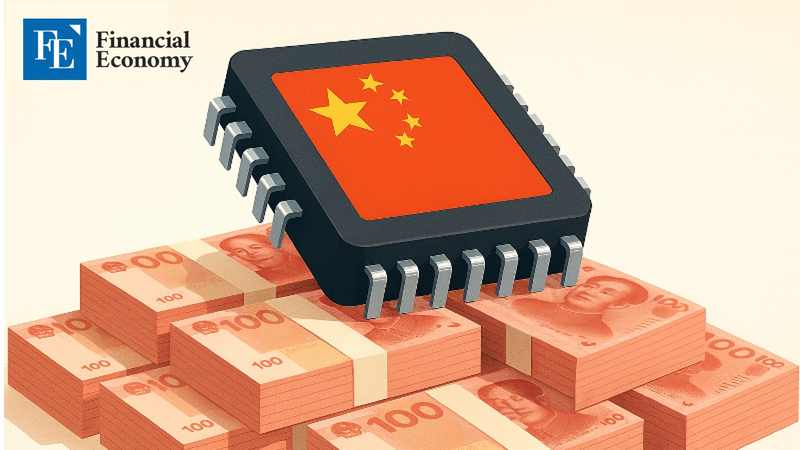
China’s rapid ascent in advanced technologies such as artificial intelligence (AI) has revived its equities market after a decade-long lull. Foreign investors have returned in force, sending overseas inflows to their highest level in four years, while major Big Tech players including Alibaba and Tencent have led the rally, with some surpassing the market value of leading U.S. counterparts. Yet despite the bullish equity sentiment, persistent weakness in the real economy—from the protracted property slump to muted consumer demand—remains unresolved, making domestic demand recovery the decisive factor for determining whether the current momentum can hold.
China Holding World-Class Technology Leaders
On November 16, the Financial Times (FT), citing data from the Institute of International Finance (IIF), reported that foreign investors injected USD 50.6 billion into the Chinese equity market between January and October this year. This represents more than a fourfold increase from a year earlier and marks the highest level since the USD 73.6 billion recorded during the pandemic in 2021. At the time, the benchmark large-cap CSI 300 index hit an all-time high, but subsequently plunged nearly 50% as the property downturn, intensified regulatory crackdowns on private enterprises, and escalating U.S.–China tensions triggered massive foreign outflows.
The FT attributed the renewed inflows to a rebound in investor sentiment driven by innovation breakthroughs among Chinese Big Tech players—including AI startup DeepSeek—and a series of major Hong Kong initial public offerings. Analysts note that a market once deemed “uninvestable” has staged a reversal on the back of its tech surge. Jonathan Pines, head of Asia at Federated Hermes, said, “China still trades at a discount to global markets, yet in the technology sector it is home to some of the world’s leading companies. In several fields, it is the only genuine competitor to the United States.”
Alibaba Jumps 37% in a Month Following Jack Ma’s Return
Chinese tech stocks have posted outsized gains this year. Since September, as Beijing accelerates efforts to achieve AI-chip self-sufficiency in response to U.S. export controls, Chinese firms have rolled out a slate of high-performance AI models, further fueling investor enthusiasm. The CSI AI Index—comprising AI-themed stocks on the Shanghai Stock Exchange—soared 61.66% from January to September 19, more than tripling the Nasdaq’s 17.20% gain over the same period. The Hang Seng Tech Index, which tracks 30 major tech companies listed in Hong Kong, likewise surged 40.87%.
A key driver of this surge is the comeback of tech giants such as Alibaba and Tencent, which had suffered years of foreign capital flight amid regulatory pressure and economic slowdown. This year, shares of Alibaba, Tencent, and Baidu have rallied 96%, 55%, and 59%, respectively. Alibaba alone jumped 37% in September after reports that founder Jack Ma—who had retreated from public view during Beijing’s tech crackdown—had fully returned to frontline management. Meanwhile, competitive AI models such as Baidu’s “Kunlun” and “Ernie X1.1,” and Tencent’s “Yuanbao,” have further powered sector-wide gains.
Corporate valuations have also climbed. As of September, the combined market capitalization of the “Seven Titans”—Tencent Holdings, Alibaba Group Holding, Xiaomi, SMIC, BYD, JD.com, and NetEase—rose 26% from the end of last year. In contrast, the U.S. “Magnificent Seven” (Nvidia, Alphabet, Amazon, Apple, Meta, Microsoft, and Tesla) fell roughly 17% during the same period. Investor appetite has expanded beyond Hong Kong large-caps to high-growth biotech innovators such as CanSino Biologics, pushing the Hang Seng Biotech Index up 98% this year.
Market Upside Unsustainable Without Real-Economy Recovery
Yet vulnerabilities loom large. Despite the strength of high-tech industries and buoyant equity performance, the broader Chinese economy remains stuck in a prolonged downturn. According to the National Bureau of Statistics (NBS), China’s third-quarter GDP growth slowed to 4.8%, the weakest since Q3 2024. After expanding 5.4% in Q1 and 5.2% in Q2, growth decelerated for two consecutive quarters. While the cumulative January–September growth rate of 5.2% still exceeds Beijing’s full-year target of 5%, a further deterioration in Q4 could jeopardize the goal.
Consumption trends also remain sluggish. Retail sales rose just 3% in September, down from 3.4% in August and marking the lowest level since November of last year. Weak demand relative to supply is pushing prices downward: September’s Consumer Price Index (CPI) fell 0.3% year-on-year, undershooting market expectations. While NBS attributed the decline largely to base effects and noted five consecutive months of core CPI increases—suggesting gradual stabilization—Bloomberg warned that China is experiencing its longest deflationary stretch since market reforms began in the late 1970s.
Investment weakness is even more pronounced. Fixed-asset investment for January–September declined 0.5%, the first contraction since 2020. Property investment, in particular, plunged 13.9%, deepening the overall downturn. Monthly property investment growth has fallen each month this year, sliding from the negative-9% range early in the year to -13.9% in September. The post-pandemic housing slump also shows no signs of easing: new-home prices fell 0.41% month-on-month in September—the steepest drop in 11 months—while existing-home prices slid 0.64%, the sharpest decline in a year.
Experts caution that an equity rally unsupported by real-economy fundamentals risks divergence. With the economy’s underlying strength deteriorating, a liquidity-driven and policy-dependent market surge may not be sustainable, raising concerns over potential overvaluation. As tech stocks lead the market upward, elevated valuations may prompt short-term profit-taking in certain names. Ultimately, whether China’s equities enter a durable upward cycle—or face a correction driven by overheating—will hinge on the pace of domestic demand revival and real-economy recovery.
Siobhán Delaney is a Dublin-based writer for The Economy, focusing on culture, education, and international affairs. With a background in media and communication from University College Dublin, she contributes to cross-regional coverage and translation-based commentary. Her work emphasizes clarity and balance, especially in contexts shaped by cultural difference and policy translation.
Similar Post
















