EU Ramps Up Defense Under Germany’s Lead ㅡ Stepping More Firmly Into an Anti-Russia Posture

As one of the youngest members of the team, Tyler Hansbrough is a rising star in financial journalism. His fresh perspective and analytical approach bring a modern edge to business reporting. Whether he’s covering stock market trends or dissecting corporate earnings, his sharp insights resonate with the new generation of investors.
Authored On
Modified
EU Accelerates Push for an Independent Defense Framework After Russia–Ukraine War
Germany Leads Military Buildup, Forming a Nuclear Cooperation Front With France and the U.K.
Regional Coordination Expands as EU States Strengthen Alliances and Support Key Strategic Hubs
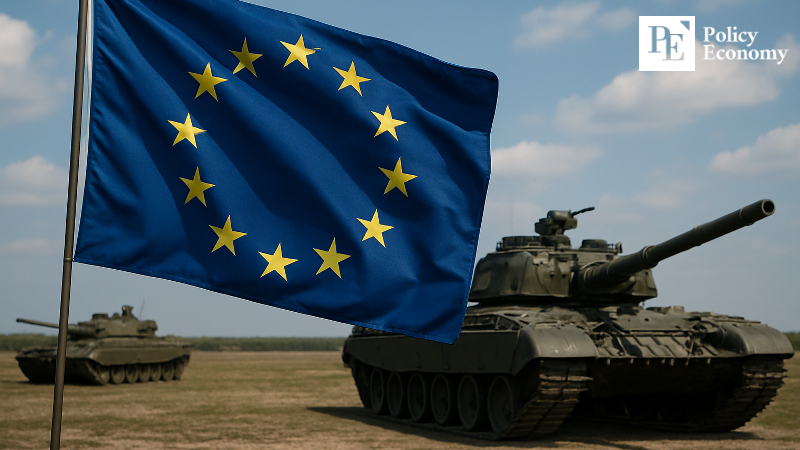
The European Union is accelerating efforts to build an independent defense framework. With the Russia–Ukraine war diminishing the United States’ influence within Europe’s security architecture, the bloc has begun reshaping its defense order by sharply increasing investment in military and security capabilities. Under Chancellor Friedrich Merz, Germany has taken the lead, and cooperation among EU member states is becoming visibly stronger across the region.
A Rapidly Shifting Global Landscape
According to Anadolu Agency on the 17th (local time), Chancellor Merz told the Süddeutsche Zeitung Business Leaders Summit that the world is undergoing “a fundamental shift in international political and economic power,” adding, “The order the West has lived under for the past 80 years is now coming to an end.” He said Europe must choose “whether we remain passive observers or become active shapers of the future political order.”
His remarks reflect the dramatic shifts following the Russia–Ukraine war. After its 2022 invasion, Russia shifted to a wartime economy and is expected to devote 41 percent of government spending to defense and security this year. Meanwhile, the United States is pushing Europe to shoulder more of its own defense burden. President Trump has even mentioned the possibility of withdrawing from NATO, pressuring European states — especially Germany — to expand their military capabilities.
In response, the EU has launched a full-scale overhaul of its defense posture. A draft of the Defence Readiness Roadmap 2030, obtained by Politico, states that Europe must be “strong enough by 2030 to deter hostile powers and respond to any act of aggression.” To meet that goal, the EU plans to mobilize up to about $880 billion through joint weapons-procurement loan programs, the European Defence Industry Programme (EDIP), the European Defence Fund (EDF), and its next multiannual financial framework set for 2027.
Regional Defense Cooperation Accelerates, With Germany at the Forefront
Germany is now leading the EU’s drive to strengthen its defense capabilities. Chancellor Merz maintains that Germany — the bloc’s largest economy and most populous member — must assume greater responsibility. Berlin plans to raise defense spending to 3.5 percent of GDP by 2030. The budget will rise from about $57 billion last year to roughly $68 billion this year, and to around $167 billion by 2029. It would be the first time since 1975, during the Cold War, that Germany’s defense spending reaches 3.5 percent of GDP — and the scale and speed of expansion surpass those of France, the U.K., and other major European powers.
Defense coordination among Germany and other key EU states is also becoming more defined. After meeting in Paris in May, Chancellor Merz and French President Emmanuel Macron published a joint op-ed in Le Figaro announcing plans to hold regular bilateral defense and security councils to discuss national defense strategy, coordination on support for Ukraine, and long-term strategic objectives. The two leaders also signaled openness to deeper military cooperation, including discussions related to nuclear sharing. Merz has long argued that non-nuclear European states can strengthen their own deterrence by engaging in nuclear-sharing arrangements with nuclear powers such as the U.K. and France.
In July, the U.K. and Germany signed a wide-ranging pact to deepen cooperation in defense, the defense industry, migration, and other areas — the first comprehensive bilateral defense and security agreement between the two countries since the end of World War II. The agreement includes a pledge to provide mutual assistance, including military support, if either nation comes under armed attack — a commitment that effectively mirrors NATO’s Article 5. Both governments described the pact as giving “concrete form to a shared commitment to European and Atlantic security.”
Nuclear cooperation is also on the table. The two sides agreed to maintain close dialogue on nuclear deterrence and broader security issues. Given that the U.K. had already agreed with France to expand nuclear-deterrence cooperation shortly before finalizing its pact with Germany, the arrangement effectively creates a three-way alignment among Europe’s biggest powers — the so-called E3 of the U.K., Germany, and France — on nuclear-related security coordination
EU’s Anti-Russia Front Intensifies
EU-wide actions countering Russia are increasing. When Poland shot down a Russian drone that entered its airspace in September, the bloc labeled the incident a Russian “provocation” and declared full solidarity with Warsaw. European Commission President Ursula von der Leyen condemned the episode, saying, “More than ten Russian drones recklessly and unprecedentedly violated the airspace of Poland and Europe.” She added, “The EU stands fully with Poland. Putin’s message is clear — and so must be our response.”
Individual member states also moved quickly. Chancellor Merz said Russia had endangered lives inside a NATO and EU country. President Macron called on Moscow to halt such “reckless actions.” Danish Prime Minister Mette Frederiksen warned that Russia’s aggression and provocations threaten Europe’s security, declaring Denmark’s solidarity with Ukraine, Poland, and all NATO allies. Even Hungary’s Viktor Orbán — typically aligned with Moscow — said he “fully stands with Poland” and that any violation of Poland’s territorial integrity is unacceptable.
In August, the leaders of Germany, France, and Poland traveled to Moldova to mark its independence from the former Soviet Union and to support the pro-EU Action and Solidarity Party (PAS). Moldova, with a population of just 2.4 million, long sat at Europe’s periphery. But since the Russia–Ukraine war, its strategic value has grown. Russia is reportedly considering securing a land corridor from occupied areas near Odesa to Transnistria in eastern Moldova. If realized, Moscow could cut Ukraine’s access to Black Sea supply routes and exert pressure on Romania and the EU’s eastern flank.
For the EU, Moldova has become a critical partner — both to block Russia’s westward ambitions and to secure alternate routes for Ukrainian grain, resources, and energy. As EU and Russian interests collide, Moldova has become a political battleground between pro-EU and pro-Russia forces. In the parliamentary election held in September, PAS, led by President Maia Sandu, defeated the pro-Russia opposition coalition, the Bloc of Patriots (BEP), by a wide margin.
As one of the youngest members of the team, Tyler Hansbrough is a rising star in financial journalism. His fresh perspective and analytical approach bring a modern edge to business reporting. Whether he’s covering stock market trends or dissecting corporate earnings, his sharp insights resonate with the new generation of investors.
Similar Post