AI Upheaval Hits Job Market — Survival Now Depends on Building the Right Skills

Aoife Brennan is a contributing writer for The Economy, with a focus on education, youth, and societal change. Based in Limerick, she holds a degree in political communication from Queen’s University Belfast. Aoife’s work draws connections between cultural narratives and public discourse in Europe and Asia.
Authored On
Modified
AI Rapidly Replaces Office Jobs, Stirring Market Turmoil
Tech Firms See Waves of Mass Layoffs
Workers Urged to Understand the Shift and Adapt Accordingly
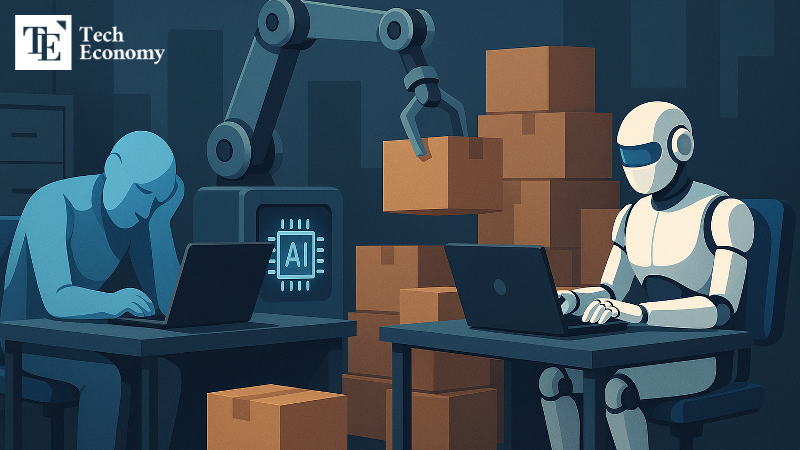
Artificial intelligence is poised to shake up the labor market. With AI advancing rapidly, low-skill white-collar roles are expected to disappear in large numbers, raising the risk of a deeper employment crunch—particularly for younger workers and office staff. Warning signs are already emerging in job markets across the United States and other countries, fueling concerns that AI-driven disruption is accelerating. Analysts say workers will need to build new skills and adapt quickly to keep pace with the changing landscape.
Pessimistic Outlook for the Job Market
On the 17th, Senator Mark Warner, a Democrat and one of the Senate’s leading voices on tech policy, told Bloomberg that AI could push the unemployment rate for new U.S. college graduates to as high as 25% within the next two to three years. He warned that as AI begins replacing white-collar roles at scale, the U.S. could face major economic turbulence.
Bleak projections are also gaining traction in the private sector. In June, Amazon CEO Andy Jassy said generative AI and AI-powered software agents would reshape workflows and could reduce total office headcount within a few years. Ford CEO Jim Farley warned in July that AI could “literally replace half of America’s white-collar workforce.” Anthropic CEO Dario Amodei similarly projected in May that AI could eliminate half of all entry-level office jobs over the next five years and push U.S. unemployment to 20%.
Financial institutions are sounding alarms as well. J.P. Morgan noted that over the past two years, rapid AI progress has increased unemployment among non-routine cognitive workers—engineers, designers, and others in roles where AI has high substitution potential. The Federal Reserve Bank of St. Louis also found that since 2022, job losses have been more pronounced in occupations with significant AI exposure, including computer and mathematics fields.

AI-Driven Job Losses Begin to Materialize
Warnings about AI-driven labor disruption are rapidly becoming reality. According to an August report by Oxford Economics, the unemployment rate for U.S. college graduates aged 22–27 has climbed to 6%, well above the national average of just over 4%. Youth hiring has fallen sharply since late 2022 in software development, customer service, administrative support and other roles highly exposed to AI automation.
Layoffs tied to AI substitution are also accelerating. A recent report from Challenger, Gray & Christmas (CG&C) shows that U.S. companies announced 153,074 job cuts in October, up 183% from September and 175% from a year earlier—the highest October total since 2003, when the post–dot-com collapse triggered widespread tech-sector cuts.
The tech industry was at the center of the surge. U.S. tech firms announced 33,281 layoffs in October, nearly five times the level in September, as companies redirected spending toward AI and reduced roles that could be automated. Amazon last month outlined 14,000 cuts, while Microsoft announced plans in July to eliminate 9,000 positions. CG&C noted that, as in 2003, disruptive technology is reshaping the industry, adding that such large-scale October layoffs—typically avoided ahead of the holiday season—feel “especially harsh.”
Adapting to the New Era
Experts say only workers who adapt to this shift will remain competitive. The most critical skill in the AI era is the ability to use AI effectively. Google DeepMind CEO Demis Hassabis has advised young people to “become ninjas with the latest AI tools,” arguing that mastering them can make individuals “superhuman” in capability. Sadie St. Lawrence, founder of Women in Data, similarly urged workers to focus less on accumulating narrow technical skills and more on integrating AI into everyday workflows.
Creative problem-solving and cross-disciplinary communication are also emerging as essential. Even if AI automates coding, humans still define problems, design systems and analyze requirements. In the U.S., programmer jobs are vanishing faster than software developer roles because programmers execute instructions, while developers engage with clients, shape solutions and coordinate across teams. Companies today seek developers who can solve business problems—not just write code.
Businesses must adapt as well. AI-driven downsizing is becoming common: Shopify now requires teams hiring new employees to explain why a role cannot be automated by AI, while Duolingo has halted contract hiring for tasks AI can perform. Companies that restructure around AI are often rewarded by investors, signaling that AI-enabled efficiency and competitiveness have become central to market expectations.
Aoife Brennan is a contributing writer for The Economy, with a focus on education, youth, and societal change. Based in Limerick, she holds a degree in political communication from Queen’s University Belfast. Aoife’s work draws connections between cultural narratives and public discourse in Europe and Asia.
Similar Post