Rising National Debt and America’s High-Wage, Low-Productivity Trap: Musk’s Answer Is “AI and Robots”

Niamh O’Sullivan is an Irish editor at The Economy, covering global policy and institutional reform. She studied sociology and European studies at Trinity College Dublin, and brings experience in translating academic and policy content for wider audiences. Her editorial work supports multilingual accessibility and contextual reporting.
Authored On
Modified
“Structural reforms needed to preserve national competitiveness”
Stagnant labor supply amid rapid manufacturing innovation
Shift toward automation and machine-based work
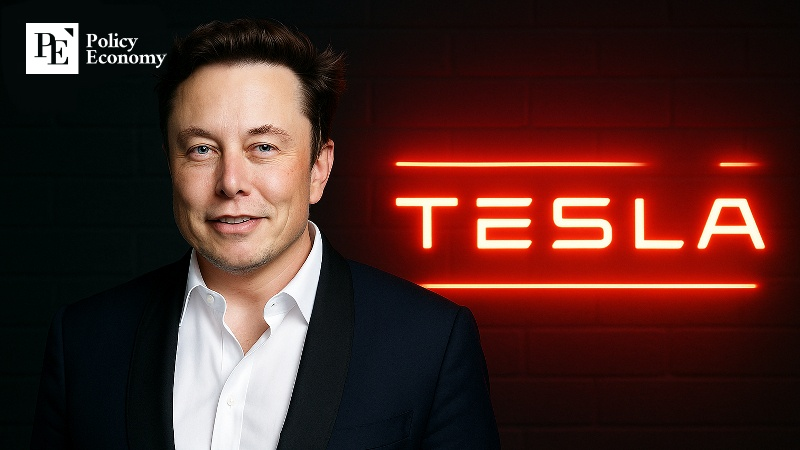
Elon Musk, CEO of Tesla, argued that America’s national debt has reached a level that can no longer be solved by the existing political system alone, and pointed to artificial intelligence and robotics as the only realistic solution. Just as electrification, computers, and automation once drove major leaps in productivity, Musk made clear his belief that technology can again carry the country through its debt crisis. His view aligns closely with Tesla’s own identity: Musk sees this technological shift not only as the foundation of his company but as a prerequisite for the nation’s economic survival.
Advocating an AI- and robotics-driven economy
According to foreign media reports on the 18th (local time), Musk said on the Joe Rogan Experience podcast that “AI and robots are the only solutions to America’s astronomical national debt problem.” Noting that federal interest payments now exceed major budget categories such as defense, he declared that “the existing political system alone cannot fix the fiscal crisis.” He added that “without economic growth, the debt problem will never be resolved,” stressing that a nationwide technological transformation is essential. His remarks are widely seen as extending beyond short-term fiscal concerns to outline a long-term model for the U.S. economy.
Musk directly linked the fiscal crisis to technological innovation. Recalling past waves of electrification, computing, and automation that reshaped productivity, he reiterated his belief that a new surge of technology will again alleviate America’s burdens. Emphasizing that democratic systems struggle to impose unpopular measures such as spending cuts, he argued that “technology must play a larger role than politics.” His logic ultimately points to productivity gains from AI and robotics as the only variable capable of bending the debt curve.
His argument is also grounded in his experience across the industries he leads. From Tesla’s automated production lines to SpaceX’s reusable rockets, Musk has long pursued capital-intensive, technology-driven projects. These experiences have strengthened his conviction that robotics and automation offer a direct solution to cost and labor constraints. Tesla’s rapid replacement of repetitive production tasks with robots has further reinforced his technology-centric worldview. In this context, Musk’s comments reflect not mere futurism but a projection rooted in cases where technological progress has absorbed economic burdens.
Tesla’s future also reflects the same direction. Musk has long argued that Tesla must shift its core identity from electric vehicles to AI and robotics, positioning fully autonomous driving, robotaxis, and the humanoid robot Optimus as the company’s central growth engines. The recent approval of his USD 1 trillion stock-award package is widely perceived as evidence that the market no longer sees Tesla as simply an automaker. Investors cite the company’s future business potential as the reason its stock price has remained resilient despite slowing EV sales. In essence, the technology-driven future Musk envisions for the U.S. economy mirrors the trajectory he has set for Tesla itself.
High wages, skilled-labor shortages
Industry perspectives that America’s manufacturing slump stems from shortages of skilled labor and rising labor costs lend further weight to Musk’s argument. According to the Bureau of Labor Statistics (BLS), U.S. workers earned a median weekly wage of USD 1,194 in the first quarter of this year and an annual median of USD 62,088. These high labor costs are creating direct pressure on manufacturers, while tighter immigration enforcement has restricted labor supply. In a survey by the Associated General Contractors of America (AGC), 92 percent of U.S. construction firms said it is difficult to hire qualified workers.
Labor shortages are becoming a major barrier to revitalizing domestic manufacturing. The World Economic Forum (WEF) projects that of the 3.8 million new manufacturing roles expected by 2033, roughly half could remain unfilled. President Donald Trump has argued that the U.S. should bring in skilled foreign workers to train American workers for advanced manufacturing. However, lengthy training periods and the lack of guarantees that foreign-trained talent would remain in U.S. industry make the proposal highly unrealistic.
The aging of the manufacturing workforce compounds the problem. Workers aged 55 and older now account for roughly a quarter of the manufacturing labor force, and at this rate, about 75 percent of expected job vacancies over the next decade will come from retirements. The mass retirement of baby boomers signals the rapid loss of accumulated technical know-how. The pandemic sharply accelerated this trend: of the roughly 1.4 million manufacturing jobs lost early in the pandemic, 570,000 had not returned by the end of 2020. Although some tasks have shifted toward digitalization and automation, educational institutions are not keeping pace, leaving skilled-labor shortages entrenched as a long-term challenge.
Raising wages may seem like a quick fix, but its limitations are clear. A Cato Institute survey found that while 80 percent of Americans believe expanding manufacturing is a national priority, only 25 percent expressed interest in working in the sector themselves. This illustrates a structural contradiction: society recognizes manufacturing as a national need, yet individual willingness to join the field remains low. With the labor base unable to expand, hundreds of thousands of manufacturing jobs are left unfilled—revealing a deep vulnerability in the “manufacturing revival” narrative promoted by President Trump.
Wage expectations far outpacing productivity
This is also why investment across U.S. industry—not just manufacturing—is increasingly focused on mechanization. Once the time and cost required to recruit and train skilled workers, along with high turnover and workplace-adaptation risks, are taken into account, labor-centric production becomes less viable as a long-term model. By contrast, machine-based production provides predictable productivity with a one-time upfront investment and is less volatile to wage, benefits, and turnover pressures. This has driven a growing industry consensus that labor-intensive production models are no longer sustainable in the United States.
The gap between wage growth and productivity is widening rapidly. Last year, U.S. unit labor costs rose 3.3 percent and have already climbed an additional 2 percent this year. Yet productivity grew only 0.6 percent last year and 1.6 percent in the first half of this year. When wages rise but output does not, hiring more workers becomes an unsound strategy for expanding production. Many companies have therefore concluded that “the only way to reduce labor costs is to automate and shrink the labor share per unit of output.”
The benefits of automation are especially pronounced in processes with high labor-cost exposure. Repetitive assembly, inspection, loading, and transport tasks can all see dramatic reductions in labor needs and greater quality consistency when automated. Meanwhile, subscription-based Robotics-as-a-Service (RaaS) models—requiring minimal upfront capital—are lowering automation barriers for small and midsize manufacturers. With automation enhancing not just cost efficiency but product quality, process stability, and plant utilization rates, mechanization is increasingly viewed not as an option but a necessity.
Corporate surveys on reshoring further illustrate this shift. In a CNBC poll of 380 firms involved in supply-chain operations, 61 percent of U.S. companies said that even if they lost their China-based factories, they would relocate to other regions rather than return to the United States. Of these firms, 74 percent cited high labor costs and 21 percent pointed to shortages of skilled workers. Even among companies planning to reshore to the U.S., 81 percent said automation infrastructure would be a prerequisite. This underscores the widespread view that automation is essential for making U.S.-based production viable.
Niamh O’Sullivan is an Irish editor at The Economy, covering global policy and institutional reform. She studied sociology and European studies at Trinity College Dublin, and brings experience in translating academic and policy content for wider audiences. Her editorial work supports multilingual accessibility and contextual reporting.
Similar Post