Backlash of Trump Tariffs: Economic Retraction in Allied Nations, Mounting U.S. Strain, and China’s Expanding Reach

Siobhán Delaney is a Dublin-based writer for The Economy, focusing on culture, education, and international affairs. With a background in media and communication from University College Dublin, she contributes to cross-regional coverage and translation-based commentary. Her work emphasizes clarity and balance, especially in contexts shaped by cultural difference and policy translation.
Authored On
Modified
Global Shock from Trump’s Tariff Offensive
U.S. Consumers and Corporations Bearing the Cost, Dual Pressure on Domestic and External Fronts
China Reshaping Global Trade Beyond Tariff Barriers
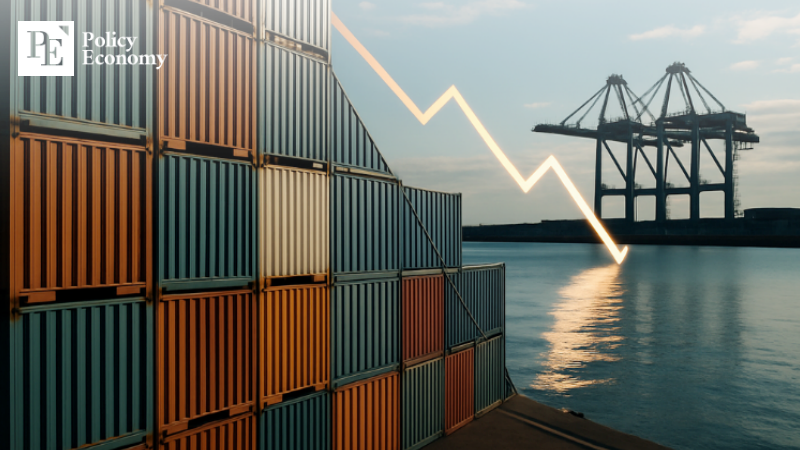
The tariff policy of the Donald Trump administration has begun to undermine both the domestic economy and the growth momentum of allied nations, contrary to its initial intent. As major trading partners report weakening economic indicators, the full-scale impact of the tariffs is materializing, spreading financial strain across U.S. consumers and corporations and amplifying political risks. In contrast, China—the primary target of the tariff offensive—is widening its trade surplus by combining market diversification with a state-backed industrial strategy, thereby expanding its global footprint. While Washington absorbs the economic and political backlash from its own allies and citizens, Beijing is circumventing tariff barriers and consolidating its influence in the global trade order.
Worsening Economic Indicators Across Major Economies
On November 17, Switzerland reported a 0.5% contraction in real GDP for the third quarter compared to the previous quarter—far worse than Bloomberg’s forecast of a 0.1% decline—marking the country’s first negative growth since the second quarter of 2023. The U.S. reciprocal tariffs, reaching 39%, triggered a sharp drop in exports of key goods such as watches and chocolates, dealing a direct blow to the export-driven Swiss economy.
Japan also recorded a 0.4% contraction in GDP over the same period, its first negative growth in six quarters since early 2024. Exports fell by 1.2%, driven largely by a steep drop in automobile shipments to the U.S. Earlier in July, Japan reached an agreement with Washington to reduce tariffs on passenger vehicles from 27.5% to 15% as part of a $550 billion investment fund deal, but even that rate is proving damaging to Japan’s economy.
In the United Kingdom, third-quarter GDP grew only 0.1%, missing forecasts of 0.2% and slowing from 0.3% in the previous quarter. The figure marks a clear deceleration from 0.7% in the first quarter and 0.3% in the second, falling below both Bank of England and market expectations. Exports to the U.S. fell 11%, the sharpest drop since January 2022, dragging overall growth.
President Trump’s “Liberation Day” declaration on April 2 set forth a plan to impose reciprocal tariffs on all trading partners, but implementation was delayed until August 7. Economists note that the third-quarter data are the first to fully reflect the tariff shock. Axios reported that “the slowdown in exports to the U.S. has created a significant burden on global economies” as tariffs dampened demand for goods.
Japanese media have criticized Trump for using tariffs and sanctions as diplomatic leverage, effectively forcing allies into what they call “economic tribute.” In a commentary for Nikkei Asia, Brahma Chellaney, professor at the Center for Policy Research in India, wrote, “The Trump administration is weaponizing tariffs as coercive tools to extract concessions.” He warned that, much like the backlash against China’s “debt-trap diplomacy,” Washington’s unilateralism could provoke strong resistance from its partners.
Rising Burden on U.S. Corporations and Consumers
While the administration justifies tariffs under the banner of “America First,” the actual impact has been the opposite—burdening not only U.S. allies but also domestic consumers and corporations. According to S&P Global, which analyzed data from 15,000 analysts across 9,000 companies, global firms are expected to shoulder an additional $1.2 trillion in costs this year due to tariffs alone.
Lead analyst Daniel Sandberg described the “trillion-dollar pressure” as multifaceted: tariffs act as taxes within supply chains, diverting corporate funds to governments, while shipping delays and rising logistics costs intensify financial strain. The report cited Trump’s decision in May to end the duty-free exemption on parcels valued under $800 from China and Hong Kong as a turning point. The exemption was fully revoked for all imports by late August, sending shockwaves through freight data and corporate earnings reports.
Despite prior claims that foreign exporters would bear most of the burden, S&P Global estimates that only about one-third of tariff costs fall on companies, with the remainder passed on to consumers. Goldman Sachs projects that 55% of tariff-related expenses will ultimately hit consumers, 22% U.S. firms, and 18% foreign exporters. With recent tariff rounds still taking effect, Goldman expects the corporate burden to grow further in the short term.
CNBC, citing LendingTree data, reported that tariffs have increased costs for U.S. consumers and retailers by roughly $41 billion. Average holiday spending per person has risen by $130 compared to last year due to tariff-related price hikes. Citigroup warned that the consumer share of the tariff burden—currently around 20–30%—could climb to 60% within months, as companies pass more costs downstream.
The inflationary effects are also eroding Trump’s political standing. A Reuters/Ipsos poll conducted from November 14–17 among 1,017 U.S. adults (±3% margin of error) showed Trump’s approval rating at 38%, down two points from earlier in the month and nine points below his 47% level at the start of his second term—the lowest since his reelection. Only 26% of respondents believed Trump is handling inflation effectively, down from 29% previously, while 65% rated his performance poorly. Notably, nearly one-third of Republican respondents expressed dissatisfaction with his tariff policy.
China’s Trade Surplus Nearing the $1 Trillion Threshold
While the U.S. faces growing backlash at home and abroad, China—the primary target of Trump’s tariff campaign—is poised to post a record-breaking trade surplus approaching $1 trillion. According to China’s General Administration of Customs, the country logged a historic $990 billion surplus last year and is on track to exceed that mark in 2025. From January to October, the surplus reached $785 billion, up 16% from a year earlier. China now runs trade surpluses with more than 170 countries, defying U.S. pressure for structural economic reform and expanding its global market share instead.
Washington had hoped tariffs would push Beijing to pivot from export-led growth toward consumption-driven demand—encouraging domestic spending among China’s 1.4 billion citizens and boosting imports of foreign goods through healthcare and social welfare reform. But analysts widely view the strategy as a failure, largely because Beijing’s countermeasures defied U.S. expectations.
China retaliated by leveraging its monopoly over rare earth metals to pressure American firms and suspending soybean imports from the U.S. After Washington imposed 145% tariffs on Chinese goods in April, Beijing responded with 125% tariffs. A temporary truce in May at the Geneva talks reduced these to 30% and 10% respectively, followed by another accord at the U.S.–China summit in Seoul on October 30 to suspend reciprocal tariffs for a year. Yet the core structural issues in China’s economy remain unresolved.
Despite six months of elevated tariffs, Chinese exports have shown remarkable resilience. While exports to the U.S. plunged 25% year-on-year in October—marking seven consecutive months of double-digit declines—China’s outbound shipments to other regions have surged. Imports from China to India hit a record $12.5 billion in August, African exports are set to reach all-time highs, and Southeast Asian sales have surpassed even pandemic-era peaks. The momentum extends beyond emerging markets, with exports to advanced North Asian economies—including South Korea, Japan, and Taiwan—also exceeding previous highs. Analysts warn that Trump’s aggressive tariff regime could trigger a new “China Shock 2.0,” destabilizing the global economy while allowing Beijing to further entrench its position as the world’s manufacturing hub.
Siobhán Delaney is a Dublin-based writer for The Economy, focusing on culture, education, and international affairs. With a background in media and communication from University College Dublin, she contributes to cross-regional coverage and translation-based commentary. Her work emphasizes clarity and balance, especially in contexts shaped by cultural difference and policy translation.
Similar Post