Japan accelerates shipbuilding consolidation, targeting U.S. Navy demand and the Arctic route

Authored On
Modified
Japan frames shipbuilding as a core economic-security sector
Targets advanced vessels to secure U.S. Navy contracts
Arctic-route ambitions underscore the need to rebuild capability

Japan is shifting its regulatory stance to allow mergers and integration among domestic shipbuilders, signaling a clear break from its traditionally cautious approach. The policy shift is intended to widen information-sharing and joint procurement among companies at a time when global competitive pressure has intensified. Alongside this move, the government has announced a public-private investment plan of roughly 6.37 billion dollars to modernize shipyards and restore production capabilities, while also designating ship components as strategic materials requiring stable supply.
Major public-private project under way
According to Nikkei Asia on the 21st, Japan’s Fair Trade Commission (JFTC) will authorize mergers among domestic shipbuilders under a new policy framework. The JFTC stated at an expert meeting hosted by the Ministry of Economy, Trade and Industry that detailed legal grounds will be formalized within the year. It signaled a shift by saying that even if domestic shipbuilders form an oligopoly, “there is no legal problem when strong foreign competitors already exist,” showing that Japan is now viewing shipbuilding through a strategic-industry lens rather than a traditional competition-policy lens.
The new guidance also allows coordinated procurement and information-sharing on key raw materials—such as rare-earth elements—when such cooperation serves national economic-security objectives. Until now, Japanese firms avoided joint procurement due to regulatory risk, but with this reinterpretation, corporate behavior is expected to change. Given recurring supply-chain disruptions and intensifying global competition, relaxing restrictions on information flows marks a significant shift away from Japan’s historically closed management of the sector.
Japan’s newly approved public-private investment plan of roughly 6.37 billion dollars aligns with the JFTC’s merger approval stance and is set to become the backbone of industry restructuring. The plan lays out core tasks including shipyard modernization, the creation of a state-led shipyard that would be leased to private operators, workforce development, and expanded R&D. Japan aims to double annual shipbuilding volume by 2035. Government officials say the focus is on modernizing outdated facilities and shoring up R&D to reform an industry suffering from aging infrastructure and a shrinking workforce.
A bid to reclaim market share lost to Korea and China
Japan’s push to rebuild the scale and output of its shipbuilding industry is strongly tied to rising U.S. Navy demand and Washington’s broader fleet-expansion agenda. After losing competitiveness over the past two decades—falling behind Korea in high-value LNG carriers and next-generation “green ships,” and losing mass-production advantage to China—Tokyo sees an opening to reenter the global supply chain.
Clarksons Research data show Japan’s global market share has fallen from 38 percent in 2001 to 13.1 percent in 2024. Over the same period, China surged from 5.8 percent to 54.7 percent, while Korea maintained about 28 percent. Japan’s recent reclassification of shipbuilding as a core economic-security industry is a direct response to this erosion, reflecting an ambition to reverse its positioning just as U.S. demand accelerates.
Central to Japan’s strategy is a national LNG-carrier shipyard concept. The government plans to invest up to about 5.10 billion dollars to establish a state-run shipyard, build core infrastructure, and lease it to private firms. This ties directly to JERA’s newly signed long-term LNG import contract with the United States, totaling 5.5 million tons per year. Handling this volume requires substantial newbuild orders, making the state-shipyard model a key component of Japan’s restructuring plan.
Japan also aims to align its strategy with potential U.S. demand for icebreakers, PCTCs, and LNG carriers—the types of vessels Washington increasingly needs as it searches for politically reliable suppliers. Japan is upgrading facilities, restoring capacity, and coordinating policy across government, ruling parties, and industry. It is also trying to address long-standing structural problems—high costs and labor shortages—through measures such as allowing corporate consolidation and establishing joint financing mechanisms.
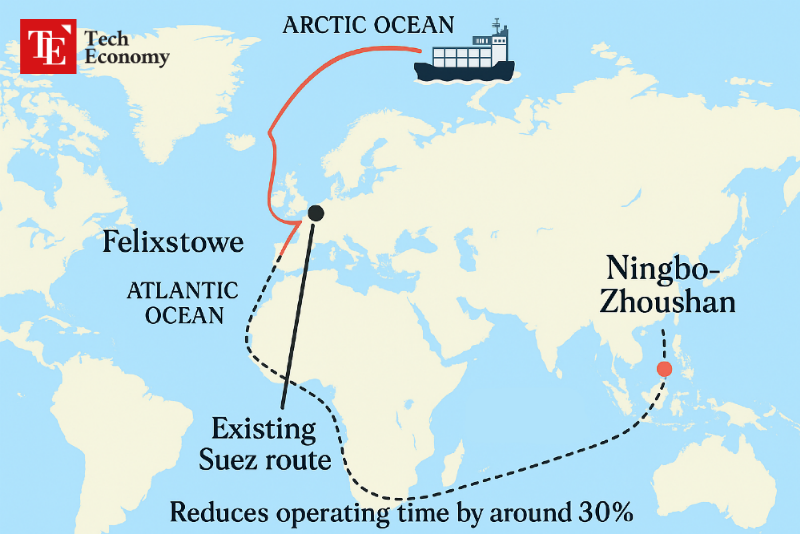
Arctic shipping lanes may reshape Japan’s strategy
Another major reason Japan cannot afford to miss the moment is the emerging feasibility of Arctic commercial routes. Traditional sea lanes—Taiwan Strait, Malacca Strait, Suez Canal—are increasingly exposed to geopolitical volatility. Japan has long considered route diversification, and China’s recent "Arctic Express" trial sailings served as a wake-up call. When Arctic transit becomes commercially viable, Japan could benefit through shorter transport times, improved logistics efficiency, and more stable energy procurement.
Arctic development implies sharply rising demand for specialized vessels such as icebreakers and ice-class ships. Japan has accumulated technical know-how in these niche areas since the late 1950s—segments where China and Korea have less dominance. With global orders for ammonia-powered, methanol-powered, and LNG-powered green vessels surging, Japan sees a chance to pair Arctic-route capabilities with leadership in environmentally friendly ship types.
Japan’s strategy therefore focuses on reshaping its industrial base—beyond expanding output—to capture rising demand for special-purpose and alternative-fuel ships. Plans include relocating old docks, introducing automated block-assembly, welding, and painting systems, and deploying AI-based optimization tools to simultaneously improve productivity and ease labor shortages. Corporate moves—such as Mitsui & Co.’s participation in Russia’s Yamal LNG project—also reflect a push to secure Arctic-related energy supply chains.
But Japan faces significant near-term headwinds. Danish Ship Finance recently warned that if Japanese shipyards fail to secure adequate new orders, average utilization could fall to 20 percent by 2027. Rising energy, materials, and labor costs, combined with long investment lead times and workforce depletion, could push yards into prolonged stagnation. Without a surge in orders, Japan’s shipbuilding revival effort faces substantial risks.
Similar Post