“Upstream Demand Has Collapsed” — EV Battery Oversupply Deepens, and the Industry Looks to Technology for Answers

As one of the youngest members of the team, Tyler Hansbrough is a rising star in financial journalism. His fresh perspective and analytical approach bring a modern edge to business reporting. Whether he’s covering stock market trends or dissecting corporate earnings, his sharp insights resonate with the new generation of investors.
Authored On
Modified
Global EV Battery Production Far Exceeds Demand
China-Driven Oversupply and U.S. Subsidy Rollbacks Freeze the EV Market
Industry Says Breakthroughs Like Solid-State Batteries Are Needed to Revive Demand
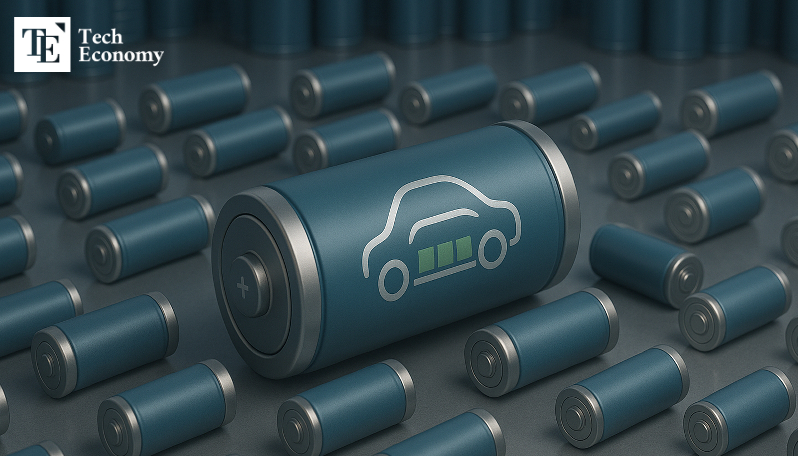
Warnings about an oversupply of electric-vehicle batteries are emerging across the market. A surge of low-priced Chinese EVs has disrupted the supply–demand balance in downstream industries, casting a shadow over the outlook for the battery sector as well. Some analysts warn that without major performance breakthroughs—such as the adoption of solid-state batteries—a meaningful recovery in market demand will be difficult.
Warning Lights Flash Over Battery Oversupply
According to the auto industry on the 21st, concerns over global overproduction of EV batteries are mounting. On the 10th, InsideEVs, citing an AlixPartners report, noted that battery production capacity in major markets—including North America, Europe, and China—far exceeds demand. The report found that North America’s capacity is 1.9 times demand, Europe’s is 2.2 times, and China’s has reached a severe oversupply at 5.6 times demand—worsened further by tariffs on Chinese EVs and components.
In August, Nikkei also reported—using S&P Global Mobility data—that global EV battery plant capacity is projected to reach 3,930 GWh this year, roughly 3.4 times the expected market demand of 1,161 GWh. S&P expects capacity to remain more than triple demand next year, and still about 2.4 times demand by 2030.
In response, companies are moving to slow production. Ford has been scaling back its EV investments, and with its Korean partner SK On, has yet to finalize the production start date for a $5.8 billion battery plant under construction in Kentucky. General Motors said last month it would lay off 1,550 workers at its joint battery plants with LG Energy Solution in Ohio and Tennessee. Panasonic Holdings also has not confirmed when full-scale production will begin at its Kansas battery plant, which opened in July. However, Chinese giants CATL and BYD—together controlling about 70% of the global battery market—are reportedly continuing to expand production.
A Deep Freeze Hits the Global EV Market
The breakdown in battery supply–demand balance stems from a sharp contraction in electric-vehicle demand—EVs being the core downstream industry for batteries. China is widely viewed as the source of the downturn. To secure early leadership, the Chinese government poured tax breaks and other incentives into its domestic EV makers. According to the Center for Strategic and International Studies (CSIS), China provided $231 billion in subsidies to the EV industry between 2009 and 2024. Long-term policy goals, including the country’s “2060 carbon-neutrality” plan, also supported continuous EV growth. Beijing had targeted EV penetration rates of 20% by 2025, 40% by 2030, and 50% by 2035.
But this support triggered an explosion of manufacturers—more than 500 at one point—creating a level of overproduction impossible for domestic demand to absorb. Although the number has fallen to 169 this year, 93 of those companies still hold less than a 0.1% market share. To survive oversupply, many turned to aggressive price cuts and exports, flooding global markets with low-cost Chinese EVs. As supply surged and inventory piled up, automakers in other countries also slashed prices, accelerating what many now call “EV deflation.”
The situation worsened after President Trump’s “One Big Beautiful Bill Act (OB3)” passed Congress this year. The law ended the $7,500 federal EV tax credit on September 30—far earlier than expected—and U.S. EV sales plunged more than 24% in October from the previous month. One of the world’s key EV markets has effectively frozen.
A Need for Transformative Innovation
Some analysts warn that the EV market downturn may persist until breakthrough technologies—most notably solid-state batteries, often described as “dream batteries”—reach commercialization. Solid-state batteries use solid electrolytes instead of liquid ones, offering higher energy density, faster charging, and improved thermal stability. Their wide operating temperature range is another advantage: they can function reliably from –40°C to 100°C, making them suitable for extreme climates as well as aerospace applications.
But the technology still faces major hurdles. Two core challenges are ion conductivity and interfacial resistance. Ion conductivity measures how easily lithium ions move through the electrolyte. Liquid electrolytes allow relatively free movement due to their fluidity, while solid electrolytes restrict ion pathways because of their rigid structure—slowing current flow and reducing charging speed and power output.
Interfacial resistance occurs at the contact surface between the electrode and the electrolyte. Liquid electrolytes adhere tightly to electrodes through surface tension, enabling smooth ion movement. Solid electrolytes, however, have microscopic surface irregularities that prevent perfect contact, creating invisible gaps that act as resistance barriers and degrade battery performance.
Major EV manufacturers are therefore cautious about adopting solid-state batteries. An industry source said Tesla has chosen to refine existing lithium-ion technology instead of pursuing solid-state cells, while battery makers such as China’s CATL and Japan’s Panasonic are also slowing their timelines due to technical limits and mass-production challenges. For now, the industry is expected to focus on improving the maturity, practicality, and cost efficiency of conventional lithium-ion batteries.
As one of the youngest members of the team, Tyler Hansbrough is a rising star in financial journalism. His fresh perspective and analytical approach bring a modern edge to business reporting. Whether he’s covering stock market trends or dissecting corporate earnings, his sharp insights resonate with the new generation of investors.
Similar Post
















