‘South Africa G20’: Triumph of Multilateralism amid Trump’s Boycott, Will the World Expand Cooperation Without the U.S.?

Siobhán Delaney is a Dublin-based writer for The Economy, focusing on culture, education, and international affairs. With a background in media and communication from University College Dublin, she contributes to cross-regional coverage and translation-based commentary. Her work emphasizes clarity and balance, especially in contexts shaped by cultural difference and policy translation.
Authored On
Modified
Unprecedented Joint Declaration Adopted on Opening Day of G20 Summit
European and Asian Leaders Attend Despite Trump’s Boycott
Reaffirmation of Multilateralism Against U.S. Unilateralism
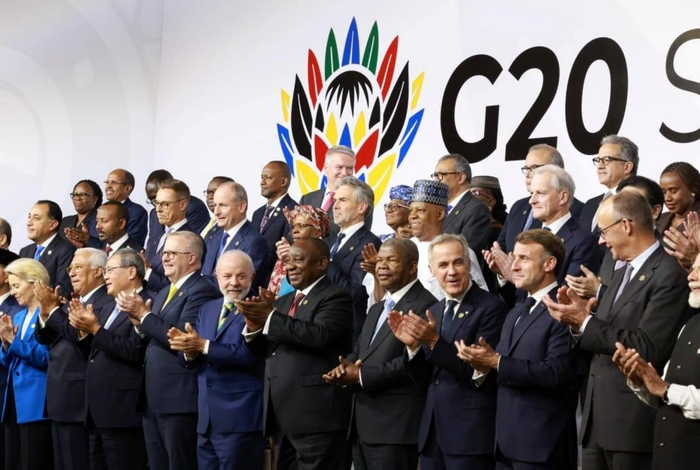
At the G20 Summit held for the first time on the African continent under the theme “Solidarity, Equality, and Sustainability,” an unprecedented joint declaration was adopted on the opening day. The declaration, long opposed by the United States—which boycotted the summit on the grounds that South Africa persecutes white people—was pushed through without Washington’s consent. As the Trump administration’s unilateralism faces growing skepticism over its legitimacy and credibility, a pattern of response from what some describe as the “world minus America” is becoming increasingly solidified.
Anti-Trump Agenda Including Climate Response
On November 23 (local time), Vincent Magwenya, spokesperson for the South African presidency, told reporters at the Nasrec Expo Centre in Johannesburg, the venue of the summit, “The leaders reached a consensus to adopt the declaration at the start of the meeting,” adding, “While such documents are usually adopted at the end, there was agreement that it should be the first agenda item.”
That day, South Africa’s Department of International Relations and Cooperation released the “G20 South Africa Leaders’ Declaration,” a 30-page document consisting of 122 clauses. The declaration’s main themes include countering unilateral trade practices that violate World Trade Organization (WTO) rules, strengthening climate change responses and renewable energy expansion, and easing the crushing debt burden of the world’s poorest nations. These objectives directly contradict U.S. policies of imposing reciprocal tariffs on trading partners and expanding fossil fuel consumption. The leaders reaffirmed their commitment to “maintaining the G20 as the premier forum for international economic cooperation and continuing to operate based on consensus in the spirit of multilateralism.”
They further stated, “We meet amid intensifying geopolitical and geoeconomic rivalries, instability, escalating conflicts and wars, widening inequalities, and growing uncertainty and fragmentation in the global economy. We emphasize our faith in multilateral cooperation to address common challenges together.” The declaration also pledged, “We commit to fully upholding the purposes and principles of the United Nations Charter, and to working toward a just, inclusive, and lasting peace in Sudan, the Democratic Republic of the Congo, the occupied Palestinian territories, and Ukraine, as well as to ending other conflicts and wars around the world.”
The United States boycotted the summit after accusing South Africa of persecuting Afrikaners and clashing over the G20 agenda. The U.S. embassy later officially notified Pretoria that Washington opposed any joint declaration adopted without its consent and would only endorse a chair’s summary reflecting its nonparticipation—an unusual stance given that the U.S. is slated to chair next year’s summit. However, South African President Cyril Ramaphosa rebuffed the pressure, declaring, “We will not yield to intimidation,” and the declaration was formally adopted on the summit’s opening day.
Trump Administration’s Withdrawal from International Organizations and Treaties
Observers interpret President Trump’s boycott of the G20 as part of a continued U.S. retreat from multilateralism. The administration began its unilateral path by announcing its withdrawal from the Paris Climate Agreement—a 2015 U.N. treaty aimed at limiting the global temperature increase to within 1.5°C above pre-industrial levels. Under the accord, member nations, including South Korea, were required to submit and implement greenhouse gas reduction targets every five years.
President Trump first declared the U.S. withdrawal from the Paris Agreement in June 2017 during his first term, claiming it imposed “unfair burdens on American workers and businesses.” In reality, the withdrawal had little practical effect, as the agreement’s rules required three years after its entry into force before a nation could formally notify the U.N. of its departure, followed by an additional waiting period—meaning the U.S. could not officially leave until November 2020. Moreover, then-President Joe Biden rejoined the accord immediately upon taking office in January 2018.
However, shortly after beginning his second term, on January 21 of this year, President Trump signed an executive order withdrawing the U.S. once again from the Paris Agreement, declaring a renewed anti-climate policy direction and asserting that leaving the accord would save more than $1 trillion. According to the U.N. Framework Convention on Climate Change (UNFCCC) Secretariat, a withdrawal takes effect one year after the U.N. receives formal notification, or on the later date specified therein. Thus, the U.S. withdrawal is expected to be finalized by around January next year.
If the U.S. withdraws, it will find itself aligned with nations such as Libya, Iran, and Yemen. Given that the U.S. is the world’s second-largest emitter—responsible for 13% of annual global greenhouse gas emissions—and the largest cumulative emitter in history, the move is widely condemned as irresponsible. Withdrawal would exempt Washington from setting and meeting national greenhouse gas reduction targets (NDCs) and from contributing to climate funds that support developing nations’ mitigation and adaptation efforts.
President Trump’s unilateralism extends well beyond climate policy. He has pulled the U.S. out of the U.N. Human Rights Council (UNHRC), the U.N. Relief and Works Agency for Palestine Refugees (UNRWA), and the World Health Organization (WHO), which he denounced as “a corrupt globalist scam owned and controlled by China despite being funded by the United States.” He also dissolved the U.S. Agency for International Development (USAID), slashing staff from 14,000 to 294 and abruptly cutting foreign aid programs worldwide. Furthermore, the U.S. sent no federal delegation to the 30th U.N. Climate Change Conference of the Parties (COP30), held on November 22.
Global Pushback and Risk of Backfire
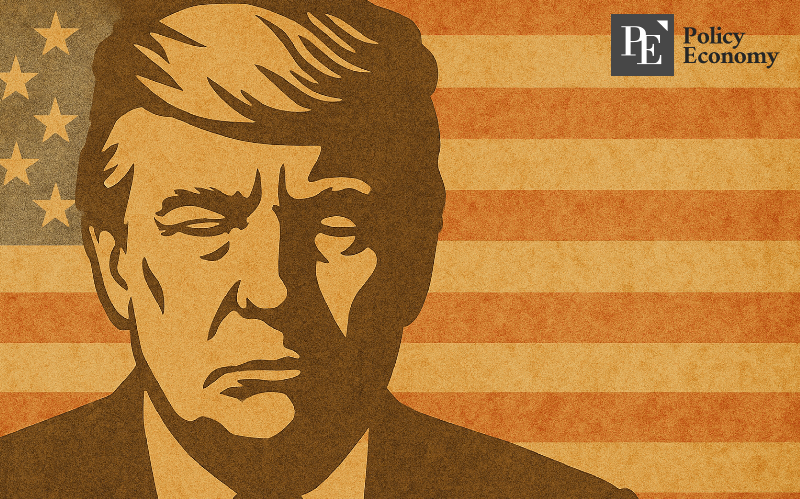
Trump’s actions are rooted in his ideological conviction that multilateralism undermines U.S. sovereignty and constrains its freedom of action. In his worldview, great-power negotiations and bilateral deals are inherently superior to the international rules set and managed by multilateral organizations.
In practice, he has abandoned idealism and prioritized economic self-interest—an unusual fusion of materialism and realist diplomacy, which some analysts describe as “material realism.” The rationale, in his view, is that past presidents’ “lofty idealism” failed twice: they sought greater freedom, peace, and security in the Middle East but achieved none. Hence, Trump claims to have discarded failed idealism in favor of a profit-driven approach that, he argues, strengthens the U.S. economy while serving its strategic global interests.
This logic underpins the so-called “Donroe Doctrine,” through which Trump is reinforcing U.S. hegemony over the Americas. Coined by the New York Post in January, the term merges Trump’s name with the “Monroe Doctrine” articulated in 1823 by the fifth U.S. president, James Monroe. Both doctrines share the goal of maintaining dominance over the Western Hemisphere through military and economic power.
Yet, as demonstrated by the G20’s renewed embrace of multilateralism and the WHO’s success in adopting a legally binding treaty on future pandemics even after the U.S. withdrawal, Washington’s unilateralism risks backfiring—not only in trade but across diverse policy domains. In an era of deeply interdependent global supply chains, energy and climate governance, and technology and security norms, unilateral action is increasingly untenable.
Former Chilean diplomat Jorge Heine warned, “2025 is not 1823. This is a ‘stick without carrots’ approach that may drive more countries into China’s orbit.” The Center for Strategic and International Studies (CSIS) similarly noted, “President Trump is relying more heavily on economic coercion to achieve his goals. While it may yield short-term results, it will ultimately fuel anti-American sentiment and push other nations further away.” Some critics call this a revival of “American hegemonism” and “neo-imperialism.” The Wall Street Journal wrote that “President Trump is weaponizing the economy to reinforce U.S. dominance,” while former Bolivian President Luis Arce denounced it as “the resurgence of American-style colonialism.”
Siobhán Delaney is a Dublin-based writer for The Economy, focusing on culture, education, and international affairs. With a background in media and communication from University College Dublin, she contributes to cross-regional coverage and translation-based commentary. Her work emphasizes clarity and balance, especially in contexts shaped by cultural difference and policy translation.
Similar Post