“Europe Must Face Russia on Its Own” — U.S. Pressure Drives Defense Spending Surge, Raising Fears of a Deepening Fiscal Crisis

Aoife Brennan is a contributing writer for The Economy, with a focus on education, youth, and societal change. Based in Limerick, she holds a degree in political communication from Queen’s University Belfast. Aoife’s work draws connections between cultural narratives and public discourse in Europe and Asia.
Authored On
Modified
European Countries Rapidly Expand Defense Spending
Fiscal Deterioration and Stagnant Growth Raise Alarms Over Economic Security
U.S. Signals It Wants Europe to Take Over NATO’s Supreme Allied Commander Europe Role
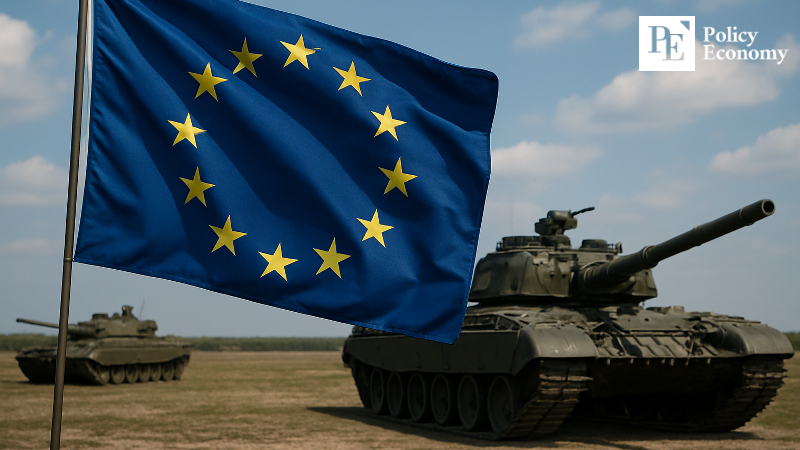
European countries are increasing defense spending to record levels. Since the outbreak of the Russia–Ukraine war in 2022, U.S. influence in Europe’s defense structure has visibly declined, prompting European governments to expand defense and security investments and begin reshaping the region’s security order. With the United States continuing to press Europe to strengthen its own military capabilities, this trend is expected to persist for some time.
Europe Moves to Strengthen Its Defense Capabilities
On the 23rd, CNN reported that European countries are sharply increasing defense budgets and expanding troop levels to prepare for potential Russian aggression. According to data released in April by the Stockholm International Peace Research Institute (SIPRI), Europe’s defense spending—including Russia—reached $693 billion in 2024, up 17% from 2023. It is the highest level since the end of the Cold War. NATO members accounted for $454 billion, a roughly 20% increase from the previous year.
The trend is continuing this year as well. In its annual report published in September, the European Defence Agency (EDA) forecast that EU defense spending will rise 10% in 2025 to €381 billion—equivalent to roughly $647.5 billion—up from €343 billion in 2024. This level surpasses Russia by a factor of three and China by a factor of 1.5, making Europe the world’s second-largest defense spender after the United States. At the time, EU High Representative for Foreign Affairs and Security Policy Kaja Kallas said, “Europe is spending record amounts to protect its citizens, and we will not stop here.”
The shift reflects the radically changed geopolitical landscape since the Russia–Ukraine war. After invading Ukraine in 2022, Russia moved to a wartime economy and is expected to devote 41% of total national spending to defense and security this year. At the same time, the United States has made clear its intention to shift Europe’s defense burden back onto Europe. President Trump has raised the possibility of withdrawing from NATO and is pressuring European nations to build up their own military strength.
Europe’s Public Finances Under Strain
The problem is that this surge in defense spending risks undermining Europe’s economic security. Fiscal capacity in the region is already stretched. As of the fourth quarter of 2024, government debt stood at 87.4% of GDP in the eurozone and 80.7% across the EU. Greece (153.6%), Italy (135.3%), and France (113%) face particularly severe debt burdens. The IMF projects that Europe’s average debt ratio could exceed 130% by 2040 without additional measures. Over the next 25 years, Europe will need extra spending equal to 5.75% of GDP for social security, defense, and climate initiatives—far beyond what current fiscal conditions can support.
Europe’s growth outlook is also bleak, reflecting its lag in advanced technology. The region captured only 6% of global AI venture capital investment in 2024, compared with 61% for the United States. According to McKinsey and Bruegel, Europe’s R&D intensity is 2.1% of GDP—well below the U.S. (3.45%) and Korea (4.96%). Its semiconductor market share remains at 8–12%, while China controls 85% of global battery production. McKinsey estimates that Europe could lose $54 billion to $1.1 trillion in annual value by 2030 if it fails to secure technological competitiveness.
Public support for higher defense spending is also fading. A poll released last month found that 67% of respondents now support increased defense budgets—down from 74% a year earlier. Fiscal pressures and inflation appear to be weighing on sentiment. While approval still exceeds 80% in countries near Russia or with high security concerns, such as Poland, Denmark, and Finland, support has fallen to the mid-50% range in southern European countries including Italy, Spain, and Portugal.
U.S. Again Presses Europe to Boost Its Own Defense
Despite the risks, Europe’s push to expand defense spending is expected to continue, driven by mounting pressure from the United States. At a recent Berlin security conference, Matthew Whitaker, the U.S. Ambassador to NATO, said he hopes that the Supreme Allied Commander Europe (SACEUR) post could eventually be handed to a European—specifically a German—commander. SACEUR oversees all NATO military operations and has been held exclusively by U.S. generals for the past 75 years. Although the Trump administration had intermittently raised the possibility of transferring command to Europe, the discussion had quieted after the U.S. recently named Lt. Gen. Alexis Grynkewich to the role. Whitaker’s remarks have now reopened the debate.
Whitaker’s emphasis on Germany reflects Berlin’s leading role in Europe’s defense buildup. Germany spent €50 billion on weapons procurement last year and has proposed an additional €377 billion—equivalent to roughly $621 billion—in defense spending. The government is also discussing reinstating conscription, abolished in 2011, with plans to expand the Bundeswehr from 182,000 troops to 260,000 by 2035. Institutional support for increased defense budgets is already in place: in March, Germany amended its Basic Law to exempt defense spending from debt limits, allowing virtually unrestricted funding.
Even so, Europe reacted with discomfort to Whitaker’s comments. Wolfgang Wien, Germany’s representative to NATO, said Berlin is willing to take on more responsibility but stressed that SACEUR remains “a core American role.” Whitaker later sought to clarify on X (formerly Twitter), saying his message was that allies must meet their Hague Summit obligations: invest in defense, strengthen industrial cooperation, build resilience, and safeguard alliance cohesion.
Aoife Brennan is a contributing writer for The Economy, with a focus on education, youth, and societal change. Based in Limerick, she holds a degree in political communication from Queen’s University Belfast. Aoife’s work draws connections between cultural narratives and public discourse in Europe and Asia.
Similar Post